MILAN — One hundred and forty years after it was founded on Lake Como, the machines of the Taroni silk factory continue to churn out the swathes of duchesse, taffeta and faille preferred by the couture houses and the princesses of Europe.
Now, under the stewardship of chief executive officer and creative director Maximilian Canepa, the company is taking an unexpected new step.
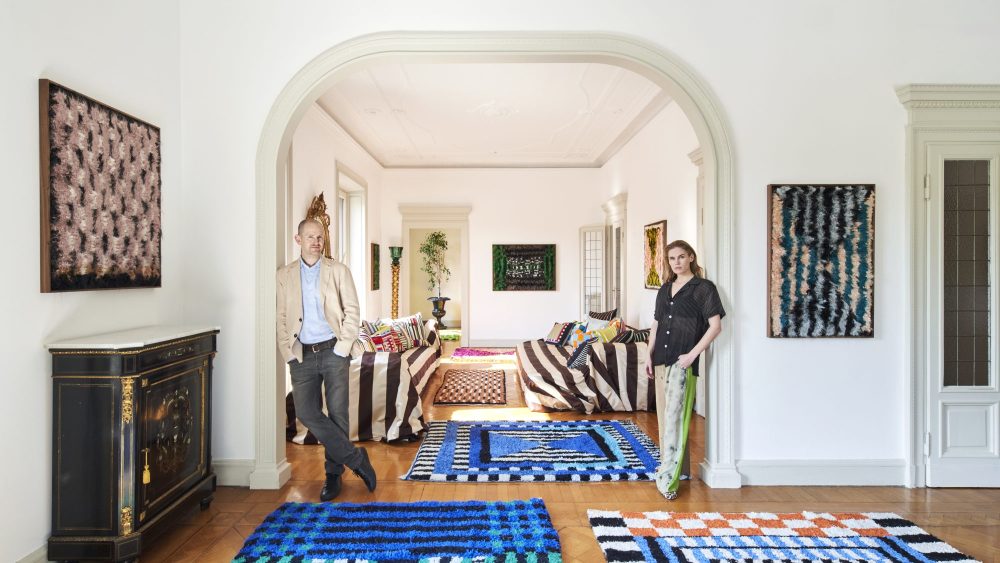
The vanguard silk-maker is deepening its involvement in the world of interiors with a growing collection of home accessories and collectible pieces, including tapestries, pillows and rugs made from its silk offcuts and geometric patterns inspired by its archives. The strategy is, in short, to keep things curated and low-key, Canepa, who studied photography at Cal Arts, told WWD.
You May Also Like
Related Articles
“It’s not something I want to mass produce. The strategy is to create some unique items that inspire and are conversation starters. These are all unique one-of-a-kind items,” he said.
Canepa, a 12th-generation textile-maker, and his wife, Lillian Grant, a multidisciplinary artist, got the itch to create interiors when they discovered how Berber carpets were made with offcuts in the Atlas Mountains of Morocco.

Canepa, who took the reins as CEO from his father Michele eight years ago, contends that his leadership style is self-taught, shaped by nearly two decades at Taroni. Though he had no formal mentors in textiles, his studies in conceptual art greatly influenced his philosophy.
For the collection, the couple also drew from their admiration for concepts by German philosopher Walter Benjamin and his essay “Art in the Age of Mechanical Reproduction,” as well as American artists like Donald Judd, known for his modernist pieces, and James Turrell, who is famous for his work with light and space.
Taroni tested the waters with the home collection through its circular project — Taroni Laboratorio — during Milan Design Week last year. Taroni Laboratorio is a sustainable design initiative that transforms textile waste into unique, artistic design goods and which also includes vases and children’s soft toys.
For all of its home objects, Canepa and Grant deep dove into the Taroni archives to create a dynamic visual language that nods to inspiring 20th-century motifs.
Available in dimensions of 45×45 cm and 60×60 cm, the cushions highlight silk’s potential to create bold patterns and color contrasts and thus infuse art into unexpected aspects of the home.
Alongside the pillows, handwoven decorative tapestries were created in collaboration with Casa Amar, a design-forward Milan-based brand specializing in ethically sourced, handmade Moroccan rugs and textiles.
Offered in various sizes and color palettes, these “textile paintings” stand out for their abstract motifs, bringing traditional craftsmanship together with contemporary elements. Taroni said incorporating silk renders this home collection more captivating than most, due to the fact that silk’s unique finer structure reflects light and absorbs dyes in a way less-noble fabrics cannot.
Overall, Taroni still maintains its vanguard status among the world’s couture houses and over the years, business has grown in other ways. Taroni is active in supplying period film and series sets with its fabrics for both interior design and costumers. “They’re looking for authenticity and it’s so rewarding. We’ve established our own direct line with these cast designers. So now we know exactly where the fabrics go.”
Like its silks for couture, Taroni’s home collection is situated in the luxury range. Pillows run from 488 euros to tapestries and rugs at 11,399 euros and the products are currently available on the Taroni website, although Canepa said the firm has plans to sell the collection through high-end design platforms.
“We’re the oldest weaving mills in Como and we represent Made in Italy so much.…It’s a great place to talk about our history.”