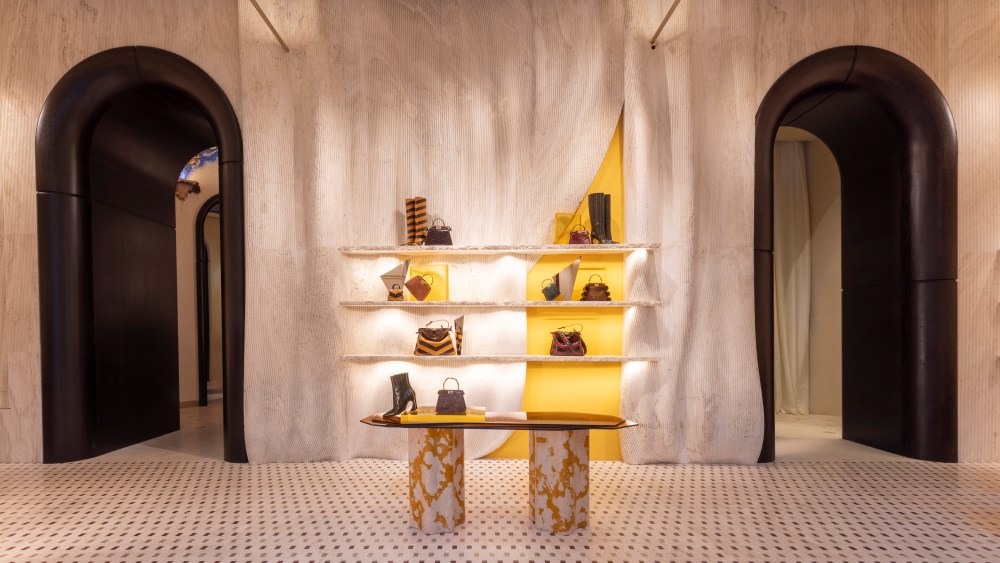
MILAN — With the new Palazzo Fendi in Milan, CEO Ramon Ros wants “to bring magic.”
In his first interview since joining Fendi on July 1 from his role as president and chief executive officer of Louis Vuitton, mainland China, Ros underscored the many references in the flagship to the history of the brand, which is celebrating its centennial this year — from its foundation in Rome to the ties with the city of Milan.
Cue the imposing entrance on the ground floor on Via Montenapoleone, where ribbed Travertino marble and Roman lime walls create a unique draping reminiscent of ancient columns peppering the Italian capital. “The draping creates a strong emotional and authentic connection” with Rome and Fendi’s history, said Ros. “Customers are looking for authenticity.”
You May Also Like
Related Articles
The flooring was inspired by the geometric patterns of houses at the time with red, burgundy and creamy yellow tiles. Women’s accessories ranging from fashion jewelry, sunglasses and belts to fragrances and textile accessories are on display on the ground floor, where at the center stands a de-structured column by artist Anton Alvarez, part of the collaboration with Fondazione Officine Saffi and custom-made for Fendi. The sculpture is crafted from enameled ceramic in an array of tones that include vivid yellow, in a nod to Fendi’s signature color, as well as delicate purple and green tones.
Art is a key element throughout the store, “creating an eclectic dialogue with our products, strengthening the connection between the artists and the products. Creativity is the fil rouge,” said Ros, who expressed the goal to further elevate the brand. “We must increasingly dream of creativity and the [financial] numbers will follow.”
Artworks are on display in partnerships also with Fondazione Arnaldo Pomodoro, and the Mazzoleni and Secci galleries.
A standout at the entrance is a handcrafted sculpture by Roberto Sironi, a multifaceted abstract meteorite-like shape colored in electric blue, dark yellow and terracotta shades.
Two asymmetric knotted pieces by artist Roger Cal, part of the collaboration with Officine Saffi, are crafted from ceramic colored in Fendi yellow and in bubblegum pink.
There is no doubt the store is luxurious, aligned with Fendi’s positioning, but it is inviting with its warm color palette.

Strategically positioned at the crossroad between Via Montenapoleone and the key thoroughfare Corso Matteotti with a central tower dominating the architecture at the intersection of the two roads, Palazzo Fendi is located in a stately rationalist building designed by architect Emilio Lancia and erected between 1933 and 1936. “We found the right place at the right moment, again to convey our authenticity,” said Ros.
Milan is seeing a flurry of openings, from the expansion of the Saint Laurent store to Dries Van Noten and Alberta Ferretti boutiques, and Ros expressed a “very positive” take on the city’s performance at retail. It is “very relevant for tourists and locals alike,” he said. While acknowledging the current uncertain global scenario, the executive noted that “we think long-term, we have clients that are loyal for life.”
The boutique covers more than 9,820 square feet over four floors, including an in-house atelier. In addition, the top three floors will host three different dining concepts by Langosteria, due to open next month.
The imposing facade is marked by alternating arched and squared windows both at street level and on upper floors — the arches also are a reference to Fendi’s Palazzo della Civiltà headquarters. Organic-shaped door handles inspired by the soft movement of leather appear on the entrance doors.
The new boutique concept was designed by Fendi’s architecture department and merges details echoing 1930s Milanese interiors, such as the building’s pre-existing marble patterns and the staircase connecting the floors that was designed by Lancia, with the addition of alternating delicate pink glass rhombus elements and a Cuoio Romano leather handrail with Selleria stitching. Similarly, the round windows present on the stairwell have been preserved and restored with metal sections creating a diamond pattern.
By the stairs, two symmetric art pieces by Levy Van Veluw recall the arches of the Fendi headquarters in Rome. In translucent polymer clay and pigments, the artworks are colored in emerald green and cobalt blue and are part of the collaboration with Secci Gallery.
A contemporary fresco by artist Edoardo Piermattei adds a sculptural dimension to the ceiling, painted in the nuances of pink, burgundy and terracotta, with touches of neon blue.
The third floor — which contains a sculpture by Nick Cave — is dedicated to the Fendi Atelier. Ros was especially proud of this space, where seven artisans work on bags and furs. “It helps to create a connection so that people can understand the brand more, where it comes from and where we are going and they can be part of the journey,” he said. “It also guarantees traceability of the products and helps in the personalization.”
Dedicated displays in aluminum, inspired by Franco Albini’s designs, will show some of the house’s iconic pieces and illustrate Fendi’s 100-year history.
During a walkthrough on Monday, in the atelier, Piermattei presented his live working exhibition that is part of the “Rock the Craft” initiative “that projects craftsmanship into the future through cross-pollination between the worlds of arts and crafts, with artists and artisans coming together while reinterpreting each other’s art,” Ros explained.
An existing artwork by Piermattei — inspired by the three-dimensional vaults he created for each floor of the boutique — in pigmented cement using a sac à poche, transforming it into soft curls, was turned into a leather and fur tablet using the unique inlay workmanship by Fendi’s fur artisans and Piermattei.
Ros viewed this also as a bridge into the future, “investing to form young and emerging artists.”
The artwork’s same softness informed a customized white canvas Peekaboo bag, which will be displayed in-store as the latest addition to the Peekaboo Artists series. Leftover materials from previous collections will be used to create a limited number of made-to-order Peekaboo bags inspired by the exclusive Piermattei artwork, which will be available for sale.
The men’s area is on the first floor, marked by the juxtaposition of teak wood parquet — inspired by the shapes of backgammon boards — and ribbed Travertino Silver walls and striped grained ceiling.
Referencing Piero Portaluppi’s Villa Necchi Campiglio in Milan, a perforated silver nickel door opens to the men’s VIP room, with a painting by Daniel Crews-Chubbs. Artist Luke Edward Hall for Rubelli designed the wallpaper.
On the same floor, the Fendi Kids room was designed in neutral tones and pastel details.
Women’s, couture and high jewelry are displayed on the second floor, where lacquered-effect ivory walls are complemented by Travertino Ascoli marble arches, accented by the gold metal details of the display system.
Sinuous shapes are added through the Eternity Bench by Arda Yeniay in the women’s ready-to-wear salons. The waved walls in Calce Romana serving as a shoe display are inspired by the unfolding of leather rolls and the facade of the Fendi footwear factory in Fermo, in Italy’s Marche region.
One of the two women’s VIP rooms is dedicated to high jewelry pieces with a console display in Travertino Ascoli marble and a powder pink color palette, while the other hosts an abstracted-human sculpture by Belgian artist Florian Tomballe.
On the third floor, the Fendi Apartment is accessible through a special arched foyer inspired by the architecture of the Roman Pantheon. A metal door recalling the coffered ceiling of the monument opens onto the VIP salon, a cocooning room with a curved ceiling illuminated by round lighting coves that represent the Pantheon’s oculus, the circular, open hole at the apex of the dome in the landmark temple in Rome.