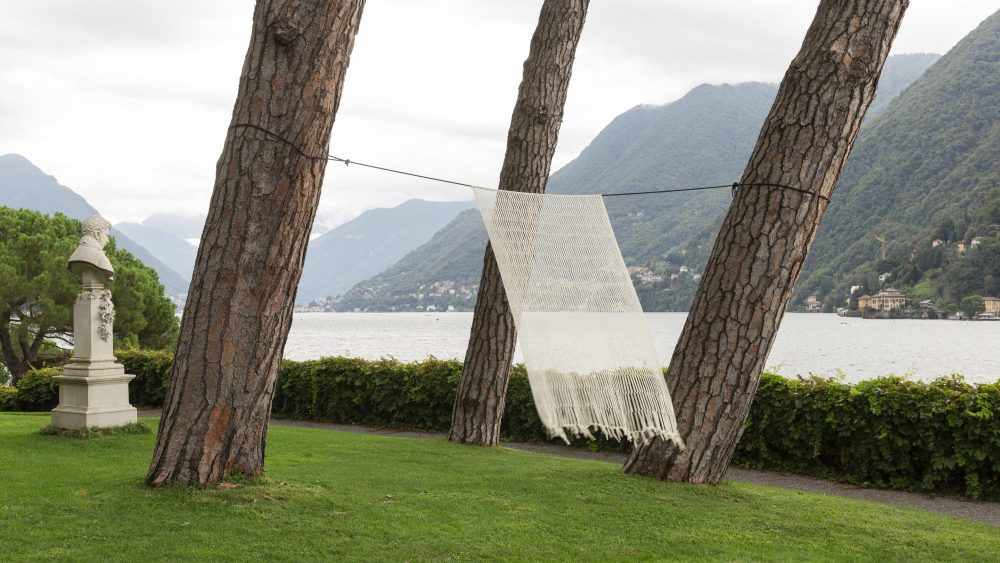
COMO, Italy — “It’s OK, take it all in. Take your time,” Giovanna Massoni, curator of Lake Como Design Festival, said on Wednesday at Villa del Grumello, built in the 15th century as an aristocratic home overlooking the splendor of Lake Como. The view was indeed worthwhile as Mirage, a swathe of fabric made by Swedish textile designer Selma Wallbom, blew in the wind while offering a poetic, pixelated image of a soft hydroplane landing in the distance.
The founders of the Lake Como Design Festival, now in its seventh edition running Sept. 14 to 21, said Como-based hotels like Il Sereno, Hilton Lake Como and the Mandarin Oriental, combined with the influx of foreign residents to the lakeside towns, have helped boost the fair’s visitors.
Related Articles
“It’s really about building connections and less about visitors. In fact, we want to keep it limited,” said Lake Como Design Festival founder, independent photographer and creative director Lorenzo Butti, adding that the aim is to avoid the long lines and crowds that form during Milan Design Week.
You May Also Like

Lake Como Design Festival’s success is a testament to the ongoing rise of destination fairs around the world fueled in part by ultra-exclusive, invite-only itinerant art and design showcase Nomad Design Fair, whose first edition took place in 2017 in Monaco at La Vigie. This is a villa renovated and occupied by fashion legend Karl Lagerfeld in the ’80s and used during key moments for Monaco’s ruling family.
Nomad is gearing up to host the first Abu Dhabi edition in the former Terminal 1 at the Abu Dhabi International Airport from Nov. 19 to 22. The decision to expand there was motivated by the region’s ongoing social evolution catalyzed by the growing expat communities of Indians, Russians and British, Nomad cofounder Nicolas Bellavance-Lecompte told WWD. “It’s a country where you have a real base of collectors that has been collecting for quite some time now…and now you have these foreigners also living there that you don’t have yet in other countries.”
Nomad also locked in the Watermill Center in the Hamptons — an incubator of radical creativity founded by visionary artist and director Robert Wilson in 1992 for a brand new event June 25 to 28.
Alcova’s trajectory, for example, has also helped build the allure of the destination fair concept. Founded in Milan in 2018 by Valentina Ciuffi and Joseph Grima, it will unfurl Alcova Miami once again at the city’s oldest hotel, Miami River Inn in the South River Drive Historic District of East Little Havana.
Collectible design showcase Intrecci Intertwinings debuted on the scene Aug. 31 to Sept. 14 in Salve, a former hub of the Bronze Age, in Italy’s Apulia region with most of the showcases staged in an old Capuchin monastery.
In Como, Villa del Grumello is brimming with an intimate mix of rare art and collectible design dedicated to the overarching “Fragments” theme. The artwork of Enzo Cucchi, a key member of the Italian Transavanguardia, a late modernist movement that emerged in the ’70s, is on display. A mix of organic sculptural forms and black and white sketches offer the viewers a glimpse into Cucchi’s abstract world.
Nearby, Brazilian luxury design firm Etel unfurled a retrospective of Brazilian designer Claudia Moreira Salles’ modernist creations imbuing Brazilian wood with sustainable earthy materials. Milan-based carpet firm Amini showcased carpets featuring designs from “Viaggio della Fantasia” (Italian for “Journey of Fantasy”), a series of graphics designed by Italian artist and graphic designer Bruno Munari while Italian furniture firm Campeggi showed off Piccy, a reissue of one of the first armchairs designed by Vico Magistretti and initially produced by the Fumagalli company of Meda starting from the second half of the 1940s.
Over the past year, Massoni interviewed and made a selection of 54 international designers for her curation of the Contemporary Design Selection, which was unfurled throughout the hilly gardens surrounding the villa.
Kyiv, Ukraine-based artist Lyuda Skrynnykova debuted a sculptural lighting piece, “Angels, Look Inside,” which was crafted from small fragments and porcelain mementos, evoking the emotional journey of Ukrainians fleeing war. “It’s always the small things that people take with them,” Skrynnykova reflected.
In the villa’s greenhouse, Lebanese-French artist Lucie Gholam presented her “Plaster Ruins” collection in a greenhouse. Using salvaged materials from demolished buildings, she transformed them into sculptural furniture pieces, complete with mammal-like feet and intricate etchings. “It’s my first time here and I’ve already made a lot of contacts,” she said, noting the influx of international design curious and gallerists that passed by. In the garden, Italy-based designer Alberto Smaldone of Plasma-f studio explained how he fused fragments of marble together with screws to a crowd of British tourists, showcasing the stylistic possibilities of reuniting fragments of overconsumption.
Other key exhibitions included in the Lake Como Design Festival itinerary include a tribute to Italian architect and designer Aldo Rossi. Architecture by “Fragments,” curated by Chiara Spangaro in collaboration with the Fondazione Aldo Rossi, pays tribute to the renowned Italian architect. The exhibition was staged in another exclusive spot, San Pietro in Atrio, a former church repurposed as an exhibition space.
The allure of the design festival was also helped by rising star, Dutch New Zealander designer Sabine Marcelis, who unleashed her “Jelly Floats” installation in the pool of the Lake Como Edition hotel, which ran concurrently with the festival. Marcelis told WWD she was looking forward to discovering the new artists and designers within the event itself. “It’s the first time for me visiting the festival and I am very much looking forward to seeing what else will be on show. I love satellite and smaller design weeks. I recently visited design weeks in Vietnam, Bali and Mallorca where smaller events were held. I think these events can be very surprising and easier to manage than the larger ones,” she said.
According to Butti, niche design events like the Lake Como Design Festival not only promote local tourism but also highlight the storytelling potential of historic locations, fostering deeper connections with their cultural heritage. “This is about connecting with the territory and helping to create experiential tourism.”