
HONG KONG — Hong Kong isn’t known for creating design or fashion — the emphasis has always been more on manufacturing it — but the city is working to change that perception.
Hong Kong Fashion Week, organized by the Hong Kong Trade Development Council, a government body, highlighted many of the difficulties Hong Kong and Asian designers face. The event, which took place from Jan. 19 to 22 at the Hong Kong Convention and Exhibition Centre, is mainly a trade fair dotted with a mix of fashion shows. These runway presentations are group shows featuring local designer brands such as Andy Ho, BeautyBerry and Ground-Zero. Others were staged by manufacturers with names like Sun Kee Woollen Knitting Factory.
Related Articles
The fall edition of Hong Kong Fashion Week and the accompanying World Boutique trade show attracted 38,000 buyers from 87 countries and 1,800 exhibitors from 27 nations, the majority from Mainland China. Buyer and exhibitor attendance was roughly in line with last year. The spring-summer season is shown in July.
You May Also Like
Exhibitors on the trade floor, which was fairly quiet, said business continues to be tough as high costs, including labor and materials, coupled with sluggish orders continue to squeeze firms. Chinese manufacturers have been struggling with these challenges for years and those on the cheaper side of manufacturing have lost business to lower-cost factories in Southeast Asia. In addition, trade agreements between the U.S., European Union and Japan with developing countries including members of the Association of Southeast Asian Nations and Bangladesh have made Hong Kong and Mainland Chinese manufacturers less competitive.
Hong Kong’s total exports of clothing and clothing accessories — which are all made in factories in China — were down 6.1 percent in the period between January and November last year, after a 2.9 percent drop in 2013 and an 8.1 percent decline in 2012. “All the workers know their salaries and compare,” said Serme Lam, merchandising manager at Hong Kong-based exporter Switraco Ltd.
She explained that fast-fashion retailers such as Hennes & Mauritz are pushing industry prices lower. “It’s hard for manufacturers,” she said.
Manufacturers have tried to go upstream in different ways. Some have tried developing their own brands, but learned the hard way that marketing and branding are very different from manufacturing. Others are working to improve productivity and move into more technical or upstream production processes. Meanwhile, young design talent is struggling to find its footing as well.
Speaking at a talk directed to young designers, Chinese fashion designer Wang Yutao said he is not very optimistic about Chinese designers’ international reach. Although there are some exceptions, such as Masha Ma, those examples are few and far between, he said.
The commercial environment within China is also difficult for designers, given the lack of IP protection. Attendees lamented that online shops such as Taobao make it easy for Chinese consumers to buy cheap knockoffs.
“You can’t get away from the problem, but the Internet has created lots of mobile brands and entrepreneurs,” Wang said. But as a designer, you just have to keep coming up with new designs, he added. People will respect you as the original designer, he assured attendees.
“You can’t think too much about it. You’ll get so mad. Don’t take it so seriously, just let it go,” Wang said.
Wang, who built his own brand called BeautyBerry, said he believes one major hurdle for Chinese designers is the lack of marketing know-how. There are many talented young designers in China, he said, but the lack of international interest “has been puzzling me for a while,” he said in Chinese. Designers lack the proper channels and, when it comes to marketing, are “not strong.” He encouraged designers to keep attending international trade shows for exposure.
Lawrence Leung, managing director of the Sun Hing Knitting Factory and one of the judges at the Hong Kong Young Designers Contest, agreed that marketing is one of the main challenges. Hong Kong and China “have to build a reputation for design. We’re known for good manufacturing quality” but design and marketing takes time. It can “take decades” to develop brands,” Leung said.
Raphael le Masne de Chermont, executive chairman of Hong Kong Fashion Week participant Shanghai Tang, said it’s time for the fashion community to pay more attention to Asian fashion brands. “Most of the consumers of the luxury industry are in this part of the world. So out of respect to start with…the media should be giving a bit more credit to the creativity and the brands which are emerging from this part of the world.”
Margareta van den Bosch, creative adviser at Hennes & Mauritz, attended Hong Kong Fashion Week to judge a young designers’ competition. She said she was intrigued by what she saw at the fair and shows, noting an emphasis on eveningwear and dressier clothes and accessories. The streetwear on offer was reminiscent of Japanese fashion in some ways, but a bit more conservative and commercial, she observed.
“Of course, it’s a different fashion but I think it’s interesting in a way,” she said.
Switraco’s Lam was less positive in her assessment. She said many of the exhibitors’ designs on the trade floor looked dated by at least five years.
“Of course, the samples are new, but seeing from the design, I’m sorry to say there was nothing exciting or special,” she said.
Shirley Chan, chairman of the HKTDC garment advisory committee and chief executive officer of YGM Trading Ltd., stressed that it’s still relatively early days for brand development in the region. “China was closed until the Eighties and Hong Kong was not rich. The lifestyle was different. You have to take care of life before you care about style,” she said, explaining that local designers are still learning that design “doesn’t have to be very loud.”
It doesn’t help that the design departments at Chinese factories — a good source of income for aspiring designers — are in many cases downsizing or shuttering. “Who wants to pay for design? No one wants to pay for design. The factories, they don’t have the capital to afford design. Some can afford it, but don’t want to pay, others cannot afford it. No one can pay,” said Raymond Lui, director of Kudos Knitting in Hong Kong.
As for designers striking out on their own, Lui said the challenges are too great. “Your own label? That is suicide,” he said with a laugh.
Highlights of the event included:
– The Hong Kong Young Fashion Designers’ Contest offered cash prizes as well as a one-month study trip to H&M’s headquarters in Sweden. The overall winner was Michelle Yeung, whose nature-inspired eveningwear in shades of white, brown and green took inspiration from sprites, nymphs and other “outdoorsy spirits.”
– Swedish designer Lars Wallin, known for his royalty-targeted couture business, launched his first ready-to-wear collection at Hong Kong Fashion Week. His fall-winter collection focused on eveningwear, such as a gray ombré dress with pleats, a shimmery silver gown and a wedding gown in white with silver foil accents.
– Wang Yutao’s BeautyBerry brand served up leopard-print furs and belted evening gowns with a strong Seventies influence reminiscent of Gucci.
– Ground-Zero, by brothers Eri Chu and Philip Chu, reprised its spring show from Paris Fashion Week. It featured colorful streetcar-like minidresses emblazoned with lightning and barbed wire.
– Australia’s Petra Vanessie collection for her brand Ava included Forties-inspired dresses with nipped waists and pillbox hats.
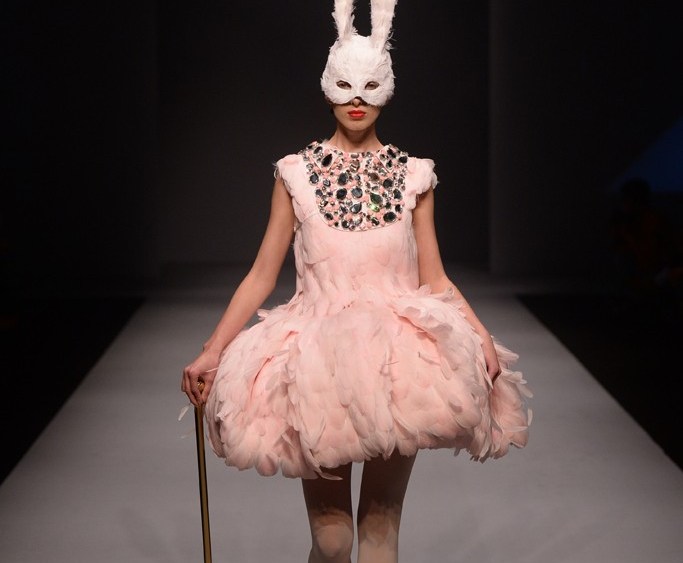
– Andy Ho went theatrical, opening his show with a pink feather tutu and bunny mask with extra-long ears.
– Cambodia’s Myo Min Soe’s ornately beaded eveningwear and headpieces tapped into the designer’s cultural iconography.
– Steffi Chan’s collection for her brand Dare to Dream featured embellished knitwear, flirty skirts and quirky macaron-adorned hats with a slight Harajuku vibe.