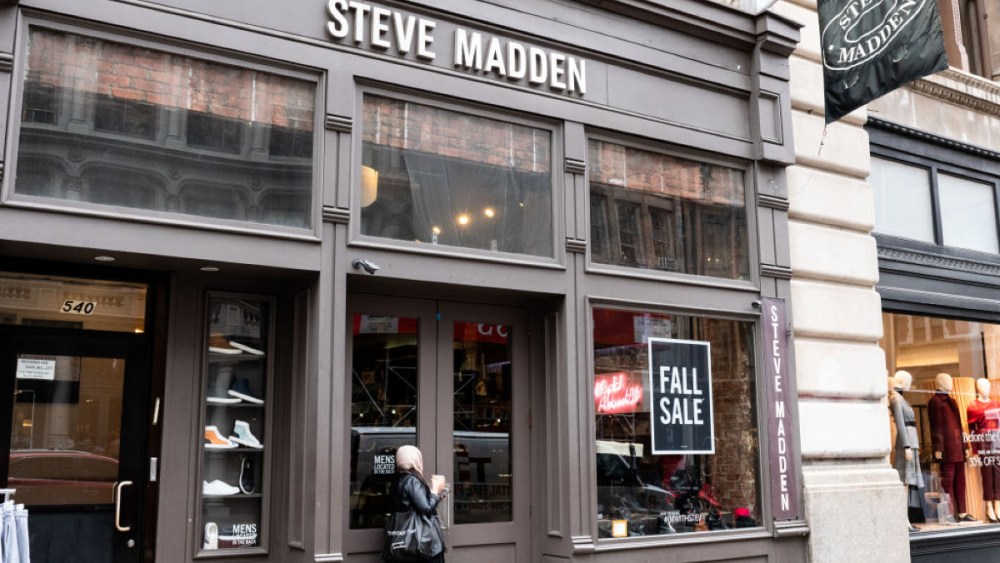
Steve Madden Ltd. has moved incredibly fast to limit the potential impact of tariffs on imports from China.
Excluding the Kurt Geiger acquisition, Madden’s chairman and CEO Edward Rosenfeld detailed in a Wednesday conference call on first quarter earnings the steps the team took to mitigate the damage from tariffs. He previously said in the company’s fourth quarter earnings conference call in February that Madden planned to cut the percentage of goods produced in China, and noted it was in early talks with factories on price concessions, but hadn’t provided specific details.
Related Stories

“The stuff that was far along in the production process or done, we are taking the majority of that in, but we have worked with our factory partners and suppliers to negotiate price concessions on those goods, so we can at least mitigate some of the damage in the near-term, and again, keep those goods flowing and make sure we’re still delivering fashion to our customers and consumers,” Rosenfeld said, emphasizing that whatever was early enough in the production process that could be shifted has been moved.
You May Also Like
“We have taken components from China, for instance, and moved them to other countries,” the CEO said, noting that for brands such as Steve Madden shoes or Dolce Vita shoes, fall production in China is “going to be virtually nothing.” Some production, likely less than 5 percent, will still be in China but that’s more due to value-priced apparel, which is taking longer to move. (On previous earnings calls, the company noted that in 2024, it sourced 71 percent of its U.S. imports from China, and forecasted that number to be in the mid-teens for fall ’25 and not hit the mid single-digits until spring ’26.)
He also said that the shift to other countries — Cambodia, Vietnam, Mexico and Brazil — also means that deliveries for those goods will be pushed out by 30 to 45 days. Mexico and Brazil have become more important, as “Mexico and Brazil did not receive reciprocal tariffs, so there is less risk when July 9 comes along with respect to tariffs in those countries.”
American President Donald J. Trump on April 2 disclosed reciprocal tariffs in the double-digit percentage range, and a few days later put into place a 90-day pause to allow for negotiations with trade partners, with the exception of China, where some goods were hit with higher tariffs that spiked as high as 145 percent. It isn’t clear what Trump will do when the 90 days expire on July 9.
Rosenfeld also said that the company has “selectively” raised prices to consumers and wholesale customers for fall items, but that it wasn’t across the board. “We have taken a surgical approach, raising prices by differing amounts and sometimes not at all depending on the brand, product category and style,” he said. While some items will see price increase by as much as 20 percent, the average is in the 10 percent range.
The CEO also said there have been some cancelations, either importers who buy from Madden and are responsible for the tariffs, or by customers who weren’t willing to accept the price increases, such as the off-price channel. But he also said that some who canceled may come back later after the goods get moved to the other countries. “And even if the customers are taking those goods in, if the initial sets go in a month or 1.5 months later, we do think that will have an impact on reorder business,” he noted.
Rosenfeld also said that certain wholesale customers are thinking more conservatively for their fall plans, in part due to the potential “consumer demand impact from the turmoil here.” And Madden will likely see a revenue impact from that, it won’t be “because we just can’t ship goods,” he emphasized.
He also said the shift to countries has resulted in the company accepting lower margins than it has historically achieved, but added that there is “price pressure on some of these other countries as everybody is trying to move so quickly out of China to these alternative countries.” Greater demand in some of these other countries has resulted in higher prices of as much as 10 to 15 percent, relative to where they were before, he disclosed.
As for Kurt Geiger, the $360 million acquisition closed on Tuesday. Rosenfeld said that about 80 pecent is sourced out of China. About 35 percent of that business is in the U.S., making it more insulated from tariff impact due to a greater overseas business.
“But certainly, 80 percent sourcing out of China is an issue,” Rosenfeld said, noting that the No. 1 priority now that the company has closed on the deal is to rethink sourcing. “We’re already engage and moving the ball forward on that front. And you’re going to see that number go down significantly for Spring 2026,” the CEO said.
Madden has a good reason for rejiggering Geiger’s sourcing out of China. Rosenfeld spoke about what the brand can be in the U.S. and said there is a “very meaningful store rollout opportunity,” given that there is only 5 stateside retail doors.
“And then I think we can continue to grow the wholesale business. The distribution there is really Nordstrom, Dillard’s and Bloomingdale’s primarily. They have very successful businesses with each of those and I think there’s room for growth there,” he said. The CEO also noted the opportunity for international expansion, whether in Europe or in Mexico, where he said “they’re doing great.”
But he also said the company won’t be abandoning China because it does produce goods there that are sold in China and elsewhere in the world. “If we find ourselves in a situation where tariffs go away and there’s a little bit more clarity and certainty that we can work in China again, then we will certainly be positioned to pivot back, if that makes sense.”
He also said that sales trends across the industry were somewhat sluggish in January and February, and the company “saw a strong improvement in March as weather turned warmer and more consumers began to look for spring fashion.” Rosenfeld also noted that so far, “consumer demand still looks okay.”
And having moved almost all of the company’s shoes and accessories outside of China for Fall 2025, Rosenfeld said there could be opportunity for the company to take share from competitors — for both its branded and private label mix — that “are not able to deliver goods or can’t deliver as much.”
He also said that recent review of expense savings and operational efficiencies, including a “reduction in force,” will result in over $12 million in annual savings.
Given the tariff uncertainties, the company has decided withdraw its prior 2025 guidance. For the first quarter ended March 31, net income fell 8 percent to $40.4 million on a slight uptick in net sales by 0.1 percent to $551.4 million.
Jefferies analyst Corey Tarlowe said that Steve Madden’s business remains “well position, despite tariff headwinds,” but noted that with wholesale ordering patterns “in flux,” there’s still some uncertainty ahead.