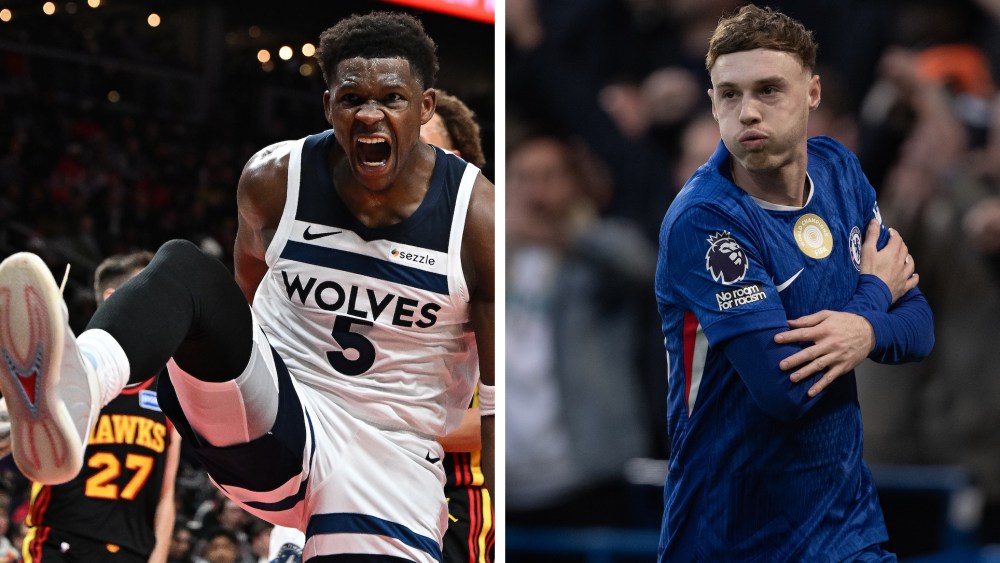
The athletic industry is going all in on marketing blitzes and high-profile product launches as a historic sports year gets underway.
Chief among the major draws is the FIFA World Cup’s journey to North America, where the U.S., Canada and Mexico will play host to a record number of 48 national teams.
Not only is the pool of competitors larger than ever for the top prize in soccer, but the tournament arrives in the U.S. just as it has surpassed baseball as the third most popular sport in the country, according to Ampere Analysis.
Related Stories
Only football and basketball take precedence, and they’ll make their yearly contribution in spectacle through the Super Bowl, NBA Finals and NBA All-Star Weekend. The latter event should be a boon this year as well, as Los Angeles (the country’s second-largest market) serves as the host city.
You May Also Like
Coming up this week, the Winter Olympics kick off in Milan. While admittedly a less popular affair than the summer event, the Winter Games present some unique opportunities by being situated in one of the world’s fashion capitals.
Matt Powell, senior adviser at BCE Consulting, told FN these sorts of sporting tentpoles are more effective as marketing occasions rather than sales drivers. Jerseys and the official match ball will move for the World Cup, but a “very small lift for a couple of weeks” is about all that can be expected for footwear.
“The consumer response is just not visceral,” Powell said. “You’re not watching the Olympics and saying, ‘You know, I want to take up synchronized platform diving.’ It just doesn’t happen that way, but it’s an excellent, excellent marketing event.”
As brands and retailers put their marketing machines into overdrive to capitalize on opportunities, FN looks at what to expect during the year’s biggest sporting events.
Winter Olympic Games (Feb. 6-22)

The convergence between fashion and sport isn’t new, but it reached a fever pitch during Milan Men’s Fashion Week in January, just a few weeks ahead of the 2026 Milano Cortina Winter Olympic Games.
Chinese sportswear label Li-Ning showcased its fall 2026 collection in front of an indoor ski station, complete with fake snow, and took inspiration from winter sports for several of its looks.
“To be in Milan as the city prepares to host the Winter Olympic Games is deeply meaningful for us,” founder Li Ning said. “It connects our heritage as an athletic brand with a global moment in sport. The show is our tribute to winter sports culture, honoring its history while looking confidently toward the future. As we once again sponsor the Chinese Olympic Team, this moment reaffirms our responsibility to support athletes, honor our national sporting legacy and continue contributing to the future of global sport.”
Meanwhile, Nike is set to sponsor Team USA and many other countries. Undoubtedly, a fashion element will continue to be present in its apparel and footwear, but all signs point to the brand using the occasion for a hard relaunch of Nike ACG, its line of “all-conditions gear.”
Nike ACG has made a relatively quiet shift toward performance since last fall, with one of its big three technology announcements being the Therma-Fit Air Milano, a jacket that allows wearers to regulate temperature by inflating or deflating air within its baffles.
Another innovation was the Mind franchise, which uses nodes precisely placed underfoot to induce feelings of calm and focus before and after competitions. Expect it to have a major presence among athletes in Milan, including those who step onto the podium.
Athletic brands aren’t the only ones in Games mode. Channeling its fashion focus, Kith continued a biannual tradition that began in 2020 by creating a Team USA capsule, which was released weeks ahead of the opening ceremony. Shaun White, king of Olympic snowboarding, starred in the campaign for a collection featuring 54 pieces of apparel and accessories.
Dick’s Sporting Goods has launched a new ambassador program for the Olympics and Paralympics with nine Team USA athletes, sharing behind-the-scenes social content and receiving personalized product. Leading up to the Winter Games, three of the athletes participated in send-off celebrations at Dick’s Sporting Goods stores, and those returning with medals will receive homecoming celebrations as well.
NBA All-Star Weekend (Feb. 13-15)
No event lends itself to sneakers more than the NBA’s All-Star Weekend, and the formula for releases tied to the event is pretty well set: There are special makeups of signature sneakers to celebrate those playing in the All-Star Game, a run of high-profile retros and collaborations, and some fresh takes on classic models tailored toward the host city.
Nike and Jordan Brand tend to dominate the conversation, especially in terms of retros, and they’ll be two of several brands involved with Foot Locker’s four-day slate of activations.
Puma, Converse, Crocs and New Era will also be brought in for the “Foot Locker Takeover” at LA Live, where it will offer sneaker drops, athlete appearances — including Jayson Tatum and Lonzo Ball — customization and “creator-led content.”
The retailer’s reach will extend across the greater Los Angeles area through additional activations at neighborhood Foot Locker locations.
“The brands have done a great job of turning the All-Star Game into a community event,” Powell said. “They put on parties and have various things that can help get the fan closer to the NBA and basketball culture. [But] people are not wearing performance basketball shoes on the street, and until we get back into a phase of that, I don’t expect this to be a significant merchandising event.”
As a solo act, or at least without a retailer, Puma will host a pop-up for its capsule of “Fast & Furious” sneakers under LaMelo Ball’s line and pegged to the saga’s 25th anniversary. Attendees will be able to shop the collection, enter giveaways and see the exclusive in-store experience.
World Cup (June 11-July 19)
With its headquarters in one of the World Cup host cities, The Athlete’s Foot (TAF) will focus its efforts in Atlanta on community-building. While details on its plans are still under wraps, Darius Billings, vice president of marketing and community engagement, said that tailgating events will be a central part of its programming.
“It’s a great opportunity because it’s not just about the sport; it’s about the culture of it as well,” Billings said. “[Soccer] is starting to grow in the U.S., so there’s a lot more storytelling with the players as they’re recognized from a more lifestyle standpoint.”
TAF also is planning in-store elements in Dallas because of its concentration of doors there, but Billings noted the retail franchise won’t force itself outside of where its presence makes the most sense.
Last year, TAF leaned into the Super Bowl in New Orleans because the city is home to what Billings described as one of its “best, biggest stores.” This year, though, the retailer (which is primarily located in the South, Mid-Atlantic and Chicagoland) will sit out the game as it moves to San Francisco — and ditto for NBA All-Star in L.A.
“Basketball is big for us, but we don’t have a big footprint [in California],” Billings said. “We can tell digital stories all day long, but we love to be entrenched in community. We want to make sure we have a footprint in the market, where we can actually tie everything together. Right now, World Cup is the one for this year.”
Without any geographic constraints, Nike and Adidas will be the two primary brands vying for attention during the World Cup. Both have been putting in the work already for soccer as a lifestyle, although the American brand is playing catch-up to its German counterpart after several years of success for the Samba.
Adidas has also shown up earlier with its kit reveals, showcasing the home uniforms for 23 national federations last fall. The away kits will be introduced this spring, as will both home and away from Nike, who will use the moment to introduce its new AeroFit apparel platform in March.
“The deeper investment in World Cup starts now,” Nike chief executive officer Elliott Hill said in December during the company’s most recent earnings report. “This quarter, we brought a fresh perspective to the culture of the game in a T90 collaboration with Palace and with our Hollywood Keepers sportswear collection.”
Hill went on to describe AeroFit as “air-conditioning for the body” and said it will scale to other performance areas.
Adidas also has the benefit of being the official partner of the World Cup, but Powell sees opportunity for some guerilla marketing from Nike or yet another brand. He pointed to the 2012 Olympics — where Adidas was the official sponsor, but polling revealed more of the public believed Nike held the claim. The Swoosh led a similar ambush at the 1996 Olympics, much to Reebok’s chagrin.
“If a Puma-sponsored team does well, that certainly elevates them in the mind of the consumer, at least temporarily,” Powell said. “So much is based on what happens on the pitch, which country wins, and that could have some influence.”
Powell said not to expect much influence on footwear, however, even with the years-long streak of soccer infiltrating the category and releases pegged to the World Cup already having begun.
“If you surveyed consumers, 80 percent wouldn’t know that the Samba was once a soccer shoe,” Powell said. “The industry wants to call [the trend] ‘terrace shoes,’ but I don’t think a consumer would ever use that phrase.”
Adidas CEO Bjørn Gulden is more optimistic about the growing popularity of soccer-inspired kicks. “From what we can see, both in distribution and in the fashion scene and in the sell-through, this is going to grow and grow and grow into the World Cup in 2026. And we also think it’s a global phenomenon.”
World Marathon Majors (various dates)
The world’s major marathons have become critical stops for athletic brands. Tokyo, Boston, London, Berlin, Chicago and New York will be joined this year by Sydney to form the World Marathon Major circuit. Time will tell how much brands activate around the new seventh major, but their massive presence at the initial six is well established.
Adidas has sponsorship rights for Boston and Berlin, New Balance for London and New York, Asics for Tokyo and Sydney, and Nike for Chicago.
No one is content to stay in their lane, though.
Last year, Nike splashed its branding all over a ferry owned by Colin Jost and Pete Davidson and towed it to the New York Harbor right by the starting line in Staten Island. Adidas used Boston to debut the Adios Pro Evo 2 super shoe, but German rival Puma was also there to introduce its own Fast-R Nitro Elite 3 and was involved in two unofficial races, including sponsorship of the 26.True unofficial marathon.
Stefan Popovic, public relations lead for Puma Run/Train, wasn’t shy about the brand’s intention to gain more attention through unsponsored races. “Our objective was to hijack race week,” he said. “We’re not an official sponsor, but everything we did around Boston was to position Puma as a really top, credible running brand.”
Saucony doesn’t sponsor any of the World Marathon Majors, but that hasn’t stopped it from recently releasing a collection of colorways of the Endorphin Speed 5 for London, Boston and Tokyo. “We’re deepening our commitment to running as both a sport and a lifestyle, and we couldn’t be more excited about the road ahead,” Saucony brand president Rob Griffiths said. “Through our owned events like the Saucony Philadelphia Love Run and Saucony London 10K, we’re continuing to create unique experiences that bring runners together. We’ll continue our presence at iconic races like the London Marathon and New York City Marathon, where we’ll be on the ground supporting runners and their communities as they chase new goals.”
As running continues to grow, look out for more brand competition in 2026. And don’t expect anyone to play fair.