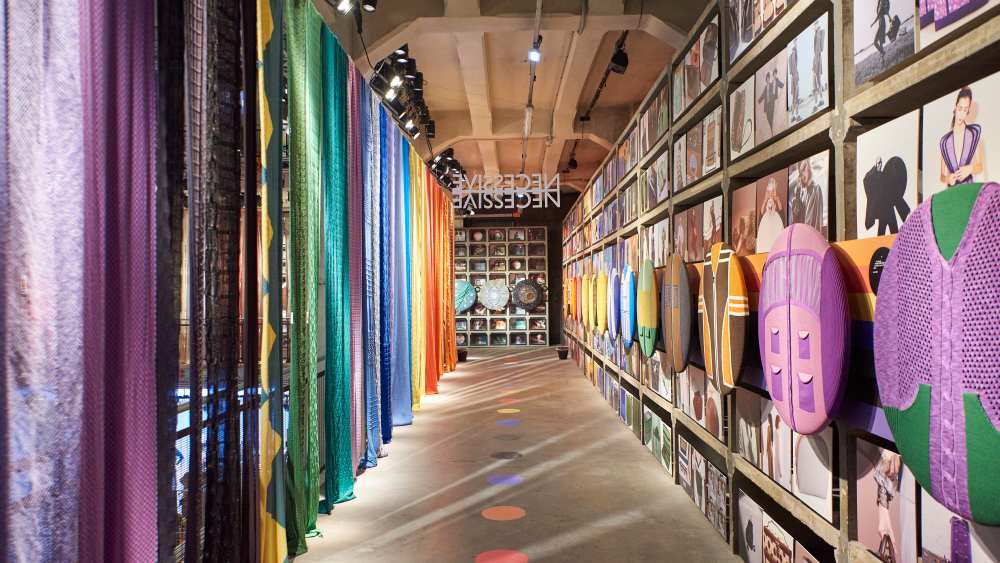
MILAN — Despite the ongoing pandemic and its accompanying supply chain woes, spinners at the two-day trade show Pitti Filati were optimistic about the year ahead.
The fair, which closed Feb. 4, was held at the small scale Stazione Leopolda venue and flanked by the Pitti Connect digital platform, showcasing the spring 2023 yarn collections of some 80 exhibitors, mainly hailing from Italy. They responded to the uncertainties still looming over the sector with comfort-enhancing yarns that blended lightweight fibers with textured and mélange effects to channel breezy summer atmospheres.
The year 2022 presents more than one challenge, as prices for raw materials have been skyrocketing, with wool up 14.2 percent in 2021 versus a year earlier, and cotton jumping 33.9 percent. According to spinners, this jump along with increased energy costs could dent profits. Yet they were bullish about surfing the positive wave offered by the economic rebound in the post-COVID-19 world.
Related Articles
According to data provided by Confindustria Moda, sales of the sector totaled 2.45 billion euros in 2021, up 21.4 percent compared to the previous year, but still 11.6 percent below pre-pandemic levels. Exports are seen jumping 23.2 percent in 2021, based on the performance in the first 10 months of last year, with exports of woolen yarns to the U.S. skyrocketing 184.7 percent year-on-year.
You May Also Like
According to Pitti Immagine’s chief executive officer Raffaello Napoleone, the fair confirmed its pivotal role in the yarn making sector “especially in such a crucial moment characterized by the retooling of the market’s nuts and bolts [needed to] give renewed fuel to the system,” he said. The textile trade show drew 1,750 visitors, 35 percent of whom were foreign attendees hailing mainly from the U.K., the U.S., France, as well as other European countries.
The CEO anticipated a return to showing at the Fortezza da Basso next June, a top priority for exhibitors, too. “It’s the second experience at the Stazione Leopolda [venue] and we do miss the Fortezza da Basso,” said Fabio Campana, CEO of Lanificio Dell’Olivo. “Despite its small scale and the sanitary measures still in place, it was great to finally meet our clients in person. We welcomed more visitors than expected, surprisingly many from abroad,” he said.
“Difficulty in sourcing sustainable materials is a huge bungle,” said Silvio Botto Poala, CEO of Biella-based Botto Giuseppe. “High-end clients are increasingly gravitating toward eco-friendly yarns and their scarcity paired with increased prices represent a fallout for the sector.” The executive forecast a rebound in knit yarns, currently seeing strong demand, which are expected to boost Botto Giuseppe’s 2022 sales to 60 million euros, up from 51 million euros in 2021
Lincoln Germanetti, CEO of Tollegno 1900, was more optimistic about wool prices, noting that the fiber has absorbed inflation better than other materials, such as cotton. As exhibitors at fellow textile trade show Milano Unica already underscored, energy self sufficiency is key to dodging the negative impact of increased energy costs. To this end, the Tollegno 1900 CEO offered that the company has managed to contain prices by relying on photovoltaic panels and turbines.

Ease and comfort continued to rule at Pitti Filati, as exhibitors updated their offerings with blends aimed at enhancing performance and easy care features. Botto Giuseppe introduced Sea Island cotton and silk combinations for superfine and shimmering yarns, while cotton combined with extra fine merino wool delivered breathability and lightness intended for elevated sportswear. The same approach was translated into cashmere and linen blends as well as angora wool paired with silk for mottled and textured suitings. The mill’s hero product, the mulesing free, cradle-to-cradle certified Slowool, was rendered in a crepe version.
At Monticolor, the new “Feel Linen” blend combined superfine linen with organic cotton crafted according to the voile technique, which enhanced the elasticity as well as providing wrinkle-free and pilling-free qualities. At Cariaggi, blends of cashmere, merino wool and cotton provided mélange and textured effects. The latter were also strong at Cariaggi, which specializes in the production of cashmere and high-end yarns. Its spring 2023 collection’s hero product was a blend of linen, silk and polyamide with a fluffy look, which appeared also in the Botto Giuseppe collection as a blend of cotton and polyamide.
Spinners are focused on offering offer yarns that can apply to both genders, a smart move not only mirroring today’s fashion but also sustainable in that it allows companies to streamline their offering and reduce unsold stocks. Lanificio dell’Olivo developed its lineup of lightweight wools with this in mind, while Tollegno 1900’s “Biolino” range combined RWS-certified wool with European Flax-approved linen for a wavy look, available in 28 nuances suitable for men’s and women’s wear.
Backed by strong performances in 2021, executives are expecting 2022 to mark an additional rebound.
“Although these are the most challenging times in the history of textile manufacturing, our goal is to safeguard our know-how, quality and service for our clients,” said Alberto Corti, owner of Brescia, Italy-based Monticolor. “We’re aiming to consolidate our position and revenues, mindful that the economic rebound will wane down at some point.” The company saw a surge in 2021 revenues, up 40 percent compared to 2020 and 15 percent compared to pre-pandemic levels to 26.5 million euros.
Similarly, Lanificio dell’Olivo is aiming to grow its revenues and return to 2019 levels by banking on an enhanced stock service catering to brands in the luxury segment. Campana forecast sales to reach 19 million euros in 2022, up from 16 million euros in 2021.
Boosted by better-than-expected performances in France, the U.K. and the U.S., Marche-based Cariaggi already managed to overcome its 2019 sales by 7 percent, totaling 113 million euros in 2021. “Despite the complex scenario ahead, our goal is to further develop our global footprint,” said Piergiorgio Cariaggi, the company’s CEO.
Sustainability sits at the core of spinners’ product development as more brands and retailers are requesting green credentials and certifications. To this end Cristiana Cariaggi, the company’s sustainability director, said the mill will invest 4 million euros this year in the renewal of its machinery to strengthen its manufacturing prowess and eco bent.