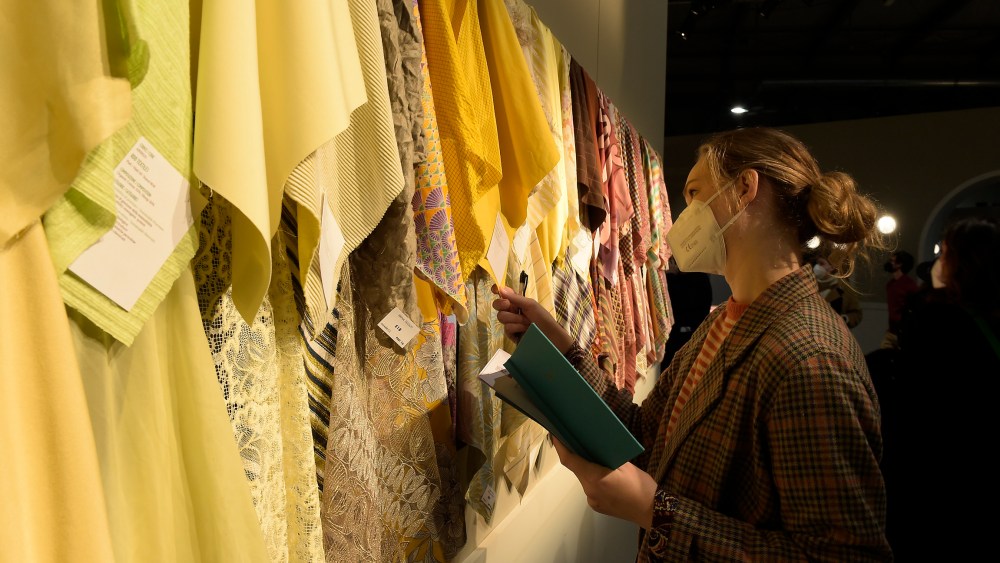
MILAN — Exhibitors at the textile trade show Milano Unica were bullish about recovery, confident they will power through the geopolitical instability and supply chain woes marked by price increases for raw materials and energy, which are both denting profits and requiring skillful negotiations.
The two-day show, which closed Wednesday, drew 3,600 attendees, up 16 percent versus July’s edition, as the Milano Rho fairgrounds were filled with optimism and energy.
Touting the choice to go ahead with an IRL show despite the Omicron wave, Milano Unica president Alessandro Barberis Canonico admitted it was a “reckless” decision, but he was pleased with the enthusiastic response.
Related Articles
Remembering the late Nino Cerruti at the fair’s opening ceremony, Barberis Canonico recalled the designer attending the fair every season and quoted him as saying: “The textile sector does not exist because of Milano Unica, yet it’s crucial to be here and celebrate the event’s role.” The trade show’s president confirmed that the 342 exhibitors — up 27 percent compared to July — shared similar enthusiasm.
You May Also Like
Although no textile industry executive went so far as to say the COVID-19-induced quagmire was entirely overcome, they all projected a positive 2022 outlook based on a general uptick in sales for the fall season, which they are marketing. For instance, Marzotto Wool Manufacturing’s chief executive officer Giorgio Todesco offered that seasonal orders were up between 30 and 35 percent compared to the same season in 2019 and 2018, boosted by a strong performance in the U.S., where the mill’s exports exceeded 2019 levels.
According to data from Confindustria Moda, the textile sector’s performance in 2021 was mostly positive with sales of 5.8 billion euros, a 9.6 percent gain compared to the pandemic-scuppered 2020. Turnover remains 23 percent below pre-pandemic levels, however.

“We’re experiencing a better-than-expected recovery,” noted Ercole Botto Poala, CEO of Reda. “There’s a lot of pressure on costs, and it’s yet to be seen how brands will respond, our prices are spiking not because we want to improve our margins, rather because it’s the only way to survive.” The Biella-based mill generated a turnover of 73 million euros in 2021, which is expected to increase to 90 million euros this year.
According to Todesco, the narrowing price difference between super-fine wools and regular options is going to level off, but consumers will nonetheless have to adapt to increased retail prices, especially in the luxury segment. So, too, believes Botto Poala, who forecast an ongoing uptick for raw material prices in the long term, a trend that cannot be offset by increased production. According to Vasiliy Piacenza, brand manager director at Piacenza 1733, skyrocketing prices will have less of an impact on the premium luxury segment where the mill operates given its wealthy target customer.
“The textile industry does not have enough muscle to power through these [increases], without adjusting its prices,” said Filippo Vadda, CEO of Lanificio Fratelli Cerruti, anticipating that the mill will adjust its prices in the double-digit region until the pressure on prices wanes.
Faced with surging energy prices in Europe, textile makers are trying to navigate the new reality and build their own energy supply chain by introducing cogeneration plants like Marzotto Wool Manufacturing, sourcing water locally via purification systems at knitwear company Maglificio Maggia and photovoltaic panels at Eurojersey, all while updating their machinery with more efficient and sustainable options.
Eurojersey, for example, will spend 9 million euros this year on the refurbishment of its weaving and dyeing departments, while Lanificio Fratelli Cerruti is revamping its weaving room with new Itema looms.
“Energy independence is pivotal,” said Giovanna Maggia, the ninth generation to helm the family-owned, Biella-based Maglificio Maggia. “The topic is too often disregarded, especially when it comes to small- and medium-sized enterprises, which are hit the hardest by increased energy prices.” Supply chain troubles didn’t dent the firm’s performance in 2021 as it posted sales of 15 million euros, up 60 percent year-over-year.
Among cotton specialists, the Albini Group also dodged the havoc wrought by the pandemic, posting 133 million euros in 2021 sales, up 35 percent versus 2020. “We’ve come out of the emergency strengthened thanks to the investments we made and channeled into pivotal fields,” said Stefano Albini, the company’s CEO.
The results of its research and development department, known as Albini Next, were focused on advancing sustainable dyeing. For instance, the “Off the Grain” dye uses anthocyanosides derived from rice production, while the “Re-Oxyde” dyes come from iron waste sourced from end-of-life appliances. Through “Hemp Feel,” the company uses hemp oil as a softener to achieve a velvety feel, while “Grounded Indigo” is a project aimed at fostering the organic growth of the indigo plant developed in partnership with Stony Creek.
The cotton maker’s high-tech approach — paired with its traceability credentials — is paying off, as all markets registered a positive performance. The group saw a 20 percent increase in 2021 exports to the U.S. and strong business in Europe. Last year also offered the group a chance to fuel its bespoke and cotton divisions, the latter supplying the fabrics to knitwear companies, which grew 25 percent and 100 percent, respectively.
For their spring 2023 collections, textile makers banked on textured surfaces, 3D effects, revisited patterns and earthy tones aiming to update classic men’s fabrics with a more contemporary and creative twist.
These were flanked by high-tech innovation and performance-driven fabrics, almost always having a sustainability element.
As part of its high-end Flow collection, Lanificio Fratelli Cerruti introduced chevron patterns and crinkled effects, as well as jacquards revealing chessboard motifs when backlit, pinstripes’ lines replaced by words or placed haphazardly. At Marzotto Wool Manufacturing, archival pieces with subtle shimmering effects were updated in feather-light Patagonia-sourced wool and silk suiting fabrics.
Woolen shirts were ubiquitous at the trade show, confirming a growing interest for alternatives to cotton. After years of research, Marzotto Wool Manufacturing managed to obtain a soft and lightweight off-white version, while Reda interpreted them in colors blending wool and linen as part of its Reda Active performance-inclined collection.
At Vitale Barberis Canonico, wavy effects translated into denim-looking fabrics and mottled ocher suits nodding to heritage pieces reinterpreted in lightweight versions, while Piacenza 1733 upped the ante on R&D, introducing a textile derived from the Himalayan urtica dioica, commonly known as burn nettle, which, blended with silk and wool, delivers tactile and shimmering effects to very light blazers.
Also, Como-based silk specialist Canepa expanded its suiting fabrics offering, coming up with Lurex-embellished textiles, damasks, moiré effects as well as cloth-dyed paisleys. For its women’s offering, the company’s archives informed shimmering tie-dye fabrics that blended silk and poly, and fil coupè geometric-patterned textiles with Lurex lozenges to add extra light, as well as impressive 3D-looking floral patterns.
In their quest to update the business suit in more ways than one, performance characteristics took center stage in the Vitale Barberis Canonico’s Off Limits collection, expanded for the second season with the introduction of the Technonatural range, in which recycled man-made fibers were blended with viscose, hemp, linen and cotton boasting stretch qualities and textured effects.
Similarly, Maglificio Maggia experimented with blends of linen and Lycra, or cotton and Coolmax or nylon for easygoing knitted suits. The firm expanded its sportswear offering with technical knits that gained the interest of premium fashion houses, according to Maggia, and introduced options crafted from Lenzing’s lsdyocell Tencel.
A pioneer in man-made fabrics with a performance bent, Eurojersey continued to develop its Sensitive Fabrics textile to achieve real-looking denim and corduroy effects, as well as 3D textures like pique. The company, which reported a 27.5 percent jump in 2021 sales to 80 million euros, is roaring in the U.S. thanks to new partners, including Skims and the Brady brand from legendary, and newly retired, quarterback Tom Brady.
The momentum being seen in the textile sector also stretched to those companies that are in reboot mode.
Canepa was recently backed by investment funds Capital Solution ELTIF Azimut and Muzinich & Co. SGR, part of the Muzinich Group, and Invitalia, an Italian government company, both considered as patient investors that are expected not to pressure the company in the short term.
“That our standstill happened in the past two years was not that bad after all,” said newly appointed CEO Virginia Filippi, who succeeded in dragging the company out of the restructuring plan Michele Canepa, a minority investor, had filed with the Court of Como.
“Now that the market is recovering and companies are rushing, we need to move quicker than anyone else,” she said.
The executive contended that the firm’s share of the luxury market share was eroded by competitors taking advantage of its standstill. Her five-year business plan envisions a return to partnering with high-end companies; a renewed focus on Canepa’s key assets, namely its archives and jacquard know-how, as well as boosting revenues to 23 million euros this year, up from 15 million euros in 2021.
Similarly, Lanificio Fratelli Cerruti is aiming higher and planning to increase its penetration in luxury by banking on the creative heritage left by the man who helmed the company for several decades, the late Nino Cerruti. “We’re the least ‘Biellese’ among the Biella-based companies,” said Vadda. “Our offering is less in sync with the British formalwear championed by our competitors and more experimental.”
This strategy should appeal to underrepresented markets, including the U.S. and Japan, and help consolidate the company’s footprint in China, which grew to represent 35 to 40 percent of the firm’s sales during the pandemic.