
MILAN — Reports that sales for the Italian textile industry increased in 2006 for the first time in five years lifted spirits at the fourth edition of Milano Unica.
The industry posted a 1.4 percent sales increase compared with 2005, to 9 billion euros, or $11.3 billion at average exchange, according to SMI-AMI, the Italian federation of textile and clothing industries. Exports were also on the rise, valued at two-thirds of the sales result. Textile sales to Asia rose 4.8 percent, including a 7 percent gain to China. Exports to European countries went up 0.7 percent, the first rise in several years.
Paolo Zegna, president of Milano Unica, said the results “are the fruit of the initiative taken by the industry, with notable sacrifices, to confront a new phase in globalization, pushing a more high-end quality production and confronting with seriousness and determination new emerging markets like China, India, Brazil and Vietnam.”
Created in 2005, Milano Unica includes the Ideabiella, Ideacomo, Moda In and Prato Expo Shirt Avenue exhibitions.
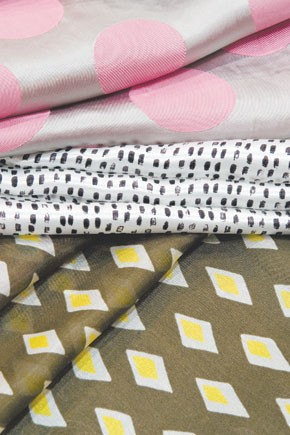
Fabric trends at the show, which ran Feb. 13 to Feb. 16 at the Milan fairgrounds, reflected the industry’s brighter sales results. Lustrous, slinky viscose and colorful, super-fine silks were on offer.
“Business is going great and so is the fair,” said Michele Viganò, chief executive officer of Seterie Argenti, which exhibited as part of Moda In.
Viganò confirmed the company closed 2006 with sales up 10 percent, to 25 million euros, or $31.4 million.
“Our sales year ends in August, so we are expecting 2007 to be even better,” Viganò added, noting that sales at the fair were strong. “We’ve just sold 80,000 meters of printed silk to Zara.”
The Como mill’s spring and summer 2008 collection included 1,000 reproduced printed silks from its Sixties and Seventies fabric archive that featured cobalt blue, cerise, turquoise and green patterns. The mill also presented a washed Ottoman silk, floral and geometric jacquards in pale natural shades decorated with a silver Lurex yarn and a fabric made from a polyester yarn that the mill dubbed “Memory Yarn” because it retained any shape into which it was manipulated.
Related Articles
You May Also Like
At Silanco, chief executive officer Davide Crotti, also noted the market’s resurgence.
“After some drastic drops in sales in past years, we’ve noticed a reawakening of the market, and it looks like we are on track for a good year,” said Crotti, adding the mill had ended last year with a 20 percent rise in volume and attributing the results to increased sales of jersey fabrics. “Before jersey was just for tops. Now, designers are using jersey in a lot of dresses, so that means they need more fabric.”
For spring 2008, Silanco presented crumpled sage green gold Lurex striped jersey, as well as oversize violet foliage prints on viscose.
Milan knitting mill Mario Boselli also is riding the jersey boom.
“Five years ago, no one wanted to use jersey, but now it’s come back,” said ceo Federico Boselli, adding that sales for the mill in 2006 had increased 35 percent, to 46 million euros, or $57.8 million.
In line with the market’s demand for chic-looking jersey that dresses well, Mario Boselli presented a pearly lavender and gray viscose jersey laminated with a new pressing technique to give a subtle shine.
Laminated finishes were also used at Ultra, located in Prato Expo’s hall, where the mill showed checked cotton fabric coated with Teflon, normally used on outerwear pieces like trenchcoats. Besides a selection of shiny, clean viscose, the mill also presented yarn-dyed Glen plaids in linen and cotton, and large jacquard floral in black and silver. Though co-ceo Stefano Rigotti was pleased with business at the fair, he said he was forced to raise fabric prices in dollars because of the weak exchange rate with the euro. At Ugo Pacini, yarn-dyed fabrics dominated the new collection. A mint cotton seersucker and elasticized tobacco-colored linen were among the mill’s best-selling fabrics, said Filippo Pacini, commercial director for Ugo Pacini.
“We’ve had a lot of requests for natural fabrics like linen, cotton and viscose woven with elastane for fitted pants,” Pacini said.
At Moda In, Ricamificio Lusi presented a plaited navy satin fabric and a gold silk appliquéd by hand with discs of elaborate lace. Andrea Tubaldo, production manager for the mill, said sales had picked up in Spain and the U.S.
“But times aren’t like they used to be,” Tubaldo said. “Now, our clients won’t take risks on their collections. Before, they’d order more samples; now, they are more decisive on what they want.”
Luxurious silks also dominated the offerings at mill Zibettie Orsini, of Como. Among the designs was a lavender silk embroidered with a scene of a boat on a lake, and red, gray and black wave-like embroidery on a net fabric.