
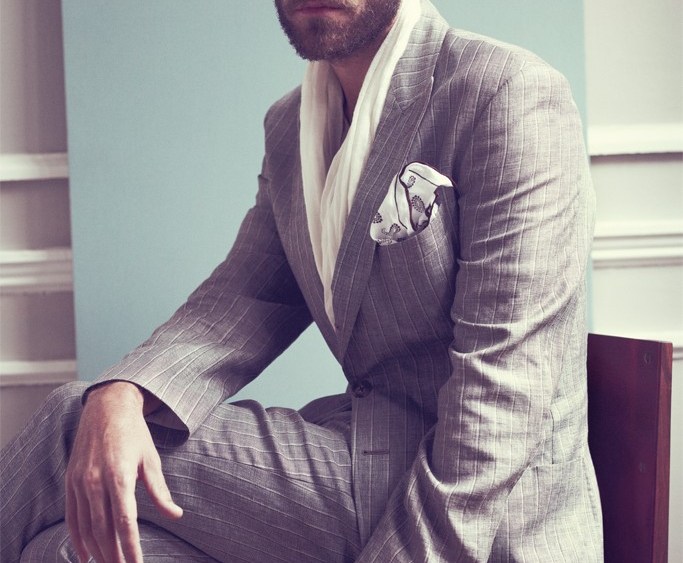
The new spring Original Penguin advertising campaign spotlights a heavily tattooed model on Coney Island during sunset, wearing tailored blazers and vests in various images. The ads help accentuate the casual brand’s recent push into suit separates, blazers and tailored waistcoats.
“Two years ago, we didn’t have a tailored clothing program,” said Ann Payne, senior vice president of design and merchandising at the Perry Ellis International-owned brand. “Today, men are wearing suits and sport jackets as an extension of their sportswear, so we can have a little more fun with it.”
Original Penguin is one of many American brands looking to capitalize on a resurgent tailored clothing market in the U.S., which was up more than 11 percent in the first half of 2011, according to NPD Group figures. In contrast to their European brethren, American brands tend to take a sportswear approach to tailored clothing, said designers and executives on this side of the Atlantic — and consumers are responding to the creative approach to suiting.
Related Articles
“Something huge is happening. There’s a whole generation of guys who never had to wear a suit to work, and they are discovering tailored clothing in a whole new way,” said designer Michael Bastian. “It’s no longer a uniform or straitjacket you have to wear to work. It’s more about a fashion choice now. It’s gone from having to wear a suit to wanting to wear a suit.”
You May Also Like
Bastian and his peers, including designers like Thom Browne, Simon Spurr and Band of Outsiders, have reimagined the classic gray flannel work suit in inventive ways — taking it out of the sphere of office drones and into nightclubs and weekend parties.
Bastian is adding more tailored clothing to his assortments for fall. In his upcoming show in February, look for the designer to evolve the slim fit of his suits and jackets and add a bit of Seventies loucheness to the look. “We’re increasing the size of the lapel and playing with the notch. It’s a bit of Halston,” he explained, noting that one-button peak lapels will be a key style for fall.
Texture and tweedy English fabrics have become more important, as designers and trendy consumers look for styles beyond the run-of-the-mill business suit. Bastian noted he avoids Super 120s fabrics at all costs, for example. “That’s the deadly Dad-going-to-work fabric that’s really difficult to turn into something beautiful and sexy,” he explained.
Also on Bastian’s nix list? Those shimmery, tone-on-tone Bemberg linings. “They look kind of sleazy,” he noted, adding he lines all his jackets with shirt fabrics.
While texture is a key trend, American men tend to prefer lighter fabrics and shy away from heavyweight wools, which can be an issue when creating sporty, rustic looks. However, textiles mills are producing the look of Scottish tweeds and textured wools in lightweight fabrics — which allow designers to create suits with lots of surface interest but in easy-to-wear weights.
“It’s a drag putting on a heavy jacket. You really want to stay in the 300-grams weight for anything that you want to wear more than one or two months out of the year,” noted Bastian, who is big on casual fabrics like corduroy, moleskin and seersucker. “These fabrics aren’t so precious. The more you wear them, the better they fit your body. The elbows break in and the shoulders settle down. It’s a real sportswear approach to tailored.”
At Joseph Abboud, rich, textured fabrics are also a primary trend for fall. “I think as the economy starts to improve gradually, there’s going to be more risk-taking in tailored clothing,” said Anthony Sapienza, president and chief executive officer of the brand’s owner, JA Apparel Corp.
To that end, the brand has embraced double-faced fabrics, leather trim on pockets, elbow patches and tabs on collars for its fall lineup of suits and sport coats. Beefy fabrics abound, and some jackets even have removable knit collars or detachable fur collars. “It makes the jacket warmer around the neck. Men have really adopted scarves as a fashion item and these give the jacket that same look,” said Sapienza.
The ceo was in Florence for Pitti Uomo this week, and he noted that many European companies there offered up their own takes on classic American preppy style, including brands like San Francisco, Hartford, Brooksfield and New England. “Western Europeans have adopted a traditional American collegiate preppy kind of look,” he noted. “But I think we have a more sophisticated understanding of it. Our design fuses traditional elements of American design with European influences. We are synthesized in the middle.”
For spring, Joseph Abboud is continuing its “Made in the New America” campaign, which is meant to both evoke the brand’s roots — JA Apparel owns a suit manufacturing factory in New Bedford, Mass. — and its interpretation of modern American culture.
“I think there’s a whole new interest in ‘Made in America’ because there’s this perception that America is falling behind and that China has taken the lead in many areas. There’s a bit of paranoia that has seized the popular imagination,” said Sapienza. “We don’t want to wrap ourselves in the red, white and blue of the American flag, it’s more subtle than that. Our brand doesn’t just represent the old, Waspy, traditional clothing. We have a multiethnic facet to the brand, and I think that has great appeal to the consumer today.”
The campaign features real men, including R.J., a half-Lebanese actor; Andrew, an English-born creative director, and Shawn, a denim designer.
At Original Penguin, look for suits with lots of surface interest in the fall, including Donegal wool, coated cotton, heavily washed cotton sateen and cavalry twill. Shawl collars, peak lapels and patch-pocket design details add additional variety to the offerings.
Tailored clothing is currently only about 5 to 7 percent of sales for the casual brand, but the category is growing quickly — particularly in the company’s own retail stores, said Payne. “We can merchandise it with our dress shirts and ties. Our stores are becoming more of a destination for that,” she noted.
The stores have become popular with grooms looking for a youthful, nontraditional wedding outfit, such as a blue and black houndstooth tuxedo offered this upcoming holiday season.
A sleeker look is the focus at Calvin Klein, where both one- and two-button blazers with strong, constructed shoulders are the principal direction for fall. Lapels are streamlined, and a narrow welt pocket on the chest was added. Unlike Michael Bastian and Joseph Abboud, tweeds are not part of the look at the PVH Corp.-owned brand.
“A key difference between American and European tailored clothing is the fabrics. In Europe, they are working more with boiled and felted materials, while we are focusing more on modern fabrics with sheen and luster to create sexy, liquid-metal-inspired suits,” said Kevin Carrigan, global creative director of ck Calvin Klein, Calvin Klein white label and Calvin Klein Jeans. “Calvin Klein brings its clean, pared-down American aesthetic to tailored clothing, offering heritage fabrics, minimal stitching and sexy proportions.”