
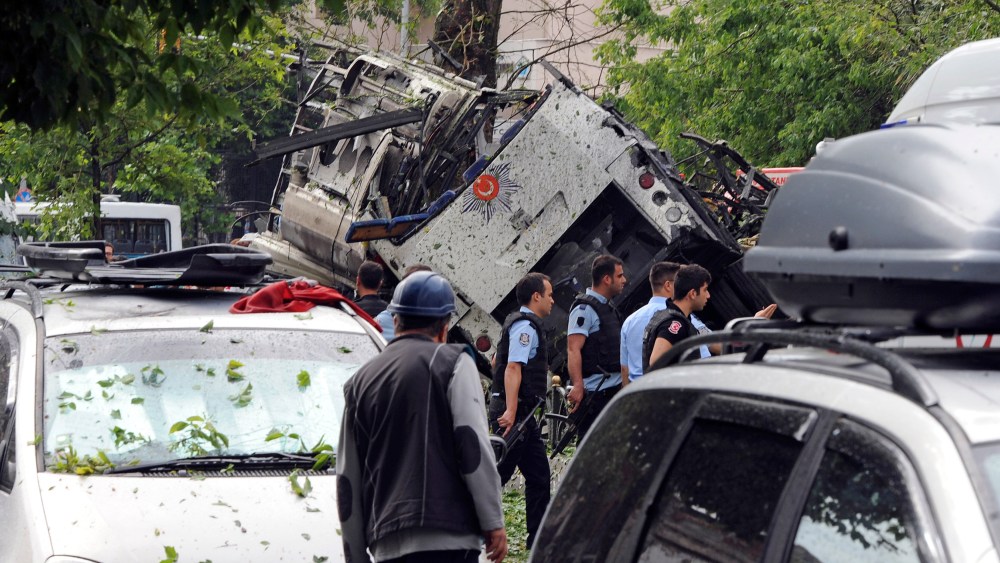
ISTANBUL — The car bomb explosion Tuesday morning in central Istanbul, which killed 11 and injured 36, also left the city’s already suffering textile trade further on edge.
The attack took place near Istanbul’s traditional garment district during the morning rush hour. Although no group claimed responsibility for the fourth major bombing in Turkey’s largest city this year at press time, government officials suspected the involvement of a Kurdish separatist group, which often targets security personnel and busy urban areas throughout Turkey.
The tremor from the explosion that targeted a police bus passing by the Vezneciler neighborhood was strongly felt in nearby textile shops of the Laleli district.
Related Articles
“I heard the explosion at home and rushed out to see what happened,” said Lorina Androni, who lives close to Laleli’s Esmeralda wholesale coat shop, where she works as a sale assistant. “Our shop was luckily not damaged, but I’m sure this attack will very much scare our customers.”
You May Also Like
The blast caused no major material damage to stores, but instigated panic and fear among members of the Laleli Industrialists and Businessmen Association, it stated late Tuesday.
Once bustling with merchants from the Russian Federation, Laleli has already suffered historic lows in trade in recent months with more shopkeepers than customers milling around stores draped in signs in Cyrillic.
When Turkey’s military downed a Russian fighter jet that violated the country’s airspace in November, Russia’s president Vladimir Putin called it “a stab in the back” and warned against consequences that ultimately brought a standstill to the suitcase trade, the practice involving Russian traveling traders, who hand-carry goods back to their own country.
“We just opened the new season, but it’s still empty,” said Nedim Kohen, 38, referring to Gel-Al, his large apparel shop in the heart of the district, in an earlier interview.
After Tuesday’s terror attack, Kohen believed future prospects looked even more grim.
“This will of course have further effects on our business in a bad way,” he said.
Not only did recent devaluations of the Russian ruble on world markets contribute to an 80 percent loss in Gel-Al’s revenues last year, but an increasing brand-consciousness among Russian consumers also added to the slump.
In the first two months of 2016, garment exporters nationwide reported a 59 percent decrease in overall trade with Russia, although Turkish textiles were not directly sanctioned like the energy, food and construction sectors.
Moscow’s pressure was more indirect. The Russian government has terminated charter flights to Turkey, pressured travel agents to stop selling holiday packages to the country and state media has kept highlighting terror attacks in Istanbul and Ankara.
“Our customers still ring us to ask whether there’s war in Istanbul after they watch exaggerated Russian news reports,” said Elena Savgaeva, 38, a Moldavian textile broker at empty Esmeralda’s, a few weeks ago.
“It is typical propaganda to make sure people are afraid to come here,” she added.
Giyasettin Eyyupkoca, chairman of Laleli Industrialists and Businessmen Association, said he believes the effects of the most recent attack would be short-lived, like he called the previous ones.
“Such attacks are very unfortunate, but it’s not true that there have been cancelations because of fear. Today’s attack will not be treated any different,” he said in a phone interview. “We were already stepping into quiet time with the season coming to an end, and Russians leaving for vacation as schools were closing this week. So the impacts will be minor.”
Other retailers disagreed, saying their business has suffered a dramatic decline in recent months. And they underlined the need for versatility in the market.
“We definitely need to stop relying on Russia. We need a backup plan,” said Muhammed Sengul, 40, Esmeralda’s owner.
Laleli’s leather shops have also been suffering. Many have kept their lights off, reduced personnel and marked their windows with big sale signs in Russian.
“I have nothing to say,” said the owner of a two-story leather shop, when asked how his business was hurt by the recent political crisis between Turkey and the Russian Federation. “As there’s absolutely nothing.”
The suitcase trade in ready-to-wear, leather and other garments to the Russian Federation generated around $4.5 billion of Turkey’s estimated $8 billion suitcase trade revenues in 2014, according to the country’s exporters’ association. The Russian Federation ranked seventh among Turkey’s top export markets the same year.
Such gray-market numbers far eclipse the registered rtw and garment exports to Russia, which have plunged from $413 million in 2013 to $351 million in 2014 and $204 million in 2015, according to the Istanbul Ready-to-Wear Garment Exporters’ Association.
Both rtw and leather exporters, however, have rolled up their sleeves to try and turn today’s crisis into an opportunity.
“In order to bypass the current deadlock and diversify our resources, we’re turning to Africa, exploring Iran in a changing financial climate for its 80 million people, reviving links in Europe and working hard to win a better share in the United States,” said Hikmet Tanriverdi, chairman of IHKIB, which represents more than 7,000 businesses that generate 49 percent of Turkey’s overall exports.
The group is preparing to launch Turkish Trade Centers in Dubai, London, Düsseldorf, Paris and New York, the latter of which is to open by the end of July, with showrooms of 30 rtw leaders.
Exports to Algeria, Libya and Egypt have already increased 25 percent, and the IHKIB is organizing familiarization trips for potential buyers from Nigeria and Cameroon with a target of doubling their Africa exports in three years, the chairman said.
In leather, there has been a similar search for new markets to compensate for the 50 percent loss in Russia, and to increase its share in the $250 billion global market.
“We’re going to fill the gap Russia created with big leather buyers like the United States, Canada, European Union countries, Japan, China and South Korea,” said Mustafa Senocak, chairman of the Istanbul Leather and Leather Goods Association.
Back in Laleli, where many had to close their businesses, Savgaeva expressed some cautious optimism.
“The Russian market is indispensable, when even Kyrgyzstan, Uzbekistan, Azerbaijan and Tajikistan altogether cannot match Russia, let alone starving Africa,” she said. “This crisis might crush small businesses, but big players will thrive and Russians will be back one way or another because we both need each other.”