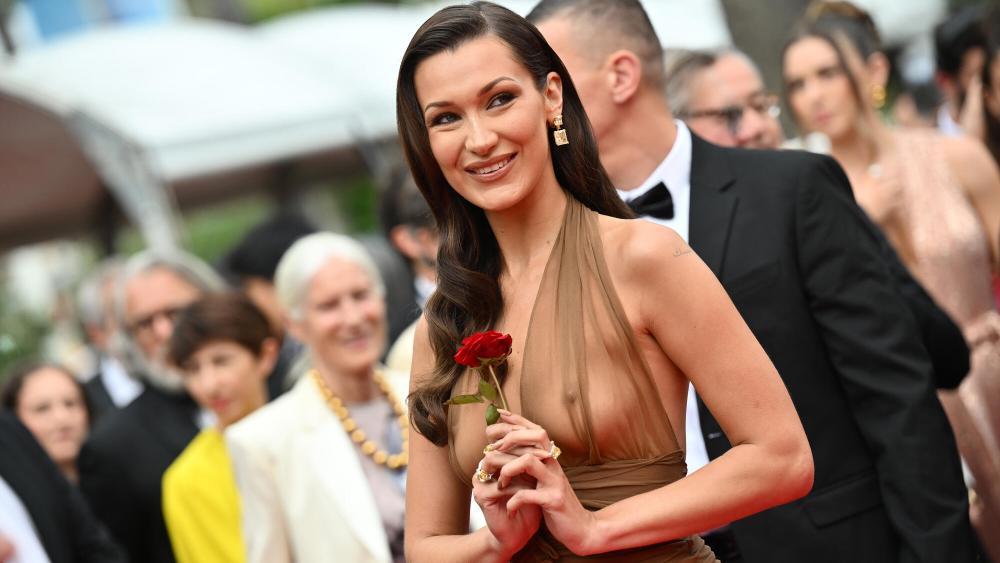
The Cannes Film Festival is shifting away from the revealing naked dress trend that has dominated recent red carpets. With its new dress code, the festival prohibited guests from displaying both nudity and excessively voluminous outfits, citing “decency reasons.” The decision comes after years of increasingly daring celebrity outfits and adds to the ongoing discussion among fashion enthusiasts on social media — Is fashion becoming more conservative?
The roots of sensual dressing at Cannes stretch back to the 1980s, when red carpet fashion began to embrace more daring and body-baring silhouettes. In 1985, Ilona Staller, soon-to-be wife of artist Jeff Koons, made headlines by wearing a topless, pink dress on the red carpet. The naked dressing tradition was kept alive at Cannes through the years with looks by many celebrities, including Cameron Diaz, Kylie Minogue, Claudia Schiffer and, more recently, Bella Hadid and Naomi Campbell.
You May Also Like
Related Articles
Nancy Deihl, a historian of fashion and chair of the Department of Art and Art Professions at NYU, views the new Cannes dress code as an effort to curb excessive displays and emphasize elegance.
“There’s a long history at Cannes of actresses wearing sexy styles, but always within the parameters decreed by high fashion. The reality is that many runway shows display as much skin, if not more, than the recent styles that inspired the naked-dressing ban. But I feel the Cannes officials are really focused on setting the event apart from every other celebrity-focused spectacle, even if it makes them seem a bit dictatorial,” Deihl told WWD.
Celebrity stylist Karla Welch, who works with Olivia Wilde, Anna Sawai and Gal Gadot, among others, called the Cannes decision “boring and patriarchal and lame” via her Instagram on Monday.

The debates over modesty and exposure are recurrent in the fashion history, but for Deihl, the current “scope of bodily exposure is unprecedented,” differentiating from other cycles in fashion. “We’re starting from a much more extreme place. A lot of what has passed for red carpet fashion recently is more like costume, showgirl costume,” she said.
Naked dressing has been in and out of the runways since the early 2000s, making a strong resurgence in 2023, with Dion Lee, Jason Wu, Michael Kors, Brandon Maxwell, Chanel, Balenciaga and other fashion houses using sheer fabrics in recent collections. In Hollywood, the see-through style was present in almost every single red carpet event in the past year, including the Oscars, Grammys and Golden Globes. While many see the style as a tool of empowerment, body confidence and artistic expression, some critics claim the style favors over-sexualization and a lack of innovation in design.
“I don’t really understand why the human body is a driving force for so much discomfort in so many people,” Paris Jackson said, while addressing critics of her sheer look at Stella McCartney‘s fall 2025 fashion show in March. “Like, it’s just a body. Don’t get uncomfortable with our bodies. It’s your body, you’ve got one, I’ve got one, we’ve all got one. It’s OK. There’s nothing wrong with it.”
The discussion on naked dressing adds fuel to a broader conversation online, where fashion influencers point out a rise in modest dressing, often paralleling it with the current economic scenario in the U.S. In videos posted on TikTok, the influencers cite ongoing trends, such as quiet luxury and tradwife-core (a style encompassing muted tone prairie dresses and demure style elements), as evidence that people are becoming more conservative with their wardrobe.
“There’s a reason people get more conservative in a bad economy. When you’ve got money in the bank, you take more risks,” TikTok creator Nikita Redkar said in a viral video that has since gathered more than 3.8 million views. “When the economy is bad, you stay safe. You don’t want to draw attention to yourself in uncertainty. You opt for certainty. And what’s more certain than tradition? What’s more certain than staying at home?”
Despite the online theories, for Deihl, the idea that fashion tends to get more conservative in economic crisis is “a long-running, but popular, fallacy.” “People love to believe in a causal relationship between economics and silhouette, but a look at the fashion of the 1950s is a great example of how it doesn’t fit: That was a period of social conformity and conservative attitudes for much of the world, but also a period of affluence,” she said.
For the historian, modesty is just one of the many choices available to consumers, but doesn’t reflect a broader change in the fashion industry. “I’d bet that in terms of red carpet events, and the special occasions enjoyed by noncelebrities, revealing silhouettes and lots of exposure are much more in favor than modest looks. An exception, of course, would be occasions where religious or cultural norms dictate modest dress codes,” Deihl said.