
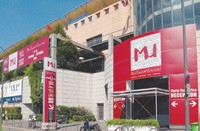
MILAN — Organizers of the Milano Unica textile fair are hoping a change of location back to Milan’s city fairgrounds will attract more international visitors for its third edition.
The fair brings together the Ideabiella, Ideacomo, Moda In, Prato Expo and Shirt Avenue shows and will take place from Sept. 12-15 in six pavilions.
“The return to the Milan city fairgrounds will help communicate better to the best international clients those elements fundamental to the ‘Italian style of life,'” said Paolo Zegna, president of Milano Unica, in a statement. “The whole world admires us for this, and that’s what we want to transmit to every foreign customer every time they put on a piece of clothing created by fabric made in Italy.”
Milano Unica will present the fall and winter 2007–2008 textile collections of 706 exhibitors, compared with 713 exhibitors in February. Organizers hope attendance will surpass February’s 30,176 visitors, and they are expecting a large increase in the number of buyers from developing markets such as South Korea, Hong Kong, India and Brazil. Organizers are also optimistic that more buyers will come from the U.S., the U.K., Germany, Japan and Spain — established markets that have shown a renewed interest in Italian textiles.
While organizers were keen to highlight Unica’s international visitor base, some executives said Unica had already established itself as an important fair for Italian clients.
“For us, Unica functions wonderfully for our Italian clients…as well being an excellent fair for public relations,” said Federico Boselli, director of MarioBoselli Jersey.
“We remain positive about this edition of Unica. We’re happy to go back to the central Milan fairgrounds because it surely will be an improvement on last edition’s organization,” said Alfio Aldrovandi, general director of Arezzo-based mill Lanificio del Casentino. “And we are really satisfied with the work we do with our Italian clients there. We hope we’ll do more business with international clients there, too.”
Unica’s early timing, right after European summer vacations, has resulted in some mills having to come to the show with unfinished collections.
“Unica is a window for us,” said Chiara Orsini, export manager for Como-based mill Zibetti e Orsini, “Our clients come by to look but aren’t ready to order until a few weeks later. It’s a question of holding back on choosing trends [until] the last possible minute,” she added.
Related Articles
You May Also Like
“We will have 60 to 70 percent of the collection ready for Unica, but we are not really worried,” said Raffaele Riela, director of Prato-based mill Lanificio Lamberto. “Our international client base is growing and has shown a renewed interest in Italian fancy textiles.”
Taking cues from the fashion changes taking place on the world’s runways, fall-winter 2007-2008 textiles are more elegant, with cleaner finishes and more sober colors. Noble fiber mixtures dominate most mills’ collections, with the emphasis on new blends that aren’t season-specific.
Forging new developments in traditional textiles is Crespi 1797. The mill will present its winter linen, which director Francesca Crespi said is the result of years of research. The winter linen “is extraordinary with an unbelievably soft hand, which feels like wool,” Crespi said. The company mixed its winter linen with Shetland wool and played with weaving and dying processes of thick sportswear cottons to give linen-like weave effects and color that changes on a garment’s first wash. For fall, Crespi 1797 developed an ultrathick stain- and water-resistant hemp fabric, printing some with Japanese graphics, which it will propose as a fabric for coats, belts, bags and other accessories.
Also working in new ways with traditional fibers is Lanificio Lamberto. “Clients want wool and cotton but not in detailed, bouclé-type weaves, now it has to be cleaner and lighter,” said Riela.
The mill has produced some stretch cotton jacquards with basket-weave and waterfall effects, and has introduced organic cotton mixed with wool. “Organic cotton is a value-added textile that we will also be using more of in our summer collection,” Riela added. Lanificio Lamberto will also present some embroidered fabrics and some decorated with ribbons. “Fancier fabrics are popular with our clients to use as borders or touches to a coat or a skirt — they buy it like trimming,” said Riela.
Zibetti e Orsini decorated classic black, navy and brown gauze-like colored wools, wool-silk blends and wool-mohair blends with embroidered geometrics and small flowers inspired by the Renaissance and Nordic style.
“Crushed vintage designs aren’t in fashion any more. We are concentrating on soft looks — the sort of style Jackie Onassis had,” said Aldrovandi of Lanificio del Casentino. The mill has created some sponge-like wools and cashmere-angora-mohair mix fabrics with a knitwear touch for outerwear looks.
MarioBoselli Jersey intends to cater to all markets with its collection. “We developed some laces and heavily embroidered fabrics for the Asian markets, while for the U.S. and Europe we are convinced the matte-look jersey style worn in the Nineties will be popular again,” said Federico Boselli. “So, we are proposing some crisp, drape-like viscose in tones of gray and Bordeaux.”