
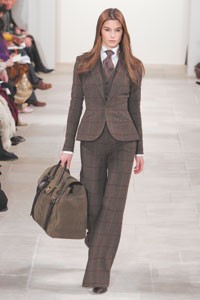
NEW YORK — The handbag shape for fall is bigger and better.
At least that’s the trend to emerge so far this fashion week, during which American designers continued their full-court press into the ever-booming handbag category long dominated by European brands. While silhouettes generally remained similar to those hitting store shelves this spring, designers tweaked them for fall by making them bigger and by adding more distinctive hardware, from brass locks and chains to jewelry. Exotic skins remain key.
And bags weren’t the only focus. Despite predictions of a turn toward minimalism and what accessories makers feared might be a lessening of interest in the category, fall’s collections last week were rife with hats, legwear, gloves, sunglasses, scarves, belts and jewelry.
The driver of the business is the bag, though, hence the ever-growing space being devoted to the category by retailers and the increasing effort by American designers to carve their niche in handbags. The retail floor has reflected this growth. In the last year, Macy’s East nearly doubled the space for handbags on the main floor of its Herald Square flagship in New York and Bergdorf Goodman has expanded its 58th Street bag room.
Evidence of the importance of bags was seen on the runways over the last week, during which:
Related Articles
- Marc Jacobs sent 34 of his 60 collection looks down the runway accompanied by handbags.
- Michael Kors accessorized a majority of his outfits with bags, from large square shoulder bags with custom-developed brushed hardware and layers of cut leatherwork to mini bags with chain-link handles.
- Seventeen of Oscar de la Renta’s 35 models swung a purse from their fingers.
- Zac Posen kicked off his second season in the bag business with a range of runway satchels.
- Ralph Lauren introduced a new saddlebag silhouette, called the Thoroughbred, in two sizes and updated its star bag, Ricky, in a larger shape. Brass hardware is important, while smaller belt bags and even a knapsack were on the runway at his show Friday.
- Designers such as Diane von Furstenberg and Alice Roi built up their brands by launching handbag lines in their catwalk presentations.
Bergdorf Goodman fashion director Linda Fargo said the proportions of the new handbags are related to new silhouettes, like the short jacket nipped at the waist and balloon sleeves.
“It’s like an overstatement,” she said. “The bags from Tuleh came out in groups and the girls were carrying suitcases. The bags overall are on a bigger scale.”
Michael Fink, senior fashion director at Saks Fifth Avenue, said, “Things are much more cleaned up than they have been. They look very modern and sleek. The big bag is still important, but it has a little more structure.”
Henri Bendel president and chief executive officer Ed Bucciarelli said about 30 percent of the store’s business is devoted to accessories and he expects the category to continue to be strong for fall.
He cited Michael Kors’ bags with chain-link straps and Phillip Lim’s totes detailed with silver chains as directional for fall.
“There’s a return to metal and a return to links on both jewelry and handbags,” he said. “They’re the new embellishments, and if there’s enough newness out there and it’s very different from where we were before, [we will buy into it].”
Sandra Wilson, accessories fashion director of Neiman Marcus, cited handbags at Diane von Furstenberg, Marc Jacobs, Michael Kors, Zac Posen and Ralph Lauren as the standouts so far this season.
Jacobs had one of last fall’s key styles with his Stam bag and for next fall is continuing to build on the silhouette by introducing new shapes, from square satchels with chain-link handles to oversized travelers in luxurious materials. But despite the changes, the designer is aiming to keep his price points similar to those for last fall and this spring.
“What we’ve been doing over the past few seasons is updating our classics because they continue to sell well, but we were ready to move on,” said company president Robert Duffy. “We believe this is the strongest bag collection we have ever done. We wanted to maintain our look, but move it forward with new silhouettes and a lot of exotic skins because we found in our stores that the exotic skin bags are selling very well.”
You May Also Like
Duffy said ready-to-wear continues to lead sales at the brand, but accessories represent about 25 percent of the overall business. Marc Jacobs products generate about $300 million in worldwide sales at retail, according to industry sources.
“Our accessories business is huge,” said Duffy. “It has always been a focus with the brand, partly due to our partnership with LVMH [Moët Hennessy Louis Vuitton], which really taught us how to do accessories. Also, because Marc really loves to design them.”
Von Furstenberg said the accessories business has become a priority for her.
“Accessories are a punctuation to clothes, but also a necessity,” the designer said. “They complete a look.”
For her new handbag collection, she sought out the help of Be Inthavong and Steve Dumain of the New York-based accessories company Be&D. Along with Botkier, Gustto, Bulga and Kooba, Be&D offers an additional resource from the U.S. for coveted luxury silhouettes in the $500 to $6,000 price range. Be&D has built its business over the last year and a half with bags like the voluminous Crawford hobo with its disproportionately large handle and the rectangular Garbo bag with its studded body.
“When I met Be and Steve, we really hit it off,” said von Furstenberg. “They are presently doing a little consulting for us because they are the experts and I am very interested in the accessories business, so I wanted to work with the pros.”
Oscar de la Renta has hired a new designer to its team to specifically focus on bags.
“The accessory business for 2005 represented about 10 percent of the total business,” said Blanche Napoleon, Oscar de la Renta’s vice president of accessories. “For 2006, we are projecting [the category] to represent 20 percent of the total business [estimated at wholesale to be about $100 million, not including licensing]. The company is looking to expand its accessories business, especially in handbags, with ‘investment’ pieces, like styles in alligator, metallic washed python and special embroideries.”
Overall sales in the accessories category jumped to $30.29 billion in 2005 from $28.85 billion in 2004, according to Britton Jones, ceo of Norwalk, Conn.-based Business Journals Inc., producer of AccessoriesTheShow, the biannual exhibition of handbags, belts, jewelry and other accoutrements that is held at the Jacob K. Javits Convention Center here. And the handbag accounts for the bulk of that at luxury brands from Gucci to Louis Vuitton, Prada to Balenciaga.
“Europeans have a strong presentation, but the U.S. is catching up,” said Deborah Rudinsky, merchandise manager for The Doneger Group, a New York-based retail consultancy. “More and more American companies are going after the handbag business directly. They are looking to expand accessories in general, but handbags are one of the most important components in accessories today. It’s a smart move because the handbag business has been very good and it’s only going to increase for 2006.”
Still, some buyers said old buying habits might change slowly.
Beth Buccini, a co-owner of Kirna Zabête in New York, said the bags presented this week looked great, especially those shown on Derek Lam’s catwalk.
“But I think people will still tend to pay more attention to the European bags,” she added. “Generally that is where the high fashion trends begin.”