
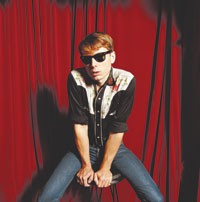
NEW YORK — Ray-Ban wants to rock the house with the relaunch of its original Wayfarer sunglass silhouette.
That’s rock, as in rock ‘n’ roll. The eyewear label, seeking to affirm its leadership in the category for a younger generation, is aiming to create buzz by focusing on its 70-year history, including its links to rock music, said Marcello Favagrossa, Ray-Ban’s brand director.
“When we began to look at how we wanted to strategically position the brand, we came to an easy and natural conclusion that in the history of our product we have a gold mine,” Favagrossa said. “So now what we are trying to do is dig out the gold nuggets. But the challenge behind promoting a history of a brand is how do you convey the message that it’s always modern? Then we began addressing the brand’s longtime association with rock ‘n’ roll, and we realized it would be a perfect thing to focus on. We wanted to stress the American DNA of the brand, but also let it be a bit rough around the edges.”
Ray-Ban, which was acquired by Luxottica Group in 1999, is staging a rock event Wednesday night at Irving Plaza here. It will bring together famed photographer Mick Rock, who will host an exhibit of his contemporary photos of musicians wearing the Wayfarer frame and classic images shot by others; Eagles of Death Metal, who will perform, and some 700 guests, many from the worlds of rock ‘n’ roll and young Hollywood.
Ray-Ban introduced the oversized boxy acetate shade called the Wayfarer in 1952 and it became an instant hit, Favagrossa said. But it took the waifish, doe-eyed Audrey Hepburn to bring the Wayfarer to another level. The actress paired the spectacle with her little black dress and pearls in her 1961 role as Holly Golightly in “Breakfast at Tiffany’s,” transforming the Wayfarer into an accessory legend.
During the Eighties, the Wayfarer had a renaissance, trickling into the mainstream after its starring role wardrobing Dan Aykroyd and John Belushi in “The Blues Brothers” (1980) and Tom Cruise in “Risky Business” (1983). It also secured a place in pop music. Madonna wore the frame in photographs, as did Blondie’s Deborah Harry, Elvis Costello, The Smiths’ Johnny Marr and members of U2, among others.
Related Articles
You May Also Like
“The Wayfarer was a huge success in the Sixties and all through the Eighties,” Favagrossa said. “In the mid-Nineties, many historians claimed it was the most widely sold sunglass in history.”
Although the popularity of the frame helped to raise the profile of the Ray-Ban brand worldwide — it came in as the fifth most recognized accessory brand in this year’s WWD 100, behind Liz Claiborne, Nine West, Gucci and Coach — meeting demand began to compromise overall quality.
“For so many decades Ray-Ban was fantastically managed,” said Fabio D’Angeloantonio, group marketing director of Luxottica, referring to Bausch & Lomb, Ray-Ban’s founder. “The iconography of the brand is closely linked with the movie industry, as well as the music industry. And that created a magic that has moved with the brand. But when we acquired it, the business results were not as healthy as the image and reputation.”
D’Angeloantonio attributed the slide to several factors: Bausch & Lomb’s move to concentrate on its growing lens business, an aggressive distribution strategy that led to Ray-Ban’s appearance in ill-fitting channels and its production being downgraded with multiple factories in Mexico, Ireland and China.
“We had no hesitation in having the chance to add the Ray-Ban brand to our portfolio,” D’Angeloantonio said. “In this category, which is strongly moving with fashion brands, Ray-Ban is undoubtedly the category captain. It’s a genuine brand for people who don’t want to be worn by a brand. They want to wear the brand to show who they are. But with any brand you manage, you have to ask, what is the brand? And the mistakes that were made in the past are ones we won’t make in the future.”
D’Angeloantonio said Luxottica has refined Ray-Ban’s distribution, as well as its manufacturing, moving it to its factories in Agordo, Italy. It also has reached into its past and is starting to pull out its iconic models for a new generation. Two years ago, capitalizing on a trend for aviator silhouettes, Ray-Ban relaunched its original design from the Forties, which now accounts for 20 percent of its sales, D’Angeloantonio said.
Ray-Ban also introduced an evolution of the Wayfarer, with a lighter weight and smaller shape that the brand expected would make it easier to wear.
“But on the con side, it lost much of its personality,” Favagrossa said.
The relaunch of the original Wayfarer design required a bit of industrial archaeology to get it right, he added.
“We had to find the hinges that were similar to those used on the original,” he explained. “No one was making them anymore, so we had to develop them.”
The company also had to re-create the logo on the temple, the proper slant of the lenses, the acetate used and the construction, which incorporates handmade steps. The only thing that is varied from its past are the colors offered. Ray-Ban is introducing white and red, in addition to the classic tortoise and black, to raise its appeal among women. More colors may follow.
The Ray-Ban Wayfarer will first roll out to Europe, beginning this month, with distribution in the U.S. to follow in January. It will be sold at retail chains like LensCrafters and Sunglass Hut, independent retailers and select department stores, many of which Favagrossa said haven’t carried the brand for years. It is expected to retail at more than double the original price at $129.95, with a version encasing polarized lenses for $179.95.
Favagrossa said that although he expects the relaunch of the Wayfarer to help the bottom line, business is not the primary objective behind the launch.
“It’s one event in a larger strategy to dust off the brand for a younger audience and rediscover its roots,” he explained, adding that similar events will follow in London and Tokyo.
D’Angeloantonio said Ray-Ban sells about 12 million pieces a year between its sunglasses and ophthalmics. It represents 13 to 14 percent of consolidated revenues for Luxottica, making it one of the most profitable brands for the firm, which also owns house brands Vogue, Persol, Arnette and REVO, as well as licenses to produce eyewear for Bulgari, Donna Karan, Prada and Versace, among others. Although he declined to reveal figures for the brand, industry estimates have put Ray-Ban’s total retail value at 1.4 billion euros, or $1.8 billion. D’Angeloantonio said he anticipated double-digit percentage sales increases for 2007.