
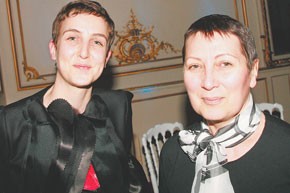
PARIS — With a sit-down dinner for 180 guests and disco dancing to music by 10 different DJs, Colette, the hip retailer here, feted a decade in business last week.
Actually, the 8,000-square-foot Rue Saint-Honoré shop has been celebrating quietly for several weeks in its own quirky manner, with myriad limited edition collaborations with brands from Cartier to Lacoste, an art exhibit by 10 curators and a one-off magazine that combines 10 different titles, from Self Service to Dazed & Confused, into one book.
As guests, including Yves Saint Laurent’s Stefano Pilati, pastry maestro Pierre Herme, Dior’s Victoire de Castellane and Azzaro’s Vanessa Seward, sat down to a supper of foie gras and sea bass at the Hotel Saint James & Albany, most offered praise for the store, which has been a landmark of retailing here for its blend of high and low fashion with cutting-edge design, books and a wide variety of other cool objects.
“It’s interracial,” Pilati said of the boutique, run by the soft-spoken style maven Sarah Lerfel and her mother Colette Roussaux. “It mixes everything in a very special way.”
Indeed, Colette, perhaps more than any other independent store opened in the last decade, has been an influential retail beacon, a measuring stick of cool for emerging and established brands alike, while in the process becoming a retail concept that would be replicated around the world.
The store opened at a propitious moment, just as luxury’s global rollout was hitting full stride. It offered an alternative voice for cookie-cutter shopping and even had its own cafe, dubbed a water bar since its menu offered hundreds of varieties of H2O.
With its throbbing music and unusual window displays (one was a pile of hundreds of Nike sneakers), the minimalist, white-walled store was likened to a nightclub. And it was often just as packed.
Given its high profile, and surging crowds that can rival a busy train station, Colette has been the subject of countless takeover and expansion rumors. Like many retailers, it struggled in the post-Sept. 11 period, laying off staff.
However, given the owners’ hands-on approach, often grooming the store into the wee hours, they have opted to concentrate on a single location.
Related Articles
You May Also Like
Though Lerfel declined to provide figures, she said business has been good, with fashion and accessories providing the bulk of sales, followed by books, gadgets and design, and the restaurant. Sources estimated Colette generated 15 million euros, or more than $19 million, in sales last year.
Over the past decade, the store has seen its share of change — even if offering whatever strikes Lerfel and her mother’s fancy remains the guiding principle.
“When we opened, a lot of brands didn’t understand what we wanted to do,” Lerfel said. “They wanted to wait a couple seasons to see if they liked our ideas. These days brands are more open to multibrand stores. They see them as a complement to their more traditional stores.”
In many ways, Colette has operated as a fashion magazine, editing collections into a personal choice and merchandising them according to themes. A Prada shirt, for instance, can wind up on the same rack as a jacket by Gareth Pugh, giving each a new cachet.
“What we’ve been interested in doing is expressing a way of life,” Lerfel said. “A view that is a bit different, and to show an accumulation of different domains that together express the modern moment.”
One of the main changes Lerfel has noticed recently is a move toward custom-made products and services.
“People want to feel privileged,” she said.
In that spirit, Colette just opened a fragrance bar dedicated to Le Labo, an exclusive brand which is brewing a special fragrance for Colette that will be ready in September.
Lerfel acknowledged limited editions have become so ubiquitous “it’s almost comical. When you turn on the TV you even see advertisements for limited edition cheese,” she quipped.
“But it still works,” she added. “It proves people want something different. We have to get them in the store. If they can’t get it online or elsewhere, they will come in. It creates traffic.”
As proof, she pointed to the success of the limited edition products created to mark the 10th anniversary, citing exceptional sales for items like a special bag from Goyard and Cartier to customized shirts from Charvet.
She said although luxury continued to thrive, it had to be the “right kind of luxury” since consumers are more and more sophisticated.
“There’s luxury and then there’s luxury,” she said with customary understatement. “Monograms, for instance, are less and less in demand — they’re really out. But still if they are treated differently, like with MCM’s new bags, they still work.”
However, Lerfel said the pool of young fashion talent, particularly in Paris, has dried up.
As for London, which has been cited as a hotbed for emerging designers, Lerfel said she remains skeptical whether those generating buzz will make it in today’s demanding retail landscape.
“In the past, we would buy a prototype of a young designer just to put it in the window,” she said. “We don’t do that anymore. The creativity needs to be backed up with a commercial reality.”
Lerfel pointed to Pugh, London’s showman of the moment, as one of the younger generation who not only has vision but also appears attuned to commercial needs.
Meanwhile, Lerfel said the high-low trend in fashion, with designers working for mass chains, remains a fresh counterpoint to expensive high fashion. Recently, the store sold out of the Proenza Schouler for Target line.
“It was phenomenal,” she said. “We didn’t expect it at all, because neither Target or Proenza Schouler is that well known in France.”
She said Colette would continue with like collaborations, the next being the Topshop and Kate Moss partnership, which Colette will start selling on May 2.
“We are guided by our own curiosity,” Lerfel said. “We follow our heart, are passionate and very sincere. Maybe that’s why people like coming to the store.”
They certainly poured into Paris nightclub La Scala to celebrate the store, with dolled-up youngsters crammed into every nook and cranny of the warren-like club, with girls spinning hula hoops or tugging on candy-floss, covered in Eighties’ smiley face stickers.
“We’ll be launching our line in Colette over the next month,” declared 23-year-old designer Anji Dinhvan, wearing her own neon pink stilettos and a hand-embroidered sweatshirt, matched with the night’s requisite oversized retro sunglasses.