
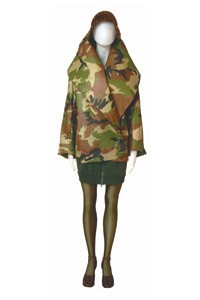
As the country gets more casual and gym rats get more fashionable, the lines between sportswear and activewear are blurring.
As sportswear companies enter the athletic arena and customers look to active companies to dress them outside the gym, athletic apparel companies are having to reexamine the balance of performance and fashion.
“It would be foolish to think that performance gear can’t be fashion-forward and that fashionable pieces can’t be functional,” said a Nike spokeswoman.
Paiva, a high-end women’s athletic store, began four months ago to fill what it perceived as a consumer need by offering stylish activewear options. According to Jeff Pofsky, Paiva’s vice president and general merchandise manager, Nike, Adidas, Fila, Puma and Under Armour are all making lines that smartly combine function and fashion.
“These companies are becoming much more savvy in the ways they are putting the lines together,” Pofsky said.
One way is enlisting big-name designers from the fashion world.
“There is no doubt we have pushed boundaries and created something that had not been out there,” said Heike Leibl, head of product for Adidas by Stella McCartney (for more on this collection, see story, this page). “It’s like a wave that starts somewhere and brings a lot of people into motion.”
Adidas by Stella McCartney launched in 2005 and has brought cachet and attention to the athletic company, while also influencing the way it thinks about fusing fashion and performance in its other lines, including the new Fuse and Adilibria. Adidas has three divisions: sports performance that includes the McCartney line, sports heritage and sports style, which includes Y-3, the sportswear collaboration with designer Yohji Yamamoto.
“Fashion and performance are not separate anymore,” Leibl said. “Our consumer does not have to compromise one for the other.”
Meanwhile, Adidas executives have said they want Reebok, which Adidas bought in January for $3.8 billion, to focus more on performance, saying the brand has been too centered on fashion fads in the past. Reebok is also promoting its relationship with the National Football League for an ad campaign. At the same time, Reebok is collaborating with actress Scarlett Johansson to create the “Scarlett [Hearts] Rbk” lifestyle fashion line, which is “about how Scarlett attaches to the brand, which affects not just her line,” Reebok chief executive officer Paul Harrington said in announcing the collection last month.
Related Articles
You May Also Like
“When we emphasize performance, it’s not at the expense of lifestyle,” Harrington said. “We feel we can play in both fields.”
Fashion-focused lines, particularly big-name collaborations like Adidas’ with McCartney and Reebok’s with Johansson, can have positive effects on the whole brand. At Everlast, the collaboration that introduced Norma Kamali Everlast this year “makes people look at our regular line a little differently,” said managing director Dion Hild.
“Everlast is moving toward being a lifestyle brand,” said a Norma Kamali Everlast spokeswoman. “It’s not just in the boxing ring anymore.”
The traditional Everlast activewear still puts performance first and finds its fashion in function. Everlast designer Stefanie Seitz uses performance details, such as mesh insets and iPod pockets, to create a modern aesthetic.
“If you are a fashionable woman, you should be able to look fashionable all the time in all of your activities,” Erin Isakov, owner and designer of Erin Snow, which entered the market as a fashion-focused ski line in fall 2003 and is adding a full ready-to-wear line this year. “Our point of view was fashion. The same jacket we sell to Paragon, we sell to Searle.”
“We know there is just as much psychology of speed that is as important as the science of speed,” said Sheree Waterson, president of Speedo. “Feeling your best is as important as the physical function.”
With its identity as a performance brand well established, Speedo has been focusing on its fashion reputation for the last few years. The company has introduced a line of activewear that includes corseted tops and has even given the traditional swim team suit a sexy back.
“We are unleashing the potential, bringing out attributes that already exist,” Waterson said. “Every detail, every line and every color has a purpose — it’s not fashion for fashion’s sake, it’s style for substance.”
Almost a quarter of Under Armour’s business is now women’s and the company thinks it could soon match men’s. Under Armour entered the women’s market in 2003, initially coming out with “smaller men’s stuff in men’s colors, which didn’t work because it was too utilitarian,” said Matt Powell, an analyst for SportsONESource Inc.
“In the last year, they have established themselves as an authentic women’s brand,” Powell said. “You cannot ignore the fact that it is always a fashion business and Under Armour has figured that out.”
Although 80 percent of women’s sales come from basic black and white pieces, the fashion elements extended the brand’s appeal, according to Bill Kraus, Under Armour’s senior vice president of marketing.
“There still is that core essence of the brand that existed in the first season, but we also found [our female customer] is probably looking for something a little more in fashion as it relates to the silhouettes and the colors,” Kraus said. “I still remember when we first started having conversations here about whether we should have pink product. It didn’t feel on-brand, but it’s amazing what it has done, even just as the lining of a garment. But performance is still our calling card.”
Sometimes lifestyle attention can feed athletic credibility, noted Powell.
“Puma is a terrific fashion athletic brand that is trading on a perceived, or rather remembered, authenticity,” he said. “Puma is going in the right direction after having established itself as a performance lifestyle brand.”
The bulk of Puma’s business is lifestyle, with performance and fashion on either extreme contributing smaller slices.
“The performance sport aspect gives us credibility and the fashion aspect gives us relevance,” said Barney Waters, the German brand’s vice president of marketing. “The performance gives us longevity and the fashion makes us relevant day by day.”
The company’s soccer cleats and its collaborations with Alexander McQueen are different beasts, Waters admitted.
“There is a lot more brand loyalty in performance — serious runners may stick with not only a brand, but also a specific model for 20 years,” he said. “In fashion, you are only as good as your last collection.”
Two-thirds of American women dedicate at least half of their closets to activewear, according to a July survey commissioned by Portland, Ore.-based lifestyle apparel company Lucy.
“Going forward, we will be putting much more emphasis on having a fashion point of view,” said Mike Edwards, Lucy president and ceo. “We are not walking away from performance, but we aren’t shouting it, either. This is a very radical shift from how the industry has focused on performance.”
Although half of Fila’s stockkeeping units are built for performance, 80 percent of its product sales come from the fashion lifestyle side.
“Even if you anchor yourself in performance, there’s more volume in sports lifestyle,” said Kristin Kohler, Fila general manager and vice president of global product. “That’s where the consumer is.”
But Fila maintains that no matter how many of its products are used outside the gym, it will focus on its performance DNA.
“The only point of difference we have compared with a Kenneth Cole or a Diesel or a DKNY, who are all making active sportswear, is that we are a performance sport brand,” Kohler said. “If you lose that, you really lose that point of view. There are signs that the low-profile look could be trending down. What does that mean for whole companies that have built their strength on that look and not on performance?”
Even small active companies must balance fashion and performance. Richard Cohen, who owns the active brand AMMA, is adding a more lifestyle-oriented collection this month to his performance lineup.
“There are only two ways to expand your business: through products or through paths of distribution,” Cohen said. “This line opens not only products, but also levels of stores we could sell to.”
Wearing activewear as sportswear can also save money.
“Our market has been taught to build a lot of value into our products because women don’t want to spend a lot to sweat, so we have learned to make everything very durable and at a very reasonable price point,” said Danskin ceo Carol Hochman.
Danskin compiles a catalogue of active items that could be worn as sportswear for contemporary stores, but is not entertaining thoughts of entering the sportswear business “because this is what we do,” Hochman added.
The dance apparel company is open to collaborations with designers. Hochman said she has been approached by several designers in the last year, and now is in serious talks with “a very well-known designer who is a very public supporter of Danskin.”
The shift may not be activewear incorporating fashion, but rather fashion incorporating activewear.
“Look at it by traditional definitions of what is fashion,” said Bob Meers, ceo of Lululemon, a maker of yogawear. “It is fashionable to be fit and to be involved in fitness. That is where the fashion is.”
Although the company has no plans to make sportswear, it does focus on making its activewear fashionable enough to wear as clothing.
“For an hour a day, our product is used for what it is designed for,” Meers said. “The one difficult thing to capture is the balance of someone’s day.”