
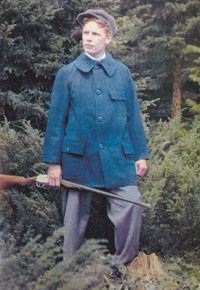
Leon Leonwood Bean turned an abbreviation of his name into a household brand.
The arcs and valleys of that 84-year-old business are recounted by one of Bean’s grandsons and the company’s chairman and former president, Leon Gorman, in “L.L. Bean: The Making of an American Icon” (Harvard Business School Press).
The title alone may conjure up images of thrifty residents and woodsy pursuits along with chinos, chamois shirts, Shetland sweaters, monogrammed tote bags and gum shoes (the latter are pictured on the book’s cover).
But Gorman doesn’t try to gloss over anything with his tell-it-like-it-is style of writing. How one man started a business with the classic Maine hunting shoe, a product the company still sells, is a story in itself. When 90 of the 100 first pairs sold were delivered with defects, he returned customers’ money, finessed the design and started over. How his grandson helped to make the company one that now sells 21,000 different items in its catalogues, Web site and stores is another feat.
To keep all those products moving out the door, L.L. Bean ramps up its workforce to more than 11,000 during the peak season and maintains a staff of 4,300 during the rest of the year. When the South Windsor, Conn., store bows in August, the company will have 10 stores in the U.S. and 15 in Japan, including three newly opened ones. Freeport, Me., is home to the flagship, a 160,000-square-foot, 24-hour, 365-days-a-year operation, as well as the brand’s only bike/ski store and hunt/fish store.
Aside from placing his company headquarters in Freeport, Bean literally put that shoe factory town on the map. When a turnpike and Route 1 were opened to alleviate Main Street’s clogged traffic — and bypass L.L. Bean’ store — the company’s namesake retaliated by putting a map in his catalogue that indicated drivers could save $1.05 and time by traveling right through Freeport.
In the 280-page book, Gorman details his own behind-the-scenes struggles to preserve L.L. Bean’s identity in the face of change. When he stepped aside in 2001, L.L. Bean’s sales were $1.2 billion with a return on equity of 18.5 percent. (Last year’s sales were $1.5 billion.)
Related Articles
You May Also Like
Gorman writes that the positive 2001 results were “largely due to Chris McCormick, our new chief executive, and his exceptional team of talented and committed senior managers — all of whom had spent their formative leadership years with the company.”
Learning the business from the stockroom to the boardroom is something Gorman experienced himself. He didn’t just keep an extensive card file of customers’ suggestions — even the one calling for a device that would allow a man to relieve himself without getting out of his sleeping bag — he responded to them. Not everyone welcomed change. Some still take issue with the green carpet that was placed on the salesroom’s threadbare hardwood floor in the Sixties. “To this day many people say nothing’s been the same since,” Gorman writes.
Colorful as the company’s ups and downs have been, Gorman has a more monochromatic view of the business. During an interview, he said he hoped readers would take away from his book “the importance values play in a business’ mission. I know from our experience that that, indeed, is the right way to go. That’s something we need to continue to emphasize without forgetting broader goals.”
Gorman’s philosophy is unmistakably tied to his grandfather’s mission of “selling good merchandise at a reasonable profit and [treating] your customers as human beings.” An avid outdoorsman, the company’s namesake frequently appeared in the company’s catalogue. He was sometimes shown holding a hunting rifle he knew how to use. A visionary of sorts, he embraced the importance of maintaining a healthy outdoors lifestyle long before it was in vogue to do so.
Above all, he aimed to deliver a superior product, respect people and maintain integrity, which the company continues to strive for, Gorman said. Bean was still working at the age of 94.
“L.L. really was the original lifestyle brand,” Gorman said. “He liked what he sold and sold what he liked. He felt that everyone should share in his belief of that lifestyle, as well. He had so much confidence in his own likes and dislikes. He was convinced other people would share them, too.”
Gorman’s path in the business wasn’t a foregone conclusion. Referring to the notion that “most men spend more time picking out a necktie than they do a career,” Gorman writes: ” I was part of that.”
In 1960, after three years as a line officer on destroyers in the U.S. Navy, he dropped by his alma mater, Bowdoin College, in Brunswick, Me., to get some career advice from the school’s placement director. The advice was simple: Talk to his grandfather about a full-time job. Until then, he was not excited about returning to the sleepy town of 5,000, “where big, arching elm trees still lined Main Street.”
Gorman did return and eventually rose up through the ranks of L.L. Bean, becoming president in 1967 after the death of his uncle, Carl. The local newspaper ran a 2-inch mention of the appointment, roughly comparable with what a baked bean supper announcement would get, Gorman noted. Jokes aside, his succession was in sync with the environmental movement that was gaining steam, as well as Americans’ interest in making the most of their leisure time. The brand’s 100 percent product guarantee helped the cause. Rapid growth followed to the tune of $30 million in sales, and Gorman realized the professional demands were more than he could handle himself, so he recruited professional managers from outside the company.
In 1976, L.L. Bean won a Coty award, and an 11-minute appearance on NBC’s “Today” show followed for Gorman. Asked how it felt to be “radical chic,” he replied that L.L. Bean had never been called “radical” to his knowledge, and he didn’t even know what “chic” meant. That statement got a chuckle out of the program’s host, Tom Brokaw, who knew Bean. Before long, CBS’s Dan Rather was off to Freeport for another look at the company’s functional and now fashionable apparel.
In the early Eighties, the success of two books, “L.L. Bean’s Guide to the Outdoors” and “L.L. Bean Games & Fish Cookbook,” helped ratchet up the awareness of the brand. “But in spite of all our efforts to remain who we were, consistent from year to year, L.L. Bean became fashionable, at least for a time,” Gorman writes. Sales went even higher when “The Official Preppy Handbook” featured L.L. Bean. But Gorman said that was also a time of “intense competition with other retailers, stores getting into catalogues, catalogue companies getting into retail and everyone getting into rugged outdoors apparel.”
Gorman pressed forward in the Nineties by extending product lines to add children’s apparel, home furnishings, more women’s performance-oriented apparel and other categories. That was also when he decided that the company should open stores beyond the Freeport flagship. Along the way, the retailer raised its profile by hosting seminars and training sessions, cross-country skiing, fly-tying, hunting safety, backpacking and a bevy of other activities.
“This is not a how-to-do-it book,” Gorman said. “People should read the book and draw from whatever conclusions they are connecting on. I’m not saying what L.L. did was the right way. I’m presenting a factual account of what he did do.”
He is equally candid about transitioning out of his own leadership role. “Presidential succession is always a tricky situation even with the best people and the best of intentions. I don’t know that there are many people who went from a pure novice to an entrepreneur to a professional manager to a strategist to an emeritus who lived to tell about it. I started out as a hands-on manager but became more inclusive and process-oriented, getting other people involved with the decision rather than making it myself.”
Like his grandfather, Gorman still practices what he pitches. “I wear L.L. Bean or use it every day, whether it’s a fly rod or a flannel shirt,” he said.