
LOS ANGELES — Denim doyen Adriano Goldschmied couldn’t stay away from the jeans business for long.
The designer, who sold out of his last brand in September, is back with a new line, called GoldSign, that intends to tap into what he described as “the new gold rush.”
“Every single town in America seems to have a store that can sell expensive goods,” Goldschmied said in an interview.
The comparison is apt, in that it was the California gold rush of the mid-19th century that first sparked demand for jeans.
After the boom in demand for premium and superpremium jeans during the past five years, Goldschmied’s latest venture offers high-end jeans and sportswear to complement them.
Goldschmied has been toiling in a loft space in the toy district of downtown L.A. since last fall, when he sold his stake in the AG Adriano Goldschmied line to Koos Mfg., which had licensed it for the past four years.
He said he decided to split from his former partners because he couldn’t stand not having complete control of his line’s presentation.
“A designer has to be able to articulate his vision to the customer, to the press, and control the brand image from the way people answer the phones,” he said, dressed in his trademark Levi’s jeans, Gap T-shirt and Adidas sneakers. “At Koos, I felt limited to only design, and I feel like I have a few more things to say.”
He also lamented that the line didn’t reach big-brand status like that enjoyed by Diesel, which he founded almost 30 years ago and later sold to Renzo Rosso, a former student of his whom he hired as a production manager. He said sales at AG last year hovered around $45 million — tiny compared with the $600 million-plus that Diesel now generates.
To make amends for what he calls a “lost opportunity,” he’s assembled GoldSign, the latest line incorporating the key syllable of his name. In the Eighties, he produced a brand called Goldie, and in the Nineties, launched A Gold E. His hope has been that “Gold” would communicate the value of his products.
Related Articles
You May Also Like
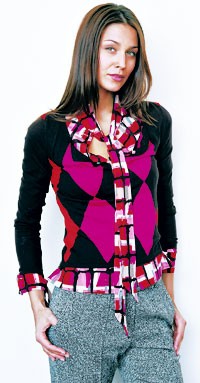
GoldSign covers a wide swath of luxurious sportswear — denim, trousers, woven tops, T-shirts, sweatshirts and leather.
“Luxury starts early in the morning and ends late at night,” he said.
While the line is broad, Goldschmied doesn’t plan to delve deeply into each category. For instance, he’s limiting himself to one leather jacket.
The collection reflects his forte in the apparel business: fabrics. He has been working with mills to develop the fabrics, using mostly Japanese denim, corduroy, velvet, chiffon and cotton twill. The long fibers in the cotton grown in the windy hills of Cameroon help give his knits a silky hand.
He plans to take his textiles to new heights with plans to purchase a local laundry, giving him more control over the whole operation.
“I can develop my own product in complete privacy and not risk my line looking like everyone else’s,” he said.
Jeans styles in the line include a boot leg, flare cut and skinny leg. The five-pocket rigid-denim “Passion” style is designed to mold to the body and features tailored stitching on the hips, angled horn bartacks on the pockets, printed pocket linings that have irreverent sayings such as “Nobody inspected this garment” and brass rivets with engraving.
His “slide button,” a snap with an internal teardrop shape, is intended to ease the fumbling factor in putting on a pair of jeans, particularly for someone with long nails.
The flare cut, called “Desire,” is geared for “feminine bodies,” while the skinny jean is named “Envy,” to elicit ill-will from others, and is designed for “great bodies,” but he realizes the market hasn’t opened up wide in the U.S. for the style.
“It’s a hard sell here,” he said. “Americans eat a lot of hamburgers.”
But Goldschmied said it’s important to position the line as a fashion leader and represent global trends. To further his mission, he’ll offer higher-end concept pieces — about 25 per season — such as a style of the bell-bottom jeans in thin denim and a futuristic pair of black jeans with no exposed stitching. There’s also a layered, organza skirt with a denim waistband.
His knits, featuring extralong sleeves, hems and waist-banding, incorporate yarns from denim, which give the surface of the garments a rippled tint.
Wholesale prices for the American-made line will average $75 to $100, and deliveries are set to begin July 30. He expects first-year sales to reach $10 million to $13 million.
Goldschmied tends to shy away from major marketing pushes, but said he hopes to win fans for the line among the Hollywood set.
Later this month, he also plans to roll out a men’s version of the line. Eventually, he’d like to open signature stores.
Retailers said they’re looking forward to seeing Goldschmied’s latest venture.
“He has a trademark and thumbprint that is visible on everything he touches,” said Thomas George, owner of E Street Denim. “Rather than follow the trends, he creates his product, then finds a fit for it in the market.”
Getting back in the denim saddle was always the plan for the 61-year-old Goldschmied, who doesn’t like practicing for retirement. He did allow for his first vacation in five years with his wife, Michela, at the luxury beachfront resort of Palmilla in Cabo San Lucas last November. But ever since, it’s been back to those 16-hour days.
“There’s so much to do,” he said.