
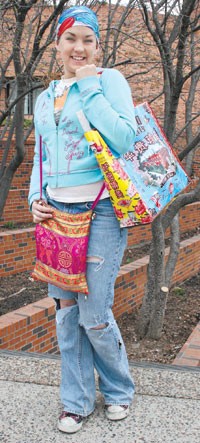
Spacious skies, amber waves, grazing cows. There are certain things one tends to associate with the Midwest, and fashion is not one of them. Even among the college set, mentions of such homegrown talent as Indiana’s Bill Blass, Michigan’s Anna Sui and Illinois’ and Wisconsin’s Mark Badgley and James Mischka, respectively, are few.
Nevertheless, for this year’s college issue, WWD set its sights on the Heartland, specifically the Big 10, whose member universities, save Penn State, are all located on Midwestern grounds. Compared with last year’s East Coast-centric roundup of the Ivy League, this athletic conference proved a different breed.
“There’s no question that people are very laid-back in the Midwest,” a student from top-ranked University of Michigan-Ann Arbor says. Another, a Los Angeles native attending the University of Wisconsin-Madison, adds, “In my opinion, people in the Midwest place less value on materialism, and so their style of dress is affected accordingly.” Even Midwesterners themselves reiterate the stereotype of a population less designer-hungry than its coastal counterparts. “We’re very fashion-tardy,” explains one student, while others put time frames — four months, six months — on how long it takes a trend to travel from more overtly fashion-conscious locales. One senior, Lindsey Anderson of Michigan State, recalls refusing to walk into the Rodeo Drive Dior store while visiting California with friends. “I knew I couldn’t afford it, they knew, so why bother?” she reasons.
The consensus? We found that, while students in the Heartland engaged enthusiastically in conversation about fashion, by and large, it’s not a major concern of theirs — or at least not fashion with a capital F. Rather, these undergraduates are interested in appearance and in looking good, but are not necessarily fashion-y. Inevitably, weather- and budget-induced pragmatism drives their day-to-day style, and many predict that, even as their buying power increases after college, practicality will continue to inform their fashion choices.
That said, we found pockets of fascination with fashion, where middle-America was anything but middle of the road. In fact, students at these 11 schools run the gamut from label junkies and design DIYers to those who just plain love to dress up.
Related Articles
You May Also Like
Senior Christophe Tedjasukmana of the University of Michigan, for example, hails from an in-state town of 1,927 and counts among his closet goods Dries Van Noten and vintage Versace as well as a $1.30 gold-chained top from discount store Value World. And don’t get him started on Cathy Horyn, fashion critic for The New York Times; this undergrad can quote her online reviews almost verbatim.
At the University of Illinois Urbana-Champaign, there’s senior Flikk (née William Thornton), resident campus couturier, who, with little more than scissors, shoestrings and spray paint, turns local sport shop sweats into deconstructed chic.
Then there are Michigan State seniors Dennis Grant and Byron McGhee, who three years ago started their own urban men’s wear line, Shióne, out of their dorm rooms. They’ve already managed to score screen time for their logo T-shirts on singer JoJo’s “Not That Kind of Girl” video.
And let’s not forget Indiana University freshman Rebecca Savoie, who, when asked about her daytime look of a black strapless tube dress, vintage Gucci bag, turquoise-drop earrings and Pucci-esque scarf, said, “Well, I have French class today.”
But let’s get real: collegiate fashion in general revolves around comfort and practicality, and certainly that holds true within the Big 10. Picture your average student and, more often than not, you’ll conjure up an image of someone wearing jeans and school sweats. “People are here all day for classes, they’re tired, they’re going to have to carry a big book bag full of books. They don’t want to wear something that’s high maintenance,” says Ohio State junior Sarah Gold. Asked to describe the typical look at their universities, many students drew a blank, then responded with the sweats-and-jeans combo, almost unanimously. The only difference was the school colors. “Every Big 10 school wears their sweatshirts,” explains Michigan State freshman Kristi Joy Jourdan. “It’s everywhere, it’s easy to get and it’s pretty cheap.” And on the plus side, at a university where athletics are integral, donning the typical sweatshirt is also a sign of school spirit.
Then there’s also the harsh Midwest weather students must face. “We have to dress based on the elements,” Jourdan says. “I don’t think we have a choice.” Old Man Winter, after all, is certainly a force to be reckoned with. Says University of Minnesota senior Molly Kentala: “If you have a [class] presentation and wear mascara, your eyelashes freeze.”
It’s no wonder, then, that the most popular garment among college kids is a fleece jacket— comfy, practical and warm. But, interestingly enough, not just any parka: The North Face was cited time and again as the most trendy item on campus. Columbia, EMS and Moosejaw were named favorites, as well, but only North Face held the kind of regard typically reserved for a must-have fashion item. Native New Yorker Sara Rapoport, a senior at Michigan, tells a story of how, before she arrived in Ann Arbor, she didn’t know what North Face was. “ I had no idea,” she says. “Then I came here and it was a fashion 180. I told my mom, ‘You go to Michigan, you have to have a North Face.’“
“It’s expensive, so people think it’s better,” Rapoport continues. “They buy it and then everyone has it, so you want it, too.” Even more telling of the North Face phenomenon is the fact that, as several undergraduates pointed out, you can actually buy counterfeits. “It’s only for the label,” says senior Kaitlyn Andrews-Rice of Penn State. “[The copy] is not good enough of a jacket, so it defeats the purpose. But it has the label.”
But even if the weather’s not on the students’ side, forcing them to scurry across campus bundled in a mass of jackets, sweats and knits, the university and local community are there to ensure that fashion doesn’t always take a backseat to practicality. Indeed, many of these Heartland institutions house apparel, textile and merchandising programs. Indiana University, Bill Blass’ alma mater, was the stage for the first retrospective of the designer’s work, and he gave a $1 million endowment to its apparel merchandising program. Ohio State University has the Wexner Center for the Arts, where a student can buy hand-crafted jewelry from Ohio artists Laurana Wong and Brooke Medlin at the bookstore, then turn the corner and catch Bruce Weber’s film, “A Letter to True.” And, yes, that’s Wexner as in Leslie H. Wexner, chairman and executive officer of Limited Brands, and an OSU alum.
As for the retail scene, there were offerings for every type of fashion somebody. Michigan State students shop at local malls that have favorites American Eagle, Marshall Field’s, Express and Abercrombie & Fitch. But there was vintage Lanvin and Lacroix to be had, too, courtesy of vintage store Scavenger Hunt.
Farther south, at the University of Michigan, there’s a good mix of earthy, sweatshop-free apparel (The Planet), hipper goods such as handmade record purses and lamps made from corsets (Henrietta Fahrenheit) and sorority-worthy fare (Y.C.I., Poshh and Bivouac).
The University of Iowa boasts boutiques that stock Citizens of Humanity and James Perse to Milly, Rozae Nichols, Ulla Johnson and Delman, to name a few. And interestingly enough, there’s an Urban Outfitters at seven of the 11 Big 10 schools. “Urban Outfitters changed my style,” says one MSU student. “I started going to Urban because it’s not something you would see in malls,” she says, although she notes that she no longer shops there. “It was just a doorway,” she says of her now more adventurous wardrobe.
Not all Big 10 denizens have backyard access to fashionable retailers, however. The students at Purdue University copped to an anemic shopping scene in West Lafayette, Ind., but with few regrets. Regarding the lack of mass retailers, senior Natalie Miller says: “No, we don’t have a Banana Republic here. I don’t think this town could support one. The price points are just too high.”
Such restrictions, however, took a backseat to student initiative in WWD’s rankings. “If I go to class in sweats one day and the girl next to me has a cute skirt and a pair of heels on, I just feel awful,” University of Iowa junior Kelly Rehan says. “So the next day, I’ll take a little more care when I’m getting dressed.”
Or take, for instance, sophomore Kate Pittel, a nursing student-cum-handbag designer at the University of Michigan. She couldn’t afford the handbags she saw in stores, so with a little sewing know-how, she began to re-create them. Soon enough, she figured, “Well, if I can make these bags, why can’t I design my own?” which led to her Insomnia collection, now available at local stores.
Sheila Pogemiller’s boutique near the University of Iowa, in turn, supports a handful of student designers, such as Jonathan Nelson and Copycat Couture’s Sarah Jane Laue. “I’ve been really impressed,” Pogemiller says. “Their quality keeps going up.”
There’s even a bevy of student organizations dedicated to, what else, fashion. Ohio State’s Fashion Guild takes annual trips to New York to visit companies such as Hugo Boss and Kate Spade. Its first project this year was an in-dorm presentation called “How To Be Fashionable When You Don’t Have The Money.” At Illinois, a group of style-conscious Illini recently inaugurated the Fashion Club, which, for its first official event, offered snarky fashion advice to students one January afternoon. This, at a school where senior Afenya Pongo, a consumer and textiles marketing major, admits, “We’re in the middle of fields, so it’s hard for us.”
So what was the winning formula for the Big 10’s most fashionable school? If WWD were measuring by the simplest of scales, the frequency of designer labels, Penn State would have neared the top. But, as senior Elizabeth Adams says of the popped-collar, Vera-Bradley toting denizens at her school, “It’s a trendy school, but I wouldn’t call it fashionable. [Real] fashion is reflecting your personality.”
And our number-one pick, the University of Michigan, had that in spades. The school seems to offer as many style camps as majors, from the Juicy-and-Seven set to hippie, granola types to hipsters.
Moreover, Midwestern students won’t let a lack of funds hinder their quest for chic-dom; in fact, it’s quite the opposite. “Anyone can buy designers,” says Iowa senior Alissa Van Winkle. “I think being a broke college student has made me more creative.”
Other WWD THE COLLEGE ISSUE articles
Students of Style
Beauty Trial
Going Underground
Runway 101
Math Course
Operation Girl Shop
Students of Style: Extreme Makeover … Women’s Studies … Rushin’ Dressing
Closet Cases