
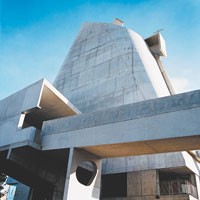
Great architecture often delivers a miraculous feeling. Yet history offers few structures with a destiny as improbable as Le Corbusier’s Saint Peter’s church in Firminy-Vert, in southeastern France.
When the great Swiss modernist drowned swimming off the coast of southern France in 1965, the church existed only on paper, the ethereal linchpin of an ambitious project to give a former mining town some artistic juice. But now, more than 40 years later, Lazarus is rising.
Thanks to a cadre of determined civil servants and the Franco-American architect Jose Oubrerie — one of Le Corbusier’s protégés who in the Sixties worked with the master on the original project — Firminy-Vert inaugurated the building, which some have likened to a pagan temple, in the last week of November. Oubrerie, now a professor at Ohio State University, calls the church’s hyperbolic concrete cone and winding suite of rooms a “final point [in Le Corbusier’s oeuvre] and an overture” to the future.
“The conjunction of the shell and the warped floor put it at the level of today’s [architectural] speculations,” explained Oubrerie. “The warped, continuous surface of the floor was designed in 1961, long before many others. Frank Lloyd Wright’s Guggenheim [in Manhattan] was a linear ramp. This in Firminy-Vert is the total area of the floor. Spectacular!”
The project’s roots stretch to the Fifties, when Firminy-Vert’s progressive mayor, Eugene Claudius Petit, invited Le Corbusier to create a complex of four buildings: a cultural center, a stadium, a housing block and a church. (Firminy-Vert today has the largest concentration of Corbusier buildings after India.)
Yet only one, the House of Youth and Culture, a thin concrete-and-glass slab with a slanted exterior, was completed before his death. Eventually, the stadium and the massive concrete housing block were finished, opening the door to more housing projects in the immediate vicinity. The success of these in imitating the master depends on one’s point of view.
But the church, which always seemed the exclamation point of transcendence for the larger urban project, proved pricklier, not the least because the project depended on funding from a cash-strapped diocese not completely convinced of its utility. Besides, in the secular nation of France, the government cannot pay for a building of worship. (Since the church is being finished with public funding, it will be used as an exhibition space, not for religious congregation.)
Related Articles
You May Also Like
Construction finally started in 1971, but in a few years funds had run dry, the contractor had gone broke and the project was left but for a bunkerlike concrete base. Pilgrims over the years visited, and the church took on mythical proportions. But it remained little more than a relic of a broken promise.
“I even studied this church in school,” said Yves Perret, an architect on Oubrerie’s team, during a visit to the site. “In the history of 20th-century architecture, it’s tremendously important. It tackled the question of verticality. The way it works with space is absolutely seminal.”
Throughout the Eighties and Nineties, multiple attempts to revive the building came to naught. When the church was threatened with destruction, a group of loyalists successfully rallied to get it classified as a national monument by the French government.
Then, four years ago, Oubrerie, who has held the intellectual rights to the design since the Seventies, finally achieved the seemingly unfeasible: He got a construction permit accepted and, in November 2003, with funds lined up from regional authorities, building resumed.
The results are stunning, a tribute to Corbusier’s innovation and genius as well as Oubrerie’s intimate understanding of and deep affinity with his work. The church sits on an elevated mound, with a bare concrete façade facing the street. The full scale of the concrete dome comes into view only when one approaches from the side. The building is complex, with a long ramp that turns back onto itself to access the sanctuary.
Entering from the ground floor, one meanders through a series of off-kilter rooms — it’s called “the priest’s path” — that ascend to the chapel, where the 75-foot-high dome, with its sloping concrete ceiling, seems suspended by magic.
Three dramatic openings — a square, a rectangle and a circle — are painted in bright primary colors to intensify the impression of light streaming in from above. Behind the altar, the wall has been perforated with circular apertures meant to form the constellation of Orion, though a technical mistake means the stars have been inverted.
Some purists have questioned the building’s authorship. After all, Le Corbusier, who only built two other churches in his career — the curving chapel at Ronchamp in 1955 and the monumental La Tourette monastery in concrete five years later — never produced final plans for Saint Peter’s. Scores of details were left for Oubrerie to decide. Such concerns leave Oubrerie and his team unfazed, however.
“We never asked ourselves what Corbu would have done when we were faced with a decision,” said Aline Duverger, another of the architects on Oubrerie’s team. “Jose took a pragmatic approach. This is an evocative building. What’s important is that it exist.”