
NEW YORK — Celebrities are the thread tying together American pop culture and, as such, provide a platform for fashion marketers that should keep gaining ground at least until the turn of the decade.
That’s largely because the fragmentation of media has all but eliminated Americans’ once universal experience of taking in events through three major TV networks and a handful of major print outlets.
“A mere generation ago you had the ‘Tonight’ show, a couple of gossip magazines and that was it,” said Robert J. Thompson, trustee professor of TV and popular culture at Syracuse University. “Now there are dozens of shows, like ‘Access Hollywood’ and ‘Entertainment Tonight,’ and an enormous publishing empire. Today, celebrities themselves are the remaining glue. This is hard to harness for advertisers.
“One of the only effective ways to do this,” Thompson added, “is to sign a celebrity to endorse fashion.”
The public’s desire to own a piece of celebrity style dovetails with the craving of many people for more authenticity in their lives, as entertainers are known partly for the way they appear and are often seen as ideals. So, the fashion products celebrities promote could be viewed as something other than items merely endorsed by high-profile people serving as shills, marketing experts said.
The ongoing explosion of media devoted to chronicling celebrity lifestyles — notwithstanding the public’s saturation point — is elevating the equity of the rich and famous in popular culture, Thompson explained. It ranges from heightened coverage in a new generation of magazines, such as In Touch, Life & Style Weekly, and Wenner Media’s untitled new weekly to bow next summer, to reality TV takes on Tommy Hilfiger, Donald Trump, and soon, Martha Stewart. In addition, the advent of digital media and technology — Internet-enabled cell phones and Blackberrys, and other gadgets — provide instant access to the latest news of the stars and an equally quick means by which to share it.
This marks a reversal of the slower, more controlled, star factory approach of Hollywood in the Thirties and Forties, and entertainment media in the Fifties and Sixties that were less intrusive in celebrities’ personal lives. Today, by comparison, even a walk in the park or trip to the store is standard fare for the paparazzi and gossip pages.
Related Articles
You May Also Like
“Marketing leverages what’s going on in society — and we live in a society that is celebrity obsessed,” said Alan Siegel, chairman and chief executive officer of Siegel & Gale, a strategic branding consultant whose clients have included Polo Ralph Lauren, A|X Armani Exchange, Liz Claiborne and Revlon.
Using the images and voices of entertainers has become more resonant in a world where the consumer likes to connect with celebrities, said brand consultant Michael Watras.
“There’s a fantasy — we almost want to live their lives,” he added.
Part of that fantasy involves wanting to have more, including the possessions and lifestyles of pop culture personalities. And celebrities themselves are more willing to participate in the economy’s marketing machine.
“It’s seen as more legitimate; people expect it’s going to happen” said Robert Passikoff, president of marketing consultant Brand Keys.
The rub is that, much like fashion itself, celebrities quickly move in and out of style.
“With celebrities you’ve got to make a quick killing,” Thompson said. “They peak for a season or two and fade quickly, with few exceptions like Paul Newman and Robert Redford.” In that sense, he said, “Fashion and celebrities are a match made in heaven.”
Kenneth Hirst, president and creative director of Hirst Pacific Ltd., whose firm has designed the bottles for the Jennifer Lopez and Celine Dion fragrances, said: “There are probably only a handful of stars who could carry off a sustained effort to market a particular brand or their own [self-named] venture.”
Perhaps that explains why only $1.6 billion, or 2 percent, of the $95 billion-worth of women’s apparel sold in the U.S. is marketed under a celebrity’s name, according to NPD Fashionworld. And despite the ever-expanding universe of star driven enterprise, from P. Diddy’s plans to offer Sean John women’s apparel and fragrance, to Donald Trump’s entree into men’s wear, the longest-running celebrity names can sometimes perform best. Case in point: Kmart’s proprietary Jaclyn Smith label, which remains the country’s leading women’s celebrity fashion brand, NPD Fashionworld has found.
Nonetheless, hot celebrities can bring ready-made images to marketers who would otherwise spend years forging a distinctive identity. “Celebrity-marketed brands can become almost an overnight success,” Hirst said. “Designers like Marc Jacobs and Michael Kors spent years to create an identity.” For instance, Hirst said, Paris Hilton quickly moved from the notoriety of a “naughty video” to a personality associated with the Guess brand. “Who would have thought?” he said.
It can be tough to determine how much of a brand’s sales and profit are due to a celebrity marketing effort, but when such a brand is flourishing, the chances are the campaign has made some impact.
Tag Heuer found success with its first endorser, Tiger Woods, which led brand executives to add Uma Thurman, Maria Sharapova and NASCAR star Jeff Gordon to its marketing roster this year. The Tag Heuer watch endorsed by Woods became the brand’s second-best-selling chronograph in 2003, while the $4,000, diamond-dial style hawked by Thurman has moved into the top 15 sellers in six months, said Daniel Lalonde, president and chief executive officer of LVMH Watch and Jewelry North America. The Tag Heuer brand offers 250 watches.
With the campaign that began in February, virtually all of Tag Heuer’s marketing is celebrity-driven. Endorsements by Gordon command about 27 percent of the brand’s media budget; Sharapova and Woods, 25 percent each, and Thurman, around 23 percent. Tag Heuer marketing last year skewed heavily to men’s products, a segment in which 70 percent of the budget was devoted to products getting the nod from Woods.
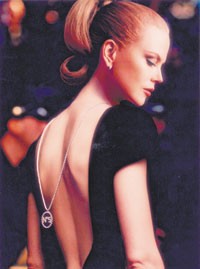
Then there’s the spike in demand for Chanel No.5 that came after a multimedia campaign featuring Nicole Kidman and Rodrigo Santoro. Sales of the fragrance in December 2004 surged 30 percent, following the TV and print ads that began in October and was treated like “the global premiere of a movie,” said Lyle Saunders, vice president of creative services at Chanel Inc. Anecdotal reports from the Chanel sales counter, Web site and toll-free phone number suggest the campaign featuring 38-year-old Kidman, written, directed, and produced by “Moulin Rouge” director Baz Luhrmann — with costumes by Karl Lagerfeld — appears to have drawn some younger customers, including teens, to the brand, Saunders said.
“I think young women find Nicole Kidman an aspirational figure,” Saunders said. “She survived a very public divorce and her career leaped forward after that.”
The next wave of the Kidman campaign for Chanel No.5, part of a three-year deal with the actress, is to resume with new print ads in October and a reprise of last year’s TV spots in November.
Despite such successes, the use of a favored entertainer as a marketing persona does not guarantee results. Some of the highest-profile celebrity endorsers have elicited polarized responses from marketing experts, who viewed them either as especially effective, or past their prime.
It is hard to pinpoint when the appeal of even successful endorsers such as Woods, Lopez, and Kidman will tail off. Currently, Woods is associated with numerous brands, including fashion players Nike and Tag Heuer; Kidman’s style has been widely exposed on the red carpet as well as in highly publicized celebrity gossip takes, and Lopez’s public franchise has extended from apparel, accessories, and fragrance to ads for Louis Vuitton and, this fall, shop-in-shops showcasing JLo lifestyle products in department stores.
Others questioned how well some of the most visible entertainers have complemented recent fashion campaigns, including Versace’s use of Madonna, whose continuing reinvention could be seen as an indistinct image for the brand, and Gap’s selection of Sarah Jessica Parker as its first spokesperson (since succeeded by Joss Stone and eight other musical artists) as she is readily associated with the designer labels she flaunted on “Sex and the City,” notably Prada and Manolo Blahnik.
Until marketers find a more effective way to differentiate brands the celebrity juggernaut is likely to continue — even though, as Passikoff pointed out, “there are more failures than tremendous successes, as most brands that are celebrity based have very short lives.”
Helping to maintain the momentum, marketing experts said, will be fashion’s move from the fringe of pop culture, closer to the center of the action. “One of the biggest shifts is the democratization of style,” said Raul Martinez, chief executive officer of ad agency AR. “Fashion is no longer seen as elitist. Since high society no longer holds our interest like it did in the Fifties and Sixties, people are more inclined to turn to Hollywood for that drama.”
Many expect the celebrity marketing craze to stay hot for at least five more years. That said, it could quickly move into eye-rolling territory for those who have seen one too many stars apparently too ready to embrace a new product. “We are quickly approaching saturation in both broadcast and print ads, and celebrities are marketing themselves,” maintained Mike Cucka, partner in Group 1066, a product and marketing consultancy. “The question becomes who’s pursuing whom?”