
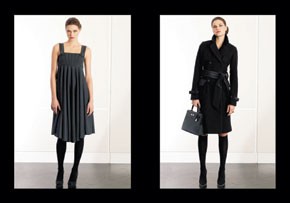
There is no shortage of ready-to-wear labels, but that hasn’t deterred four designers from forging ahead to try to stake their claim. With the exception of Alexander Julian, who is the only veteran in the group and is launching a women’s outerwear collection this fall, they are all newcomers who followed somewhat roundabout routes to fashion. Here’s a look at how Stelle’s Barbara Baldieri-March, Kozomara’s Zorana Kozomara and Nima’s Nima Taherzadeh got their starts.
STELLE
If “How I Became a Designer” were an actual contest, Barbara Baldieri-March might have the grand prize locked up. The Roman-born newcomer had careers in modeling, music and acting before she decided to give fashion a try.
Her latest act is Stelle, a collection that is a cross between ready-to-wear and what the company describes as luxury sportswear. More than anything, the 47-piece all-jersey line is designed to make women looked pulled together with minimal effort. A $450 trenchcoat, a $112 button-down shirt and $133 pants (at wholesale) are expected to be bestsellers when Stelle launches in high-end specialty stores and select department stores this fall. The name means “stars” in Italian and “everyone is a star in their own life.” Baldieri-March said.
Her own starlit career started by chance, when one of entertainer Luca Sardella’s back-up singers fell ill at Malindi, a Rome club owned by Baldieri-March’s parents. At the age of 12, she persuaded Sardella to let her step in and he was so impressed that he took her along on the road. A few years later, in between modeling jobs for Jean Paul Gaultier and Italian Vogue, she continued to perform and eventually went out on her own. Her first single, “Todo lo que quiero,” helped to create a European following, and she released her debut album in 2003.
But Baldieri-March often found herself either glammed up to perform or totally dressed down to relax. “People would come up to me and say [disappointedly], ‘Oh, you’re Barbara?’ They wouldn’t recognize me.” she said. “I thought ‘Why can’t women look great all the time?'”
So she said she decided to design a line that was “comfortable, sexy, classy and appropriate for day-into-night. It doesn’t wrinkle so you can wear it on a plane with a pair of flats and then put on your little heels once you land. You could even jog in this stuff if you had to.”
Related Articles
You May Also Like
This month Alexandra Richards, a fan of the label, was host at a Stelle party and preview at Thom Bar in New York and took her mother, former model Patti Hansen. While Baldieri-March, a married mother of three, divides her time between Malibu and Manhattan, and is looking for a New York sales rep. First-year projected wholesale volume is $500,000, she said.
“When you’re beginning, you have to be careful,” Baldieri-March said. “This business is not forgiving. You want to make sure the product is right and the deliveries are on time. I thought singing was so time consuming — fashion is even more time consuming.”
Nima
It’s not often that a venerable store picks a collection straight from fashion school and places it among its established designer labels, but that’s just what happened to Nima, the new label by 25-year-old Nima Taherzadeh.
The Tehran, Iran, native moved to the U.S. in 2000 to study interior design at Santa Monica College before transferring to Parsons The New School for Design in 2001. His graduation collection earned him the school’s Golden Thimble award, and caught the attention of Saks Fifth Avenue, which launched the line at its Manhattan flagship this spring. At Saks, Nima is located on the store’s second floor, which is also home to Ralph Lauren, Donna Karan, MaxMara, Giorgio Armani, Peter Som and Richard Chai.
Taherzadeh said he aims to make clothes that are “strong, simple, modern and effortless” with Nima, which means half-moon in Farsi. “In today’s fast-paced environment, we constantly search for ways to make things easier,” he said. “Easy skirts with cotton shirts are great for women who wake up in the morning and are on the go.”
Where most young designers opt for a contemporary, urban philosophy, Nima, which is manufactured in New York, has a distinct dressy feel, and fall’s 27-piece lineup includes shift cocktail dresses, cotton shirts and jersey separates and details like brushed gold-tone buttons. “My shapes are very easy and forgiving,” he said. “I design for different customers, with different bodies. The things are designed to be easy on her in terms of fit.”
The collection wholesales from about $300 to $350 for dresses, $100 to $120 for shirts and $350 to $380 for coats. This year, Taherzadeh’s goal is to reach a wholesale volume of $200,000, with sales in about eight to 10 specialty stores nationwide. “As I expand the scale of the business, I would also like to break into Asian and European business,” he said of future plans. “But I believe in taking small but strong steps. My goal is to build a brand with a strong foundation and a loyal client base.”
ALEXANDER JULIAN
After exiting the U.S. women’s market in the Eighties, five-time Coty award winner Alexander Julian is back with a new women’s outerwear collection.
Through a licensing deal with Gordon & Ferguson, Julian has developed a three-pronged collection — the upscale Private Reserve, the city-minded American Modern and the spirited Colours. The designer, who has continued to work in men’s wear, textiles and home design, said he didn’t need to look far for inspiration.
“My wife and three daughters” provided the impetus, Julian said. In addition, the response to the signature jackets and coats he has been selling in Japan for the past couple of years encouraged him to pursue a domestic business. “I wanted to give this a try,” Julian said.
Widely known for the textiles he designs for his men’s wear and home collections, Julian worked with mills in Italy and Scotland to develop the women’s outerwear fabrics. A laser-printed paisley was plucked from a necktie print, which was extrapolated from the uniforms he once designed for the University of North Carolina women’s basketball team, he said.
Multidisciplined, Julian created pieces for retired race-car driver Mario Andretti and Dennis Connor’s yacht-racing crew to compete in.
The new washed-lamb motorcycle jacket is a variation of something offered in his men’s collection. “It absolutely weighs like a feather,” Julian said, adding that the wearer can move easily while still feeling sexy and feminine.
Among the more unusual pieces are a distressed stretch suede coat and a velvet nonrepeat paisley printed equestrian jacket from Private Reserve; a Jackie O-inspired enzyme-washed denim coat in a zebra-weave with bracelet sleeves and a metallic slim-cut quilted nylon car coat from American Modern, and a washed-lamb hooded blazer in Colours. Wholesale prices range from $100 to $1,600, and 75 to 100 stores are expected to carry the line this fall. The label is being shown at the Gordon & Ferguson showroom at 58 West 40th Street in Manhattan. First-year projected wholesale volume is $3 million to $5 million, Julian said.
The designer said he has already worked with his mills on a full women’s apparel collection, though no launch date has been set. “Any place you can put color and patterns — I want to be there,” Julian said. “If it’s not next season, it’s going to be soon.”
Kozomara
“Accessible clothing” is how Sarajevo native Zorana Kozomara describes the design philosophy behind her label Kozomara. Launched last spring, the collection consists of elegant suits, coats and dresses using fabrics such as silk, silk chiffon and cashmere and detail touches like lace or double satin linings.
Kozomara’s background is eclectic and seeps into her work. The designer left Sarajevo for Hong Kong at 14 and spent four years there, before returning home only to leave again within a year because war broke out in the region. She moved to France to earn a degree in art history and finance, then studied fashion design in Canada before starting her own line. Today, she is based in Amsterdam and Paris, where the collection is manufactured. She targets the “conscious, elegant working woman,” and for fall, top items include an alpaca and cashmere bell-sleeved coat with embroidered lining for $600 wholesale, a cotton and silk suit for $700 and knit dresses for $400.
“In fashion, everyone tries to be so different that everyone ends up looking the same,” she said. “Fashion today seems to understand only itself — it is there for socialites and nouveaux riches. The rest is a big void that only a couple fulfill, [such as] the likes of MaxMara. This is where we really saw our chance. So initially it was really about creating beautiful things, mainly for the kind of people who worked with me — beautiful, elegant, wearable clothing, and feminine above all.”
Since its launch, the collection has been picked up by stores such as Vivaldi in New York, Saks Jandel in Washington, David Lawrence in Seattle and La Donna in La Jolla, Calif.
Wholesale prices are about $600 for coats, $250 for pants, $250 for skirts, $220 for blouses, $700 for suits and $400 for dresses. Kozomara anticipates wholesale sales of $500,000 in the U.S. this year.
Next up? A new, more casual collection called Fashion Party, which she hopes to launch this fall. Each season will be tied to a current issue, with a portion of sales going to a pertinent cause. “It will also be a platform for discussion on issues such as the meaning of democracy or global warming,” she said. “We will try to engage our customers in a dialogue on issues that really matter. We are hoping to reach a woman who cares.”