
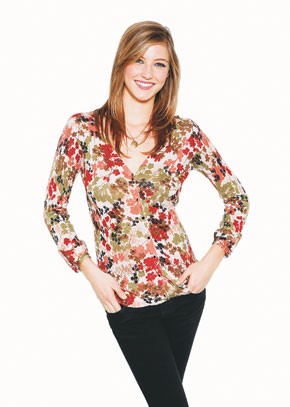
Vendors are reaching out to an older customer by addressing the ambiguity between contemporary and misses’, launching new divisions or fine-tuning existing ones and trying not to alienate a customer base that’s intimidated by too-trendy designs and true contemporary fits. Meanwhile, companies are relying heavily on item-based pieces and reorders, citing buyers’ reluctance to shop too far ahead in such a fickle market.
“The older customer who’s thirtysomething is becoming more contemporary,” said Lani Karls, creative director for Vancouver-based Mac & Jac and its divisions, Kenzie and Kenziegirl. “Before, we kind of left her to go off into the missy world. That’s a whole new market that everyone is addressing.”
The 15-year-old line that sells to about 950 doors, including Macy’s and Dillard’s, is incorporating styles from its contemporary division, Kenzie, into its own offerings that, Karls said, aren’t as item driven. High-waisted pants and slim pencil skirts that sell well for Kenzie are done in stretch fabrics, and a swingy jacket for day-to-evening wears better for a more mature customer than a fitted blazer,
according to Karls.
She is still unsure if the high-waisted bottom trend will catch on, but says she isn’t afraid to try new things, as long as they’re wearable.
“I don’t think people will sacrifice comfort for fashion,” Karls said. “The bubble [shape in skirts and dresses] was iffy, but with newer fabrics like jersey, it has hung on. We’ll always try something new.”
Because of the shift in target customer, changes in distribution are now on the horizon, said Karls, adding that department stores had been slow to address the “white space” between misses’ and contemporary. The Mac & Jac, Kenzie and Kenziegirl divisions are all beefing up advertising — launching four-page and some eight-page print campaigns — to make sure consumers are familiar with and able to differentiate among the three brands.
“You see the brand identity and it’s extremely important to maintain that,” Karls said. “Most department stores and retailers are realizing the customer doesn’t want to be confused with mixed messages.”
Wholesale prices for the three divisions start at $59 for a sweater and run up to $169 for a coat, with Mac & Jac offerings accounting for the highest price points.
Related Articles
You May Also Like
Also doing its part to address an older customer, Los Angeles activewear firm XCVI Wearables is launching two new women’s divisions — Wearables by XCVI, which translates best-selling basic tops and skirts from XCVI into a misses’ fit for mid-level prices, and Maze, a higher-end line of stretch twill and sateen bottoms that serve as a denim alternative.
“XCVI, at a certain point, was successful at being everything to everyone,” said Daniela Zeltzer, director of marketing and communication. “It was not smart. It was not good for the consumer and it was not good for retailers. Our response to that is giving them something more tailored to specific customers.”
XCVI boasts an eight-week turnaround and introduces lots of new items every season. “Our line is cumulative,” said Zeltzer. “That’s a challenge. We never get too attached to a certain trend.”
Eight-year-old XCVI already has a loyal customer base among its 1,000 department store accounts, said Zeltzer, and the Maze division is intended to jump-start the company’s foray into specialty stores. The line is doing limited online retail, offering only four items. “We don’t want to compete with our own retailers,” said Zeltzer. “[Online retail] is not something we’re working toward.”
Keeping a lid on distribution is a theme among other contemporary vendors as well, as the craze to be everywhere at once continues to die down. “We are incredibly selective with our retailers to make sure you don’t see Voom anywhere and everywhere,” said Jane Yim, sales rep for Voom by Joy Han.
Keeping business relatively small allows the company more creative leverage, she said.
“Because the overall market is slower, a lot of the buyers tend to shy away from bold prints and innovative bodies,” said Yim. “But the problem with that is everybody begins buying the same line, causing everyone to compete with one another. Although our prints are extraordinary and our bodies are pushing people out of their comfort zone, it seems to be retailing well for our buyers. I can see that the contemporary market is hungry for designs that are more unique and not so mainstream.”
The 18-month-old company is based in Los Angeles and did $3.5 million in sales last year, more than doubling 2005 numbers, according to Yim. She said she expected sales to double again in 2007.
Retailers that carry Voom, including more than 500 specialty boutiques worldwide, are buying item-based pieces rather than collections, said Yim, who added that buyers frequently reordered key pieces for their stores.
Voom manufactures domestically, and though production costs are up, she said major markups were not part of their business model. “We prefer domestic production because we have more control over the quality and fit, which is incredibly important to the integrity of the line,” said Yim. “Nor do we import and then charge our buyers domestic prices. People appreciate good quality at a good price.”
Wholesale prices run from $79 to $149 for silk pieces and from $49 to $109 for cotton prints and knits.
New contemporary vendors said that challenges range from monitoring production costs to churning out trendy designs that won’t alienate the 30- to 40-year-old customer.
“My biggest challenge is creating quality clothes, yet trying to keep the costs down,” said Chloe Kkoni Park, owner and designer of Kkoni, which is being launched at WWDMAGIC. “If I use expensive fabric, I try to keep the design simpler so I save on the sewing costs.”
Kkoni is manufactured domestically, but Park said she was looking into overseas production, particularly for a line of cashmere and merino wool sweaters that she plans to introduce at a later time.
Kkoni features jersey tops, cotton jackets, knit sweaters,
T-shirts and tanks that all get visual interest from careful details such as rhinestones and trims. Wholesale prices start at $19 and go up to $89. First-year wholesale volume is projected at $100,000, according to Park.
Commenting on buying patterns, Park said the Los Angeles specialty stores she sells to favored seasonless items such as T-shirts and light knit sweaters. “Buyers are always looking further ahead, but they are more cautious in ordering larger quantities way ahead of time. They seem to feel more secure ordering smaller quantities closer to season and reordering more frequently,” said Park, adding that basics accounted for most of her reorders.
Park targets the typical contemporary age group as well as the “older, trend-conscious customers who wear bridge designer clothes and who shop contemporary…to update looks,” she said. “Younger women like to dress older, and older women like to dress younger.
“The contemporary market should never be too trendy,” said Park. “Those items get outdated easily and we should focus on developing styles that last while respecting the current trend.”