
MILAN — A return to its home in the city proved to be a good-luck charm for the third edition of Italian textile fair Milano Unica.
Visitors rose by 15 percent compared with February’s edition, to 35,512, as the exhibition moved to the Milan city fairgrounds. International visitor numbers also increased, by 26 percent to 12,441, with organizers reporting buyer attendance from Japan, the U.S. and emerging markets India, South Korea, China and Russia. Combined exhibitor numbers totaled 709.
Milano Unica made its debut last September in Milan’s old fairgrounds and moved to the suburban Rho-Pero space for its sophomore edition in February. Snarled traffic and unrelated events simultaneously taking place at Rho-Pero produced logistical headaches and plenty of complaints.
Related Articles
Milano Unica president Paolo Zegna said despite disappointing results from Italian textile sales in 2005, this year would close much more positively.
You May Also Like
The Italian textile industry recorded sales of 8.6 billion euros, or about $10.7 billion, in 2005, a decrease of 3.9 percent from 2004. Exports in 2005 dropped 5.3 percent to 4.9 billion euros, or $6.1 billion, compared with the previous year. The first six months of 2006, said Zegna, showed production volume had decreased compared with the same period in 2005, while sales have increased, thanks to Italian mills shifting their focus to high-end products.
“[The Italian textile industry] is aware of the pathway we need to take to ensure success through quality and creativity, and of Milano Unica as an instrument to follow that pathway stronger, faster and more directly,” said Zegna.
Riccardo Marini, president of Prato Expo, which is part of Milano Unica, said, “There’s renewed faith this time around for Unica by Pratese exhibitors. In Prato, the path we have to take is clear now to all of the textile mills that have since abandoned producing basic product.”
Some mills admitted to being more strictly focused on high-end products. Prato-based Marcolana restructured its collection to make higher-priced, fancier fabrics.
“It’s a risk we are prepared to take because the fabrics are more adapted to the clients who come here to buy Italian-made fabrics,” said Andrea Barontini, executive vice president of Marcolana. “Now we’ve delocalized everything basic from the collection to Bulgaria.”
Executives were well aware of the problems international buyers faced.
“We understand why some big overseas manufacturers are pressured to buy textiles from a place where they can be made into garments at the same time,” said Stefano Rigotti, co-director of Prato-based mill Ultra. “But for me, someone who wants to make fashion has to get textiles from Europe.”
International buyers shopping at the fair echoed Rigotti’s sentiments.
“All our textile manufacturers come from Italy, so it makes sense for us to come to this show,” said Timoteo Corelli, designer for the Florida-based line Blue Ice. “It’s the only way to source the interesting, novelty fabrics we seek for our line.”
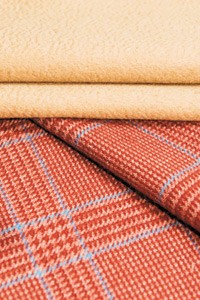
Outerwear fabrics at Loro Piana included double-faced cashmere with a fuzzy textured finish for coats in hues of rustic orange and bottle green. Loro Piana also produced a luxurious baby camel hair fabric in sand with a weave that resembled moiré silk.
Larusmiani produced some luxury women’s wear fabrics for fall and winter, including a cotton and cashmere and cotton and silk plaid and herringbone woven cloth. The mill also experimented with denim, creating a cotton and cashmere blend dark indigo denim and in some cases adding glittery Lurex.
Venice-based mill Gentax showed denim woven from a combination of cotton, wool and linen available in a lilac blue tile-pattern jacquard. The firm also produced a pinstripe indigo and silver lamé denim.
Following a financial restructuring, Biella-based mill Luigi Botto went back to its roots and showed a collection that featured alpaca and angora. For its Lanificio Fila line, the mill produced cashmere flannel and cashmere mixed with Lurex, as well as a spongy outerwear fabric of alpaca.
“It has an Eighties look, but it’s a little more refined,” said Arianna Leone, marketing director of Luigi Botto.
Silk producers at the Ideacomo section of the show felt the pressure of Unica’s early dates, with most admitting to being able to exhibit only a percentage of their finished collection.
“Clients come here and look, but they won’t decide on anything at least until Première Vision,” said Beppe Pisani, president of Ideacomo and the mill Serikos.
Tiny jacquard designs inspired by neckwear were part of the trends in silk fabrics, as well as tone-on-tone embroidery and three-dimensional weaving effects. Beige, honeycomb, caramel and pale rose pink were shown alongside darker shades of violet, plum and black.
Wool and silk specialists played with textures in fabrics for fall-winter 2007-2008. Soft gunmetal gray stretch chenille was woven with metal and Lurex at Prato-based Lanificio Lamberto, which also produced a popular cream wool plaid fabric with organza inserts. Gauze and cobweb black and cream wools were mixed with washed gold lamé-embroidered ivory velvets at Varese-based Ricamificio Lusi.
Knitted fabrics featured a rainbow of Lurex stripes in gray, gold, silver, blue and fuchsia at Silanco, while Marini & Cecconi produced a diagonal fine-striped wool and linen coat fabric in black and lamé gold, alongside smart mercerized shiny black compact cottons.