
NEW YORK — American production is seeing an uptick — unfortunately, it’s the wrong kind.
A federal crackdown on counterfeit imports could be driving an increase in domestic output of fake merchandise, according to investigators and industry executives.
A raid carried out by the New York Police Department on Monday of a commercial building in the College Point section of Queens resulted in 13 arrests and the seizure of an estimated $4 million in counterfeit apparel bearing the logos of brands such as The North Face, Polo, Lacoste, Rocawear, Seven For All Mankind and Fubu. The raid also uncovered a trove of tags, buttons and labels of brands such as Apple Bottoms, Baby Phat, Tommy Hilfiger, Nike, Adidas and Enyce.
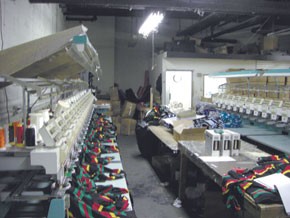
While the seizure of three tractor trailers worth of counterfeit merchandise was significant in itself, it was the discovery that the location was being used as a finishing facility for fake goods that has raised new concerns that counterfeiters may be shifting their tactics in an effort to circumvent U.S. Customs. Among the floor-to-ceiling stacked boxes of bogus North Face jackets and National Football League jerseys were four embroidery machines, each capable of putting trademarked logos on up to 18 garments at a time. Sources said the facility easily could embroider thousands of apparel items in a day.
The alleged leaders of the ring, Jung-Ho Ryu and his wife, Ji Young, were arrested Monday and are accused of importing blank shirts, jackets and jeans — primarily made in China — and then finishing the goods with trademarked embroideries, buttons and labels. A spokesman for the NYPD said the Ryus and their workers will face charges ranging from felony trademark counterfeiting to criminal possession of forged instruments.
Finishing goods in the U.S. to avoid Customs seizures isn’t a new strategy for counterfeiters, but it’s one some private investigators and intellectual property lawyers are beginning to see more frequently.
Kevin Dougherty, president of private investigators Counter-Tech Investigations Inc., which was involved in the case, said it was the first time he had encountered a domestic manufacturing operation in nearly a decade. Dougherty attributed the change to the increasingly successful efforts of U.S. Customs in seizing counterfeit goods before they enter the country.
Related Articles
You May Also Like
“The fact that it was a domestic embroidery operation with four 18-head machines, it means some of the recent Customs work made them deviate from importation and start manufacturing domestically,” said Dougherty.
He noted the embroidery machines require a significant investment, sometimes in the hundreds of thousands of dollars. The machines are easily programmed to copy logos and symbols and don’t take skilled labor to run.
Barbara Kaplan, senior counsel at VF Corp., which owns The North Face, believes there is little doubt the operation had set up shop domestically after several of its counterfeit North Face shipments were seized by Customs. According to Kaplan, VF has been investigating the Ryus for two years. During that time, foreign customs officials in Shanghai and U.S. officials in New York and San Francisco had seized more than 44,000 counterfeit North Face jackets connected to the Ryus. More than 7,000 North Face jackets were seized in Monday’s raid.
“What this points to is it’s getting tougher to get the stuff in the country,” said Kaplan. “It somehow makes more economic sense to bring stuff in generic and then put the counterfeit labels on, which was the way it was 10 years ago before it stopped because it was more expensive to do here.”
There is ample evidence the efforts of both the NYPD and U.S. Customs & Border Protection and Immigration & Customs Enforcement could be forcing counterfeiters to change tactics. Last year, CBP and ICE made more than 14,000 seizures of counterfeit goods — including CDs, DVDs and other consumer goods — valued at more than $155 million, a 67 percent increase from 2005. Their investigations yielded 219 arrests, 134 indictments and 170 convictions, representing a 71 percent increase in its conviction rate.
CBP and ICE reported the largest seizure in their history last year when a joint operation in Arizona, Texas and California netted 77 containers of fake Nike Air Jordan shoes and a container of Abercrombie & Fitch clothing valued at $69.5 million.
The NYPD has had equally impressive results. In mid-September, a two-year investigation ended in the seizure of 160,000 Nike shoes, filling 18 containers and valued at $7 million. The ring also was involved in making fake Bluetooth earpieces and Microsoft software.
Andrew Oberfeldt, a private investigator who works with luxury and apparel brands, said he has seen a surge in the instances of embroidered trademarks or other identifying marks being added domestically to blank goods that were manufactured overseas. Oberfeldt likened the situation to that of the music and movie industries, where small operations can churn out thousands of pirated DVDs using 50 to 100 computers. Similarly, apparel and luxury goods counterfeiters can download trademarked images from the Internet and use technologically advanced embroidery machines to easily churn out a high volume of counterfeit goods, he said.
In addition, Oberfeldt pointed out, the technology allows for real-time inventory control. Counterfeiters can create a fake logoed shirt or hat in small batches, allowing them to switch from brand to brand to meet consumer demand.
This creates additional enforcement challenges for brands. Under New York State statutes, the severity of charges against counterfeiters are determined by the aggregate value of the counterfeit goods with which they are caught. A counterfeiter with 2,000 boxes of blank shirts or hats but only 200 items that have been embroidered faces only penalties for those logoed items. Brands are then faced with arguing that accused counterfeiters intended to add trademarks to any blank items found.
“Because it makes good business sense in addition to avoiding customs, it’s a win-win situation for the counterfeiters,” Oberfeldt said.
Brian Brokate, partner with Gibney, Anthony and Flaherty, agreed. “There’s always been a combination of two sources of counterfeit goods,” he said. “One would be those manufactured abroad and smuggled into the U.S. fully counterfeited with trademarks, and then a certain amount of counterfeit goods are created here with the application of trademarks here.”
Kaplan of VF isn’t positive domestic manufacturing is a major trend among counterfeiters.
“I don’t think you can read the tea leaves yet, but it certainly is interesting because these guys were pretty organized,” she said. “They were sophisticated and they made that decision.”
Steven Gursky, an intellectual property lawyer and partner with Dreier LLP in New York, acknowledged that finding finishing facilities was “not an everyday occurrence,” but said he has regularly run into it during his years of practice.
“If you ever saw one of these machines in operation, they blast through production,” he said.
Gursky also doesn’t necessarily believe there is a wholesale shift in tactics among counterfeiters going on.
“I think it’s always been there….There’s always been an illegal element that would invest in the machines,” he said.
However, Gursky does believe there are scenarios that would make domestic finishing even more attractive to counterfeiters. It’s easier to import the blanks and it doesn’t take skilled labor to run the machines. Aside from that, Gursky noted there is a large embroidery industry across the country doing everything from corporate T-shirts to school uniforms. An economic downturn could spur legitimate businesses to run a night shift on their machines that handle counterfeit goods, or a legitimate business may go under and have to liquidate its assets, forcing the firm to sell its machines at low prices.
“There’s a huge business of embroidery and these machines are out there,” said Gursky.