
The distinction in the West between decorative and fine art — art with a function and art for art’s sake — has roots in Renaissance Italy and was influenced by seminal 16th-century art historian Giorgio Vasari.
That, however, has never kept Italian design from crossing boundaries, exercising purity of craft to carry out aesthetic vision, or turning objects into canvases and sculptures.
Gucci creative director Frida Giannini combined fine art and fashion in a collaboration with Canadian painter Kris Knight for the cruise 2015 season. Known for his moody, evocative portraits, Knight reinterpreted Gucci’s historic Flora silk scarf motif, creating artwork that was then reworked into prints that appear in Giannini’s designs, from men’s and women’s clothing to accessories such as silks, handbags and luggage.
Related Articles
Art is a signature for Piazza Sempione, whose spring line is inspired by the work of Italian Futurist painter Fortunato Depero.
You May Also Like
It takes more than a month and an enormous amount of work to create an elaborately detailed and colored, lushly illustrated Ferragamo silk foulard. Eighty percent of a printed silk scarf’s success lies on the shoulders of the master engraver, said Fulvia Visconti Ferragamo, who has run the fashion label’s silk accessories division since the Seventies.
She pointed to a particularly prized master engraver in the historic Como silk district who has worked with Ferragamo for several decades and is now in his 70s. He is training young people in his craft. “Sometimes he wants to retire. And we say, ‘Not yet, not yet,” she said.
Achieving Emilio Pucci’s unique look poses serious technical problems, and critical phases of silk foulard-making are still done by hand, said chief executive officer Laudomia Pucci. “Our graphic elements, apparently clean and simple, create many headaches.”
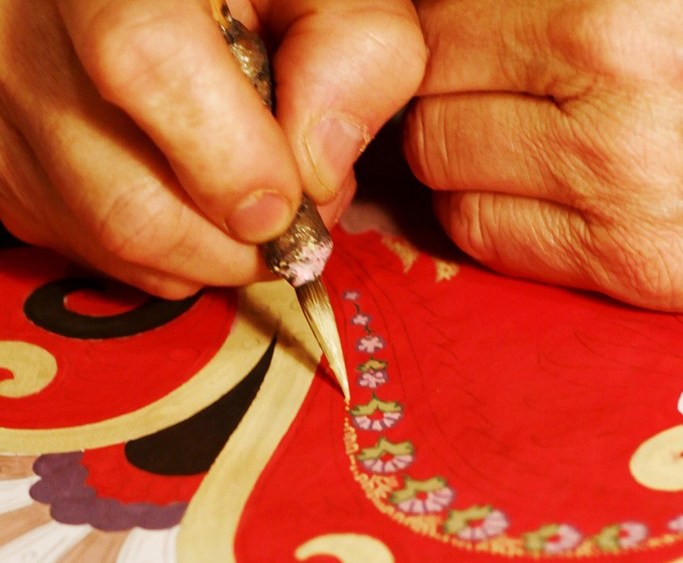
Luxury label Etro draws inspiration for its signature paisleys from an archive of 300 historic shawls, dating from 1810 to 1880, owned by the label. Expert paisley designer Serge Maury draws pencil outlines that are then filled in with tempera paint using sable brushes. From there, the design is transferred through a complex process to photogravure plates to allow printing on fabric.
Bag and accessories specialist Braccialini Group turns bag-making into figurative sculpture. Bags shaped as colorful, finely crafted creatures and objects require designing, 3-D modeling and prototyping by a master craftsman, said Massimo Braccialini, creative director and son of the founder. “Often when the object is actually constructed, has a different look and needs to go back to CAD modeling.”
Meanwhile, luxury leather house Borbonese built its technically difficult Butterfly bag, with a melange of precious leathers, inspired by a foulard.
GUCCI
Canadian painter Kris Knight calls his interpretation of Gucci’s historic Flora silk scarf design “quietly dangerous.” It references seduction tactics in ancient pagan Rome and features nocturnal blossoms and butterflies.
Creative director Frida Giannini applied Knight’s designs for prints on men’s and women’s ready-to-wear, accessories and luggage for the cruise 2015 season.
ETRO
“Many of the paisley patterns in the Etro collections are still designed by hand,” said Jacopo Etro, creative director and son of the house’s founder. “There are very few masters who pass on this art and the technique of its realization. A single design can require a month of processing.”
The paisley pattern was born in Mesopotamia and is a symbol of the tree of life. “From Indian prints to Celtic embroideries, it became a real object of desire in the 19th century, which all the elegant women in European courts wanted to wear,” said Etro.
SALVATORE FERRAGAMO
Fulvia Visconti Ferragamo said the house produces 12 to 15 new scarf motifs for each season, that are then created in a number of color and size variations that often require careful calibration and further motif modifications.
Early motifs centred on patchwork animals composed of flowers. Scarves evolved into worlds of exotic foliage and magical savannahs — tigers, leopards, zebras and other wild animals — and into other inspirations running from Oriental art to 20th-century European painting.
“People ask me why are they always jungle animals. I’ll tell you, they are the most elegant animals in the world,” said Visconti Ferragamo.
Thick, premium silk, details like a contrasting hand-sewn border, and a beautiful backside hardly distinguishable from the front, are also hallmarks of the silk accessories, which have become a hallmark of the brand.
PIAZZA SEMPIONE
Piazza Sempione has adapted a 1918 painting by Italian Futurist Fortunato Depero, “Rotazione di ballerina e pappagalli” (rotation of a dancer and parrots), as a motif for its spring capsule collection. The ready-to-wear features the use of a special pigment overprinting technique.
In a collaboration with the Museum of Modern and Contemporary Art of Trento and Rovereto, or MART, Piazza Sempione is displaying the original painting, which is on loan from the museum, along with the capsule collection during Milan Fashion Week. The event celebrates a beginning of a relaunch for the company after recent acquisition by the Sinv Group in Vicenza.
BRACCIALINI
Creative director Massimo Braccialini said the Flower Express bag required outside consulting from an automotive expert to understand how to model the front of its mini-truck form.
BORBONESE
The Lady Butterfly bag by luxury leather house Borbonese was made in 2006 as a reinterpretation of a historic foulard in the Borbonese archives. The elaborate construction of the purse requires precious leathers from ostrich, crocodile, lambskin and Borbonese’s signature Occhio di Pernice suede for a retro-Seventies patchwork look.
PUCCI
Emilio Pucci archives of its signature designs has reached approximately 15,000 designs, said ceo Laudomia Pucci. “Despite the experience and the help of technology, some difficulties always remain the same: getting the shine and fullness of our colors is a challenge that puts a strain on even those who have done this job for years.” Here, a foulard from fall.