
Related Articles
MILAN — Italian furs have had a reality check, as sexy, tailored and, perhaps more importantly, wearable, were heralded as the new directions at the latest edition of Mifur.
The 10th edition of the fur and leather exhibition was held at the Milan fairgrounds March 16-20 and featured 283 exhibitors.
The Italian fur industry has seen a strong upswing in sales, which hit 1.5 billion euros wholesale in 2004, or about $1.94 billion at current exchange, according to Pambianco, a consultancy that follows the Italian fashion business. Pambianco has predicted that this figure will rise by 6 percent in 2005.
“Fur is having a particularly good moment, it has been embraced again by the fashion industry and many labels have transformed their production with the help of new laboratories and the search for new product to offer more markets,” said Norberto Albertalli, president of Mifur and president of Albertalli Furs.
Russia, Ukraine and Kazakstan were the Italian fur industry’s strongest new markets, added Albertalli. These backed up existing markets in the U.S., Korea and Japan. In fact, while there was a slight decrease (less than 3 percent) in overall attendance this year — 5,195 visitors compared with 5,343 visitors in 2004 — Russian attendance jumped about 11 percent to 419 from 376 in 2004.
Executives at the fair were mostly upbeat about where the industry seems headed.
“Business is going really well, even Europe is good,” said Italo Cavaggioni, president of the 33-year-old company Cavaggioni, based in Verona. The firm expects a 25 percent increase on its volume of $7.7 million, or 6 million euros, in 2005. Cavaggioni put success down to new designs such as shaved mink fur sewn in pinwheels onto Loro Piana cashmere crocheted fabric to produce ultrasoft, light and movable coats.
“This is all made by hand. Other Italian industries are suffering because they are not using our capital — our ability to invent and create,” said Cavaggioni.
Skins supplier Paoletti also has experienced positive effects from the fur fashion boom.
“In the last three years, we have grown 10 percent annually, even now with the counteraction of the dollar,” said Nicola Paoletti, export manager of the 40-year-old firm, which is based in Brescia. Paoletti said there was a return to the most luxurious furs, such as mink and sable.
You May Also Like
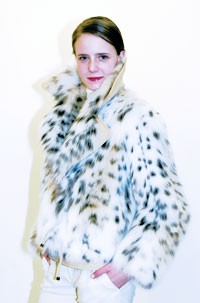
Mink and sable were given a new look at Vito Nacci. Chief executive Olga Nacci said the company always has used those furs, in addition to lynx and fox, to create its trendy line.
“Our trends are more dynamic and younger — it is not the fur coat of the past,” said Nacci. “We have created pieces that can be mixed with jeans and flat shoes. Fur has become more real.”
Also showing fur in its most luxurious form was Vicenza-based Giulana Teso. The company created a 24-karat-gold-lacquered leather coat with sable cuffs and collar. Ceo Carlo Teso said 2004 was a good year for the company, despite problems with the dollar exchange rate.
“We are looking to new markets like China, even though they are still developing their luxury taste,” said Teso.
Teso added the company’s three-year-old fur line, Byte, aimed at a younger clientele, was steadily gaining sales.
Already catering to a young, hip woman, Spanish line Olga Rios showed a bejeweled black astrakhan coat, a shaggy violet hip-length mink coat and a gold leather, mink-lined parka with a hood as part of its rock star-inspired collection.
At Bologna-based Centro Bel Furs, younger line Mala Matì recently had achieved higher sales than classic lines Mio Oro Bianco and Marconi — which designer Valeria Zanibona attributed to a sign of the times. Overall company sales were up by 20 percent in 2004.
“Mala Matì is now a stronger line because customers want exclusivity and details that look bespoke,” said Zanibona. Laser geometric designs, swirling embroidery and python leather inserts were some of Mala Matì’s details.
Tailored furs in trenchcoat, blouson and bolero styles dominated collections. Accessories such as Swarovski crystals, stamped and metallic leathers and embroidery were key decorations. At Albertalli, red beaded ribbon trimmed a shaved rabbit and fox short black coat; leather toggles and soft wide belts were interpreted in a knee-length fitted mink trenchcoat at Vito Nacci, and bands of Swarovski-encrusted gold ribbons circled a brown mink cape at Giuliana Teso.
The fair drew positive buyer reaction. One, a designer for a leading U.S. retailer who asked not to be identified, said, “We are looking for hunter green and violets in a mix of furs. We like the cuts closer to the body, like the trench, and accessories like Swarovski crystals for buttons.”
On the fair’s last day, Saga Furs, the joint marketing organization of fur breeders from Finland, Sweden and Norway, celebrated its 50th anniversary with a cocktail party.
Saga managing director Jan Erik Carlsson said fur’s reentry into the fashion world is not a surprise, since the association had embarked on a heavy promotion campaign 10 years ago.
“That grandmother A-shaped fur coat — I challenge you to find that at Mifur. Now there is a new type of consumer buying fur and it’s in a high-fashion context. Designers gave us the shot in the arm we needed with putting more fur on the catwalk,” said Carlsson.