
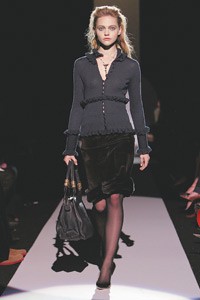
American Designers are turning the runway into a billboard for their licensed accessories.
Minimalism once ruled the catwalk and handbags, sunglasses or jewelry were shunned as fashion faux pas. That was then.
Now, as designers such as Badgley Mischka and Betsey Johnson, among others, extend their reach with more accessories categories, the runway is a high-profile opportunity to create a lifestyle presentation and boost the bottom line.
“American ready-to-wear designers have always treated accessories as a stepchild,” said Michael Kors. “There was a lip service of ‘Yeah, we really believe in it,’ but at the end of the day it’s the Europeans who really base their businesses on accessories. I am the kind of designer who gets his wrist slapped and I get told, ‘Why do you have to send so many accessories down the runway?’ I think that I spend more time on all these accessories lines, ultimately, than I spend on the clothes.”
Showing a pair of bold sunglasses or a forward-looking handbag in a designer’s higher-end collection directly affects the sales of their lesser-priced brands, industry analysts said. Such is the case with Calvin Klein Collection, which has a runway show, and its lower-priced licensed brands ck and Calvin Klein. Ralph Lauren premiered the luxe Ricky and Voyager bags on the runway in 2005, paving the way for the Polo Ralph Lauren’s push into accessories throughout its brands.
“It’s vital” that designers support their licenses on the runway by showing accessories, said Andrew Jassin, managing director of the Jassin O’Rourke Group consulting firm in New York. “The discerning public is peering through the TV to see what the mannequins wear. If it’s not shown on the runway, why should consumers support it?”
Donna Karan, Kors, Johnson and other designers told WWD that they plan to showcase accessories on the runway to present their entire vision for their respective brands, which they feel will boost their accessories licensing businesses.
For some designers, putting accessories on the runway isn’t simply a business decision.
“I definitely plan to show accessories on the runway because this is how you communicate the totality of the lifestyle to the press and ultimately the consumer,” said Karan, who has been criticized for not consistently showing hosiery on the catwalk, which is licensed by Hanes. “But I won’t just take any bag and put it on the runway. If the accessory or jewelry doesn’t make sense and doesn’t work with what I am trying to convey, I won’t do it.”
Related Articles
You May Also Like
Marc Jacobs president Robert Duffy similarly said, “Our bag business has been great. For fall, we showed a bag with every look because we were doing this whole layered thing and the bag was very appropriate. But I don’t sit and say to Marc that we need to show bags when we style a look. At Marc Jacobs the accessories are important, but it’s more personal.”
Duffy added that licensees would likely be pleased if the firm put more of its licensed accessories on the runway.
Michael Kors continues to increase the amount of accessories on the runway because the category accounts for 60 percent of total sales. The plan is to increase that number to 75 to 80 percent in the next two or three years. In addition, the firm’s new stores are merchandised by theme, not collection or price, so there are Michael Michael Kors shoes beside Michael Kors collection tops, making the runway even more relevant.
“It’s important that a brand gets exposure for a licensee,” said Arnold Aronson, managing director of retail strategies at Kurt Salmon Associates. “The consumer is more sophisticated, more exposed, more media conscious and more internet savvy. [The runway is] a credible way to expose product.”
Johnson, who received the Lifetime Achievement Award from the Accessories Council last year wearing at least one product from each of her new licensees — eyewear from Legacie, fashion jewelry from Miriam Haskell and watches from Geneva Watch Co., among others — didn’t show accessories on her fall runway, but at today’s spring show, said she would go in the other direction.
“Absolutely, because you get tons of international press out of what’s shown on the runway,” she said.
Badgley Mischka launched its first licensed accessories this year, including handbags made by Franchi, cold-weather accessories with August Accessories, footwear with Titan Industries and eyewear by Sama. The company plans to show many of them on the runway on Thursday.
“[The licenses] are a very important part of our overall business,” said Mark Badgley. “There isn’t a better opportunity to showcase the union of our [collection] product along with shoes. We would miss out by not showing accessories on the runway.”
Anna Sui, meanwhile, has always been a designer who styled her runway looks with lots of accessories.
“They are part of my philosophy,” Sui said. “I like the whole head-to-toe look and want to present the whole story. I am not a minimalist.”
Sui relies on her licenses to develop the runway accessories she desires each season, including handbags and shoes with Ballin, hosiery with Japanese firm Atsugy, and jewelry from Vendome, also in Japan.
“It used to be the biggest challenge to find people to help make things [for the runway], but now that I have the licenses, it gives me the luxury to develop them the way I imagine them to be,” she said.
Sui is also working with Erickson Beamon for jewelry, and James Coviello is creating special hats this season. Sui added that some of the pieces she puts on the catwalk end up being among her accessories bestsellers, while others can be ignored.
“You never know; it’s a gamble,” she said. “When we did the golf-inspired collection, cutting the bottom off of athletic socks to make them into legwarmers, everybody copied it, and it became a trend that season. You never know what’s going to catch and what’s going to hit.”
Derek Lam today plans to show the first fruits of his licensing deals with Tod’s SpA for shoes and handbags and Modo for eyewear on the runway.
“It’s important for us to put them on the runway,” Lam said. “We don’t have ad campaigns and the show becomes the format in which we can show all the product that we can develop and sell.”
That said, Lam plans to showcase only an edited collection of the offering, which has to work with the overall feel of the apparel.
“I think it’s about setting a look,” he said. “If we went in and said, ‘we have to show everything that is made in the collection,’ it might be a little unfocused. From my point of view, the show is about giving as direct a message as possible. We won’t show everything, but highlight the pieces that are part of the strongest message of the season.”
Accessories, he added, were always part of all the elements he feels are necessary for a fashion show.
Eyewear makers, however, struggle with the timing of the shows, which don’t coincide with their production and delivery cycles. New eyewear begins to hit stores in November for holiday, while advertising and editorial featuring new spring eyewear hit consumer magazines in January or February.
“The challenge we used to have in this business was for eyewear to be accepted as a fashion accessory, like handbags or footwear,” said Al Berg, president and ceo of Marchon, which produces Calvin Klein, Michael Kors and Fendi eyewear. “Having [eyewear] on the runway reinforces the fashion statement a product can make, sending a clear message to the audience … but we don’t have the photos [advertisements] ready for the launch of the product. We do get [in-store ad displays] to market, but just not as quickly as the eyewear.”
Claudio Gottardi, ceo of Safilo Group, which produces eyewear for firms such as Marc Jacobs, Gucci and Alexander McQueen, said he was pleased that designers have been supporting the eyewear business by having models saunter down the runway in big, bold shades.
“The media coverage that ensues from these runway shows offers our collections heightened visibility in the most desirable context, which promotes sales,” Gottardi said.
Retailers said seeing a sampling of what a company offers on the runway whets their appetite for more, but agree that the runways should be a showcase for clothing mostly, not accessories.
“I think it’s really important that designers add a touch of accessories on the runway,” said Ikram Goldman, owner of Ikram in Chicago. “But I don’t like when designers do it for every look.”
Barneys New York fashion director Julie Gilhart agreed, “More and more handbags, sunglasses and jewelry are what brands are trying to sell. If [accessories are] part of a designer’s vernacular, it’s important to show, but it’s not going to make it or break it.”