
PARIS — Who says a stool is just made for sitting on? Thanks to recent design innovations, furniture can be manipulated to take on other shapes and functions.
A felt shelter that doubles as a rug and a futuristic bridge that coils into a circular sculpture when closed were a few of the finds during a recent tour of some of Europe’s more directional design projects.
Take the Rose Line bookcase by Paris-based designer Jörg Gessner, a jet black shelving unit that can be swirled into the form of a wave or curled to form a circle, which was introduced at the Via art gallery here.
“Design that can change shapes gives the impression that we can interact with the objects that surround us,” said Gessner. “It’s an important aspect of design today because it frees the user’s creativity.”
Other design chameleons include a tabletop with sliding trays by Paris-based industrial designer Pierre Chanh-Van Truong, and a shape-changing chandelier made from 16 desk lamps assembled in a circle by American designer Ron Gilad for an exhibition at the Tools art gallery.
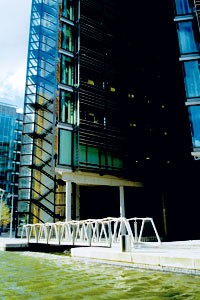
Even bridges can undergo major transformations. London-based design firm Thomas Heatherwick Studio last September created a pedestrian bridge at the Paddington Basin that curls into a perfect circle.
Some designers are pushing the shape-changing concept yet further by creating objects that not only morph into different forms, but can be used for other purposes. Budding French designer Marie Compagnon is concocting pieces to do just that.
Her three-dimensional felt shelter, dubbed Alphabet, can be unfolded into a rug. “The shape the structure finally takes reflects the user’s state of mind,” she said. The shelter, as well as Chanh-Van Truong’s tabletop and Gessner’s bookcase, were all introduced during Salon du Mode earlier this month.
Meanwhile, Didier Krzentowski, founder of Galerie Kreo, the trendy Parisian art gallery, believes innovative design can have multiple purposes without taking myriad forms. Instead of reconfiguring the objects, users have to figure them out themselves.
“Interesting design today calls for users to research the use,” he said, noting that German designer Konstantin Grcic’s box with handles calls for the user to define its function, a particularly innovative design concept. “It’s the design that encourages users to think.”