
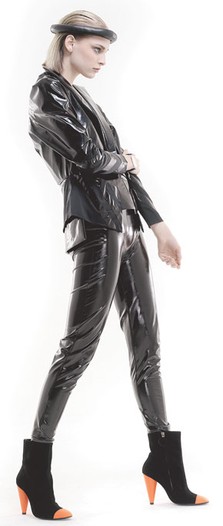
Club fever is back.
This time around, it has made its way into Europe’s effervescent after-dark scene. Kids are expressing themselves with a vigor not witnessed since the Eighties, with influences that vary from Gianni Versace to performance artist Leigh Bowery.
Some of the most influential fashion-fueled happenings now include BoomBox and Anti-Social in London, Le Paris Paris in Paris, Klubb Ace in Stockholm and Yohad, a nomadic club night that moves to different venues throughout Copenhagen. The music at said events is nothing if not eclectic, ranging from electro disco to camped-up versions of acid house music, with guest DJs driving the mood. Designer Jeremy Scott, for one, recently entertained the crowd at one of BoomBox’s Sunday night slots. As for the typical club-kid attire? Eccentric garb in trippy colors and frenetic prints, lots of masks and extra-loud accessories.
The fashion attitude is very much DIY, with wearers mixing outlandish homegrown clothes with streetwear and designer gear. The scene has fostered a burgeoning Brat Pack of designers such as Gareth Pugh and Danielle Scutt. But its inspirational heroes — notably Scott, Bernhard Willhelm and even Jean-Charles de Castelbajac — have also resurfaced into the limelight. “It’s like being born again,” declares de Castelbajac, who sees a tongue-in-cheek stance as the linking leitmotif among the new purveyors. “The underlying message is about having fun.”
Meanwhile, Danish label Wood Wood is one of the contemporary brands that’s being embraced on the club scene. “Youngsters are going wild in Copenhagen clubs, wearing painted faces, mad getups and tooting whistles,” says Karl-Oskar Olsen, one of Wood Wood’s designers. “We didn’t plan it, but one of our playful prints, Epidemic, which looks like a disease, struck a chord [with the younger crowd].” That motif, he says, is now one of Wood Wood’s bestsellers.
But this new set of scenesters is also tossing high-end labels into the mix. Harvey Nichols’ buying director, Averyl Oates, says savvy young customers are scouring the store for cutting-edge pieces, notably by brands such as Marios Schwab, Giles Deacon, Sinha-Stanic, Thomas Wylde and Libertine. “The bronze knit dresses from Balenciaga’s pre-fall also sold out immediately, and are seen layered with T-shirts, leggings and Converse trainers at clubs, as are pieces by [Alexander] McQueen and Marc Jacobs,” she says.
Related Articles
You May Also Like
To further jazz up their looks, Oates says, shoppers are choosing oversize sunglasses and statement accessories from the likes of House of Flora, Tom Binns and Scott Wilson. “Hannah Martin’s jewelry will pin this trend down, with her bound leather pieces with chunky clasps and rings,” Oates adds.
Reflecting this rising demand for outre club wares, certain alternative cult brands have crossed mainstream high-end specialty store thresholds. Harvey Nichols and Barneys New York, for instance, have stocked up on House of Holland’s brash slogan T-shirts for fall, while Colette has just received its first batch of customized vintage pieces by French art and design collective Andrea Crews. And for fall, his first selling season, Gareth Pugh has been picked up by both London-based Browns Focus and Liberty of London, as well as Neiman Marcus and Barneys New York. Known for his sculptural black-on-black sampling of synthetic and luxurious fabrics, such as vinyl mixed with fur, Pugh is being hailed as one of the club scene leaders.
“The Gareth Pugh [groupies] are the most outlandish,” says Pablo Flack, co-owner of the ultrahip nightspot Bistrotheque, located in a converted clothing factory in London’s East End where cabaret performances are held regularly. Typical looks there include ultraskinny vinyl pants paired with kooky tops sculpted into Space Age dimensions — sometimes in all-black ensembles, or sprinkled with harlequin and checkerboard motifs. A former designer for the clothes label House of Jazz, Flack notes that in London it’s “almost become mainstream” for boys to go out slathered in glitter and makeup. “With the effort that kids are putting into dressing up, you know it’ll make a great coffee table book in 10 years’ time,” he says.
Organizers of BoomBox, the club night held every Sunday at London’s Hoxton Square Bar & Kitchen (see sidebar), are one step ahead of Flack. They’re introducing a book, called “BoomBox Book,” that will be released during London Fashion Week in September. The tome features photos of the club’s wackily dressed regulars taken by guest photographers such as Wolfgang Tillmans and Katharine Hamnett, with text written by fashion stylists and writers, including Katie Grand and Sarah Mower. Colette will also hold an exhibition and signing party for the book during Paris Fashion Week.
While such publicity is all well and good, many designers say cracking the commercial code is not the first thing on their minds. “I love doing my thing, whether it be music or performance art or clothes,” says Pam Hogg, one of the scene’s pioneers and a cult figure from the Eighties. Also a musician, Hogg is back with a hand-stitched capsule collection for fall, pieces of which were used in the music video for her band, Doll, which features The Kills’ Alison Mosshart. Likewise, David David designer David Saunders is a contemporary artist by trade, best known for his line of vivid hand-painted garments. However, in a rather commercial move, Saunders was recently tapped to design a group of screen-printed T-shirts for Fred Perry, set to sell this fall.
Another British designer, Carrie Mundane, says she’s targeting mostly small stores with Cassette Playa, her kaleidoscopic digital-printed men’s wear. Last spring, she landed her first order from Seven New York; the 30 pieces sold out in a single day. “I take inspiration from virtual technology, text messaging and file corruption — beautifully chaotic and pixelated,” says Mundane, who plans to launch a women’s line within the next year. “It’s very graphic and tribal, pulling on Aztec and hieroglyphic influences.”
Mundane says she considers herself among a number of young “outsider” designers making a living mainly out of one-off pieces. “There’s a big market for that, particularly in New York,” she says, adding that, despite its wacky prints, her collection remains entirely wearable on the dance floor. “You know, at the end of the day, the garments all have two arms or two legs.”