
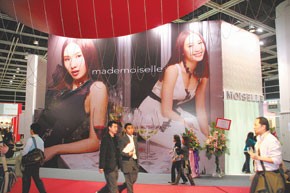
HONG KONG — One way to attract only serious potential clients at a trade show is to build an enclosure around your booth and block the entrance with sheer fabric.
This was Moiselle’s tactic at World Boutique, which ran concurrently with Hong Kong Fashion Week, Jan. 15 to Jan. 18. The intended target: Mainland Chinese interested in setting up franchise shops in China for brands Moiselle and mademoiselle.
The two brands already have more than 90 shops in China. (Moiselle has 17 in Hong Kong, its home market, and mademoiselle has six.) The company’s third brand — imaroon — caters to the younger set. Still new to China, it has six or seven shops in Hong Kong, said Kennis Chan, the firm’s marketing officer.
“The China market is a very promising market for us,” Chan said. “They [Mainland Chinese] really like our style, our image.”
Moiselle stores are a destination for some Mainland tourists once they’ve landed in Hong Kong, in part because the brand is more expensive in China due to a value-added tax that can increase the price by as much as 30 percent.
An indication of the brand’s popularity was its fashion show on Jan. 16: It was a full house, 600 seated and 300 standing. “It was more than we expected,” Chan admitted.
After China, Moiselle is looking to expand in Europe, then America. In the short term, the company wants to grow in London and has updated its image to cater to the international market, Chan said.
As part of this strategy, the company switched from using Hong Kong celebrities in its ads to European model Freja Beha in its fall 2006 and spring 2007 campaigns, and this season’s catalogue was shot in Denmark.
But Moiselle wasn’t the only brand at the show with broader ambitions. Hong Kong designer Koyo William Cheung also has his sights set on Europe, specifically Paris.
Five years ago, Cheung attended the shows in Paris and understood that he needed better design and quality for his casualwear collection. Since then, he said he has had more response from buyers in Europe who are attracted to the color, washing and vintage feel of his denim.
Related Articles
You May Also Like
There are a lot of designers for women, but not a lot who do men’s and women’s collections, he said. His casualwear collection is 60 percent men’s wear and 40 percent women’s wear.
Cut is important to Cheung, who for fall opted for a variation of the popular superslim cut. He added “3-D cutting” to give dimension and added comfort to his jeans and jackets.
Cheung has three shops here and his namesake brand also is available in China, Japan, South Korea, Taiwan, Macau, Australia and New Zealand. His next step is to go back to Paris to make a pitch to Galeries Lafayette for a shop-in-shop there.
Not all exhibitors were focused on their design capabilities, however. Some, like Hong Kong’s Triple Force Garment Co., were at the show to display their manufacturing prowess.
The company, which has a factory in southern China’s Dongguan and specializes in shirts for men and women, has clients from throughout Europe, including in the Netherlands, France and Germany. It used to have some clients from the U.S., as well, but they were for specific orders that have already been completed.
Styles are usually provided by the clients, typically small brands that cater to people in their 40s and 50s, said Joanna Tsang, who was manning the booth at Hong Kong Fashion Week.
“Some of the European designs are unfashionable,” she said, meaning the styles wouldn’t translate for Hong Kong, but would clearly do well in their own markets.
Some larger manufacturers are working to be more vertical in a competitive marketplace by providing services such as in-house design. Triple Force isn’t considering that route because it’s easier to have the client provide designs, Tsang said. The company has six or seven people working at its office and more than 100 at the factory.
The company isn’t looking for clients in its own territory. For now, Triple Force Garment is focusing on more developed markets, while the Chinese market matures, Tsang said. Most of the goods Triple Force Garment manufactures hit a middle-price range and range from fashion forward to formal.
The exhibition attracted many exhibitors from outside China, including those looking to maintain their niche in the face of increasing competition from low-cost producers in China. For example, Satish Singhal, owner of Mint Impex from Moradabad, which is about 100 miles from New Delhi and specializes in woven garments for men and women, sees China as a growing threat to Indian companies.
India’s edge is being flexible with quantities and color changes, he said, adding the country also was good for embroidery and other hand work.
He acknowledged, however, that China was “now trying to copy” the embroidery work for which India is renowned and also has started to accept smaller quantities.
Even if India wanted to, it would be difficult to compete with China when it comes to mass production because factories in India aren’t as large and there isn’t government support for export, he said, adding that insufficient labor laws, unreliable power supplies and poor infrastructure also have a negative impact.
Most of Singhal’s clients are European, but some — including J.C. Penney and Guess — are from the U.S., .
Attendance figures for Hong Kong Fashion Week and World Boutique were up this year. Fashion week had 25,546 visitors, an 8.4 percent increase over last year, and World Boutique had 19,271, a 7.8 percent rise.