
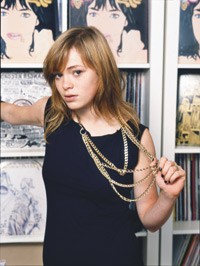
Bling translates into almost any language. But even though over-the-top, hip-hop-inspired jewelry ranks as a key spring accessories trend in Europe, some independent designers are carving out their own Continental take on the flashy phenomenon.
“There’s a different style of bling in Europe that’s more sophisticated. It’s not about the size of the rock, it’s about the style and design,” says British designer Shaun Leane, whose past clients have included the Sultan of Brunei. The designer says he prefers creative expression to designing baubles that scream money.
Leane’s nascent diamond jewelry collection, launched last year, has attracted such followers as Gwen Stefani and Kate Moss, who, along with Liv Tyler, own diamond and white gold initial necklaces retailing at $2,280. The collection’s yellow diamond and pink sapphire ring, retailing at $1,951, is also a bestseller.
“[Alexander] McQueen’s fall show will also be very bling,” hints Leane, who has been collaborating with the designer since 1995. “We’ve reached a stage where we want to bring the jewelry up a level and give it a couture feel,” he says.
To be sure, bling is “definitely on the up in Britain,” according to London celebrity stylist Chloe Beeney. Originally from Los Angeles, Beeney was recently called upon to dress Diddy’s partner, Kim Porter, for David and Victoria Beckham’s “Full Length and Fabulous” World Cup party in May.
The stylist attributes the growing trend to the bling-festooned WAG posse—an acronym adopted by the British press for footballers’ wives and girlfriends. Among the ringleaders is Victoria Beckham, who has sported diamond-encrusted timepieces from Daniel Lazar and Damon Dash’s luxury watch range, Tiret.
Also fueling demand for flashy jewelry, Beeney says, are current chart-topping music acts such as Lily Allen, who delivers a popular street mix of rap, reggae and hip-hop, and So Solid Crew’s Lisa Mafia—nicknamed the “24-Carat Princess.”
Fast-fashion chains are at the ready. Bling will be one of the main trends represented in H&M’s accessories department for spring, according to a spokeswoman for the Swedish chain. “We’ll be stocking heavy gold chains and other bling elements inspired by the rap and R&B scene,” she says.
Related Articles
You May Also Like
Topshop’s head of design, Nick Passmore, confirms that bling-inspired accessories will be a major statement for spring, and that oversize pendants, chains and gold already are hot products. “It’s a look that has grown steadily, but since its origins are street rather than catwalk, it isn’t documented so readily as a rising trend,” she says.
Most Brits are adopting a pared-down take on the trend, using it to add a street twist to preppy sportswear brands such as Burberry and Lacoste, rather than baggy tracksuits, according to Beeney.
Look-at-me Indian jewelry has also been appropriated as part of the look. “Britain’s bubbling street scene is notorious for borrowing from its immigrant cultures, such as Jamaican or Indian,” Beeney says.
European bling brands, meanwhile, are banking on manufacturing finesse and creative designs to outshine the competition.
“Whereas U.S. brands tend to use heavy Thai silver that’s cheaper and has a darker finish, we produce hand-polished chains made from rhodium metal to give a Tiffany-like, preppy vibe,” says 26-year-old Georgi Philip Pecenikov, who took over a defunct Italian chain factory from the Seventies for his up-and-coming brand, Toy Me.
Although bling clichés such as sheriff stars and dollar signs sprinkle Toy Me’s chains—a nod to Pecenikov’s time spent studying in America—European references also figure. His collaborator, Gnagno, has developed charms based on vintage toys found in Kinder Surprise chocolate eggs for fall. And for spring, Pecenikov will introduce rocks sourced from high-end diamond dealers in Antwerp, Belgium.
Such chains have hit a nerve with Europe’s burgeoning bling culture. A batch bearing DJ charms has been commissioned to promote a new radio channel from trendy Italian magazine Pig in September. And Paris-based rising rap star Uffie, originally from Miami, often sports a triple-strand Toy Me star chain when she performs. The hoop-earringed rapper finds European bling much more of a discreet affair. “It’s still rare with French girls, but those who wear it pull it off elegantly,” she says.
Toy Me’s distribution for now remains limited to high-end streetwear stores such as Purple in Milan and Gerard Loft in Florence. “More and more skater and hip-hop shops are popping up around the country, but it’s still a niche market,” Pecenikov says.
“I’m planning to play on the line’s European craftsmanship to enter the States this fall.”
Paris-based jeweler Beatrice Philippeaux also touts French savoir-faire as her bling de resistance. A graduate of Paris’ prestigious Ecole Boulle, Philippeaux got her first taste of bling when rapper friends approached her to repair broken jewelry brought back from the States. “I noticed that U.S. brands were churning out the same machine-made logos for jewelry, like bling versions of the Coca-Cola symbol,” scoffs Philippeaux, 35.
In 1996, she decided to establish her own boutique, Anjuna, where, in tattoo parlor fashion, sketches are transformed into individualized jewelry. Stylists soon came clamoring. MTV and a number of record labels put in orders and, in 2002, she scored a prolonged stint as jewelry designer for Lagerfeld Gallery.
“France is the land of couture, and we’ve always been about individual style,” says Philippeaux, pointing out her four-finger graffiti ring embedded with jade, garnets and moonstone, priced at 3,000 euros ($3,866 at current exchange), or her sculpted coral flower ring, priced at 500 euros ($644). “It’s about mixing street spirit with creativity.”
Philippeaux says she is even getting more requests for bling wedding rings, a development she likens to graffiti entering art galleries. “When bling is no longer confined to street culture but has been adopted by the bourgeois, or ‘bobo’ set, in French, you know it’s hit a nerve,” she says.