
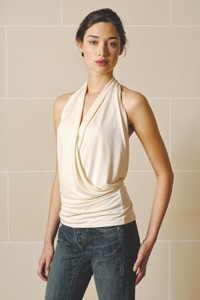
PARIS — Textile’s green giant, bamboo, is proving to be a sustainable option of the fashion-friendly sort. Already, the fiber is taking root in diverse categories, from lingerie to denim. Nevertheless, challenging its frumpy associations is the aim of a number of young designers who are busy foraging for novel fabrics — such as bamboo — to lift to a sophisticated level.
“The first time I saw the fabric was when working at Adidas,” says Portland, Ore.-based designer Anna Cohen, 28, who did stints at Max Mara and Patrizia Pepe in Italy before launching her own sportswear line. Cohen’s collection is one of a new breed of labels — including Form, Racines du Ciel and Doie — that is incorporating more green fibers into its clothes. Cohen said she adopted bamboo to give a luxurious edge to her collections.
“It drapes beautifully, it’s really lightweight and has a high-end quality,” says Cohen, who otherwise works with hemp and silk blends, Ingeo, organic cotton and wool; her line retails for $150 to $600.
For next spring, luxury loungewear designer Sarah Kirsner, who formerly worked with cotton, is switching her one-year-old line, Doie, entirely to bamboo.
“It’s not as easy to obtain bamboo, and I find it a little more expensive, but it’s opened up doors and makes me feel like I’m doing something for the environment,” says Kirsner, who worked for Marc Jacobs and DKNY before starting her own collection. The designer first used bamboo when a friend requested an eco-friendly version of one of her designs. It paid off. Kirsner has just landed a deal with gourmet organic food giant Whole Foods to be distributed in its stores.
“Clients are looking for new messages,” notes Rahol Greuter, product manager for Swiss textiles company Greuter Jersey, which supplies bamboo fabric mainly to lingerie clients such as French designer Elise Aucouturier, who’s made one bamboo lingerie set for her spring collection.
Factors that make the fiber compatible with the lingerie market, according to Greuter, include its fluidity, color resistance and ability to be blended with a number of fibers such as Lycra, Tencel, Modal, silk and cotton.
Related Articles
You May Also Like
“It’s going to take off in lingerie,” Greuter says, adding that the firm is developing special bamboo fabrics that will cater to various lingerie applications, such as bra cups.
Still, marketing such a product has been a challenge. The French company Noyon, which introduced a bamboo lace line four seasons ago, still has no takers. “The lingerie industry is constantly seeking new fabric alternatives, but they’re always slow in taking off,” says Anne-Marie Langry, director of research and design for Noyon.
“Japan has been using bamboo for four centuries, but it’s still an uncommon fiber in clothing today,” Elio Tomsini says. Since 1995, his denim line, Kohzu, has been made using kumazasa, a wide-leaf bamboo indigenous to Japan. “Bamboo reacts to climates in a similar way to silk: insulating in the winter and cooling in the summer,” Tomsini says. “But its downside for denim is the high production costs.”
Semi-handwoven on shuttle looms from fine strips cut from bamboo and rice paper pulp, Kohzu jeans retail at a lofty $500 and are available in high-end stores such as l’Eclaireur in Paris and H. Lorenzo in L.A. Meanwhile, on the other end of the price scale, 25-year-old French sportswear line Spilan distributes bamboo products, mostly T-shirts and sweaters, in the $20 to $30 range to Europe’s mass market giants Carrefour, Casino, E. Leclerc and Auchan. “Supermarkets are now after eco-friendly clothing,” says Spilan chief executive officer Evelyne Spilet. The company recently established its own plantations in China and Indonesia. To get the message across, the firm has invested in a $1.3 million TV campaign, featuring a young T-shirt-clad woman pushing her way through a bamboo forest that eventually opens out into the heart of a bustling city.
“The message is simple,” Spilet says. “Bamboo has come to town.”