
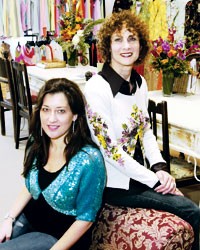
To get an idea of the state of Northern California’s manufacturing community, consider the incredible shrinking business of veteran contractor Angie Bates.
In partnership with her sister, Gina Ng, for 10 years, the two operated a sewing facility with 60 employees, manufacturing private label women’s sportswear for Wal-Mart and Kmart. Then these megaretailers transferred production offshore in the late Nineties, and her sister followed, selling Angie her share.
But Bates didn’t exit manufacturing. She opened a smaller, 7,000-square-foot facility in 2003 called Lee & Lee. It employs 18 full-time sewers. About 90 percent of the company’s business comes from one vendor, Weston Wear contemporary clothing in San Francisco.
“I just make my salary. I’m not making money and I’m not losing money,” said Bates. “But, if I lost Weston Wear, I would have to think about closing my business.”
Bates is one of the lucky ones among her peers.
A decade ago, there were 300 contractors in the Bay Area. That number has dwindled to fewer than 100 today. The production exodus has been slow and steady in the last decade, led by the region’s longtime leaders Levi Strauss and Gap Inc. The dot-com boom of the late Nineties also contributed to San Francisco’s tide of runaway production as factories priced out of real estate traveled south to Oakland, turning that area into a hub, or simply vanished altogether.
Although larger, commodity-driven manufacturing has exited the community, many smaller, higher-end designers, whose sales can range from less than $10 million to more than $25 million, have kept sewing machines humming and operators basing their hopes on the region’s growing contemporary direction.
“Companies who are choosing to do business here are those whose labor is a relatively small percentage of the garment’s cost,” said Randall Harris, executive director of San Francisco Fashion Industries. “They can afford to absorb the labor expense. Budget and moderate-price goods can’t typically survive here.”
Indeed, the city is the most expensive in the state in which to run a business, according to the 2004 Kosmont-Rose Institute Cost of Doing Business Survey. The high cost of real estate also tops the list. And city and county measures implemented in February that raised the minimum wage to $8.50 haven’t helped the apparel cause, either.
Related Articles
You May Also Like
In 1997, there were 12,300 people working in the apparel industry in the Bay Area, generating $2.4 billion in sales. By 2002, that figure had plummeted more than 50 percent to 5,400 workers, in turn bringing down industry sales by about 25 percent, according to Jack Kyser, senior vice president and chief economist at the Los Angeles County Economic Development Corp., referencing data from the 1997 United States Bureau of the Census and 2002 County Business Patterns. With businesses moving production elsewhere, the number of workers and volume of sales fell accordingly.
As a result, it’s a challenge to find good contractors in the community. Hedging its bets, Weston Wear opted to purchase one of its five area contractors last year, bringing 25 percent of its product in-house with the new team. Even with the cash outlay and the increase in her workers’ compensation premiums, the strategy has proven profitable, said Weston Wear owner Julienne Weston.
“I’m especially saving money on sample-making, which can double or triple my costs because of smaller runs,” she said. However, Weston said she currently has no plans to make a bid for Angie Bates’ Lee & Lee.
Margaret O’Leary has manufactured her knitwear in her own 20,000-square-foot factory and headquarters for the past 13 years, a strategy she said gives her a pricing edge in an area starved for contractors specializing in the category. She uses outside contractors for sportswear and China for her suede pieces.
“I must field five calls a day from other designers of knitwear who’d like me to handle their production,” said O’Leary, who declines offers because the orders are too small.
O’Leary, Weston and others say they’ve flirted with the idea of moving production to Los Angeles or offshore. But the potential cost of lost quality control won out.
Barbie White, owner and founder of Japanese Weekend Maternity, said her costs have gone up 30 percent in the last two years, prompting her to test the Los Angeles market, but pricing and even concerns about wage and labor issues there didn’t add up. Currently, she works with four contractors in the San Francisco area.
“I didn’t find it to be cost-effective for my minimums, and I tend to be apprehensive about L.A. not meeting all the labor requirements,” White said.
A U.S. Department of Labor survey in 2001 found that the labor law compliance rate in San Francisco’s apparel industry was 75 percent, compared with Southern California’s 33 percent in 2000, the latest figures available. That doesn’t mean, however, that there are that many fewer violations in San Francisco; more likely, there are fewer on the record.
Labor officials attribute the difference more to the makeup of the workers rather than employer negligence. “In San Francisco, the workers are mostly Asian, whose culture touts a quieter, more submissive role compared to Hispanic workers in Southern California who are likely to be more vocal,” said Jose Millan, deputy secretary of enforcement for the California Labor and Workforce Development Agency. Speaking out draws more attention and can lead to lawsuits, effecting change and cooperation from employers, he said. Essentially, there’s just less of a spotlight on the Northern California scene.
Aside from cost and labor issues, the biggest reason to keep production in the region is the cachet it affords, said manufacturers.
“My customer loves the idea of something made in the U.S., and my Japanese customers and other international customers appreciate that something’s made in San Francisco,” said O’Leary.
To manufacturers’ disadvantage is the lack of support services within San Francisco’s apparel industry. Fabric mills, cutting shops and dye houses are either nonexistent or limited.
And a dedicated apparel showroom facility hasn’t been around in a while. Sales reps left the San Francisco Apparel Mart at 821 Market Street after it shut down following the 1989 earthquake. They relocated to a new 400,000-square-foot space called the Fashion Center in 1990 at 699 Eighth Street, about a mile south of the Apparel Mart. By 1995 the oversized building went into foreclosure and many reps began working from home, while others moved to the nearby San Francisco Giftcenter and Jewelrymart at 888 Brannan Street.
“We live in a bit of a shell here,” Weston said. “It’s not an apparel center where I can run down the street to the trim shop or visit showrooms and see other lines. You don’t always see what’s going on in the fashion world from here. I have to go online.”
Stitch by stitch, that might be changing, as the industry seeks ways to create community and the city enters a designer and fashion renaissance.
Last summer, Mystery Girl Productions staged the city’s first fashion week, showcasing nine local lines, with plans for a similar event this August. Although targeted to more of a consumer audience, participants were encouraged by the camaraderie it provided them.
The Golden Gate Apparel Association, which stages five fashion markets annually, has grown by about 20 percent in exhibitors, according to Jacqueline Stone, chairman of the board. Also in October, Giftcenter showroom owner Lori Markman, with another sales representative, Mary Joya, signed a master lease at the 680 Eighth Street building to be closer to the Golden Gate show held at the Concourse Exhibition Center. They’ve dubbed themselves the San Francisco Fashion Collective.
“We needed a prettier, more glamorous space to attract buyers, and everyone’s business has picked up,” Markman said. “We’re just trying to brand ourselves into something more permanent and attract quality lines.”
Markman and others said there’s a growing regional design contingent to tap into for future lines as well.
Schools such as the Fashion Institute of Design & Merchandising and the Academy of Art University report growing enrollments in their apparel programs. At San Francisco State University, enrollment as an apparel major has doubled in the past two years to 254 students. The San Francisco Center for Applied Competitive Technologies at City College has transformed from a contractor-focused program to a design studio in the last two years, attracting 75 students.
“At one time, we were pulling teeth for Paris to look at our San Francisco students for exchange programs, and now they’re begging for our students,” said Gladys Perint Palmer, executive director of the School of Fashion and Merchandising at the Academy of Art University, where the 10-year-old program has ballooned from 300 students to nearly 1,000.
“There’s a sense of entrepreneurialism and independence here spilling over from the dot-com days, when you could start a business on a shoestring and in your garage,” said Susan Stark, professor of apparel design at San Francisco State University and a consultant to City College.
And, the area’s rising status is starting to cross the Atlantic. Beyond finding jobs in design at Nicole Miller, Gap and Banana Republic, graduates of the School of Fashion and Merchandising at the Academy of Art University have gone to Paris and found work such as conducting trend research at Louis Vuitton.