
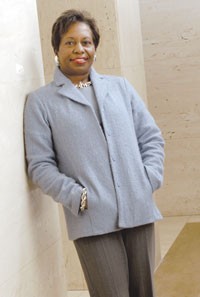
ATLANTA — Dolores Watkins and Lea O’Neal say they have sophisticated clothing tastes and money to spend, but few stores in which to spend it.
Atlantans Watkins and O’Neal are middle-aged, middle class and African-American.
The women said they and many of their contemporaries have been largely ignored by the fashion industry and retailers, which have never fully addressed their needs for fit, wider size ranges or preference for dressier, more put-together looks. They complain that predominantly black neighborhoods have far fewer retail offerings than white areas.
Their frustrations are especially resonant because Atlanta has one of the largest, fastest-growing and most prosperous African-American populations in the U.S. The Atlanta metropolitan area has about four million people. The number of blacks in the 20-county region increased 57.2 percent from 1990 to 2000, compared with an overall population growth rate of 38.4 percent, according to U.S. Census figures.
“Stores have never courted an upwardly mobile black customer,” said Camille Wright, owner of Kaleidoscope, a contemporary boutique in Decatur, Ga., about 10 miles east of Atlanta, one of the few stores to cultivate a mix of white and black clientele, who range in age from 27 to 45. “Black women are used to difficult, inconvenient shopping experiences. They’ve never had product that addresses them, much less the pampering and service behind it.”
Watkins, who is in her 50s and runs an accessories showroom in downtown Atlanta, has practically given up on retail apparel and relies on custom tailoring for suits and dresses to get the fabric, fit and look she wants.
O’Neal, 51, a freelance writer and founder of several social organizations for black women, has lived in a mostly black southwest Atlanta neighborhood for 28 years. Yet she often finds it more efficient to spend several hundred dollars on airfare to shop special occasion stores in her native New York than to try finding what she needs closer to home.
“There are no stores in my neighborhood that suit my needs,” said O’Neal, a large-size customer on a weight loss program who plans to spend about $3,000 to update her wardrobe this year. “The closest mall is all cheap jewelry or fast food.”
Related Articles
You May Also Like
Atlanta is the nation’s “sweet spot” for marketing to African-Americans, said Jeffrey M. Humphreys, director of the Selig Center for Economic Growth at the University of Georgia. And Georgia is the only state that ranks in the top 10 among states in three key categories: largest black population, fastest growth rate and highest African-American buying power, which is defined as total personal income after taxes.
Nationally, the black population is projected to grow 29.9 percent from 1990 to 2009, compared with 12.1 percent for whites and 23.7 percent for the total population. The 10 states with the most African-American spending power are, in descending order: New York, California, Texas, Georgia, Florida, Maryland, Illinois, North Carolina, Virginia and Michigan.
Total African-American buying power increased 127 percent, to $723 billion in 2004 from $318 billion in 1990, and is projected to reach $965 billion by 2009, according to a study last year by the Selig Center. From 1990 to 2009, African-American buying power will grow 203 percent, compared with 140 percent for the white market.
African-American women spent $11.8 billion on apparel in 2004, up 10.1 percent from 2003, according to The NPD Group, a Port Washington, N.Y.-based research company. Spending by the total female population was $94.5 billion, 4.9 percent higher than in 2003. An NPD survey last year found that 75 percent of African-American women said they were “interested or very interested” in fashion and spent more on the category, compared with 50 percent of total respondents. When asked the same question about electronics and computers, the percentage for blacks and total respondents was the same, about 75 percent.
Apparel has lagged other industries, such as cosmetics, cars, technology and entertainment, in successfully marketing to African-American women, experts said.
“In a time when retailers and manufacturers are so challenged to grow their business, here’s a golden opportunity the apparel industry is either unaware of or totally ignoring,” said Wendy Liebmann, president, WSL Strategic Retail, a New York retail-marketing consulting firm. “Fashion retailers have been looking in other directions, like teens, Hispanics, [Baby] Boomers, etc. Here’s a consumer ready and eager to spend.”
Liebmann said neglected real estate in black neighborhoods indicated a lack of understanding or unwillingness to address the customer.
“I hope it’s a sin of omission, not commission,” she said. “When neighborhoods change and black people move in, retailers often leave and are slow, or afraid, to come back in.”
Such is the case in DeKalb County, east of downtown Atlanta, where the black population increased 56.6 percent from 1990 to 2000, compared with 21.9 percent total population growth, according to Census figures. DeKalb is one of the inner rings of originally white middle-class suburbs that have shifted to more black, Hispanic and Asian residents. As whites moved out, retail that served them followed, said Leonardo McClarty, president, DeKalb County Chamber of Commerce. Fast-food outlets, pawn shops and check-cashing operations have replaced restaurants and specialty stores.
One of DeKalb County’s retail success stories is Stonecrest Mall, a 1.3 million-square-foot shopping center that opened in 2001. Owned by Forest City Enterprises and Cadillac Fairview Corp., Stonecrest, about 30 miles southeast of downtown, serves a 67 percent black demographic, mostly educated professionals with average household incomes of $65,000, according to the International Council of Shopping Centers. Anchored by Macy’s, Sears, Dillard’s, J.C. Penney and Parisian, the lineup of 120 specialty stores includes Cache, Ann Taylor Loft and Gap.
Sales for 2004 averaged $400 a square foot, according to the council of shopping centers, which cited an industry average of $345. Stonecrest also spurred surrounding development, including office space and restaurants. Women’s apparel is Stonecrest’s most successful category, with double-digit gains in 2004, said Donald Bieler, marketing director, who added that there is demand for upscale stores, but getting commitments is difficult.
“Our top requests are Coach, Banana Republic, Bebe and Chico’s, and we’re speaking to these merchants,” he said. “But it took 20 years to get developers, officials and retailers on board to build the mall, the only large center in the area.”
Chamber of Commerce president McClarty drives developers around DeKalb neighborhoods to sell them on the area. While he acknowledged that lower-income districts skew the demographics, developers are often surprised by the relative affluence.
“Developers are often afraid to be the first to commit, but sometimes there’s the ‘ah-ha’ moment,” he said.
Beyond attracting stores, African-American women said few retailers and designers offer the fit, size range and style considerations they want. Lines such as Baby Phat, Rocawear and Enyce that are attuned to the young black women started as spin-offs of men’s lines.
But the explosion of so-called Urban brands in the last decade, including Fubu and Sean John, did get the attention of a few big retailers, who now recognize the potential of the older market. Macy’s Central, formerly Rich’s/Lazarus/Goldsmith’s, with 71 stores, mostly in the Southeast, considers the larger demographic.
“Urban business was the catalyst, the low-hanging fruit,” said Gail Nutt, senior vice president, community affairs, diversity and urban business development. “Now the urban business is big, but not growing. We don’t need more jeans lines for young black women. The opportunity is for the 35-to-55 age group. And it is huge.”
Nutt, 50, researches the African-American population, which is 25 percent of the customer base in many of her markets.
“We’ve learned that she likes brands,” Nutt said. “She will invest in work apparel, and has a multitude of needs, from suits to accessories and shoes, from traditional to updated. There’s a sassiness about her, and we can’t just have a one-color/style-or-size-fits-all approach.”
At each store with a large African-American clientele, Nutt analyzes sales, determining best-selling categories, such as suits, then beefs up inventory to make sure popular sizes, colors and styles are in stock. The effort has improved sales in suits and career sportswear, helped consumers get what they want and reduced markdowns, Nutt said. Brands that are hot with African-American consumers — Jones New York, Ralph Lauren, Liz Claiborne and private label lines I.N.C. and Style & Co — have been increased.
Nutt works with vendors, including Kasper, Tahari, Anne Klein and Liz Claiborne, to offer more variety in skirt lengths for the customer who wants longer lengths or double-breasted jackets. A frequent demand is for color palettes beyond basic black, navy, brown or gray, and for for bolder print patterns. Nutt encourages shoe and jewelry buyers to offer more color choices that coordinate with clothing.
Advertising that targets African-Americans through specific print, radio and TV campaigns has increased, and there is more diversity in the models. For the last four years, in February, Black History Month celebrations in Macy’s stores have included in-store appearances by black politicians, celebrities and authors in Atlanta, Memphis and Cincinnati.
Last October, Sears, Roebuck and Co. announced a revamp of 97 full-line stores — including New York, Miami, Los Angeles, Chicago — in regions it identified as having a multicultural customer base of more than 60 percent. Sears added more African-American designers, along with extended size ranges in private brands, like the women’s sportswear lines Apostrophe and Covington, a spokeswoman said. Sears also celebrates Black History Month and this year published and distributed two million free calendars commemorating black artists in 870 full-line stores.
These efforts need to be consistent and backed by marketing muscle in order to succeed, said Ken Smikle, president, Target Market News, a Chicago news-research company for the African-American consumer market.
“Big retailers are mass marketers, and niche markets don’t often play well in the corporate culture,” Smikle said. “Stores often have innovative ideas, then when they get the small return they want out of it, they’re on to the next thing. This needs to be a long-term investment and commitment rather than an experiment in a few stores.”
One specialty store chain, Urban Brands, made a major commitment 20 years ago. Urban Brands, based in Secaucus, N.J., targets plus-size African-American women 30 years old and up, and has grown to more than $300 million in annual sales. Merchandise evolved as the customer has become more sophisticated, said Marla Minns, vice president, general merchandise manager. Recent fashion additions include bouclé, Lurex, fringe and more denim offerings with a variety of washes, novelty and fit options.
“We don’t look at her as just black and large-sized, but as a sexy, confident woman,” Minns said. “She’s more educated and affluent, and she wants individual expression in her clothing. We embrace this woman. There’s not a lot out there for her because the industry isn’t going after her.”