
TOKYO — Perhaps only in fashion-obsessed Japan would a crowd of more than 1,000 shoppers line up for hours waiting to greet the opening Sunday of the world’s largest Christian Dior boutique in Omotesando here.
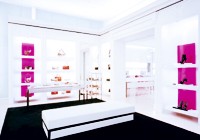
Designed by architects Kazuyo Sejima and Ryue Nishizawa of the firm SANAA, the building, occupying a corner lot, was inspired by a John Galliano couture dress. The double-layered facade combines transparent flat glass on the outside with curved acrylic walls inside — vaguely reminiscent of layers of tulle. Perched on the top of the building stands a neon star, the French house’s good luck symbol, which is visible for blocks.
Related Articles
“I want to give full marks to this shop,” said Bernard Arnault, president of Christian Dior SA and chairman of LVMH Moët Hennessy Louis Vuitton, who flew to Japan to celebrate the opening. “Of course, this is one of the steps for further business expansion of the brand in Japan. I am not satisfied with the present scale of business, but I am 100 percent satisfied with the new shop.”
You May Also Like
“Dior has stepped into the next phase,” asserted Sidney Toledano, president of Christian Dior Couture. In 1997, Dior terminated its 30-year-long licensing agreement with Kanebo in Japan and started to manage the brand directly. Since then, Dior’s popularity has skyrocketed in this market.
“Sales in 2003 were doubled compared with two years ago,” Toledano said of the Japanese business. “In this new shop, we are presenting Dior’s luxurious, deluxe, elegant and modern image to reach the consumers of mainly 25 to 35 years old who have buying power.”
Dior declined to give sales projections for the store, but Toledano said, “We are now expecting more sales than our original budget,” given the strong response. On Sunday, the boutique sold 500 limited-edition “Hardcore” handbags priced at about $905, or 98,000 yen at current exchange.
Market sources estimate the boutique would likely pull in at least $24 million the first year.
About 17 to 20 percent of Dior’s sales now comes from Japan, “and within three to four years, we want to increase the ratio to 25 to 30 percent,” said Toledano. “We have plans to open flagship shops in Kobe, Shinsaibashi in Osaka and Ginza. Of course we need more shops in this market of high potential.”
The building, which boasts about 10,760 square feet of selling space, has four floors above ground level, plus a penthouse. At 5 p.m. last Saturday, people started gathering in the dark for opening festivities. The crowd cheered when the building blinked to life, bathing the sidewalks in white light. The shop is located at 5-9-2 Jingumae, Shibuya Ward in Tokyo.
According to Dior, a line of customers began forming at midnight Saturday ahead of the 11 a.m. opening Sunday. At the police’s urging, Dior threw open the doors 30 minutes early to help ease congestion on the popular shopping strip, often called the “Champs-Elysées of Tokyo.” Dior and LVMH already have a stranglehold on the street, home to the world’s largest Louis Vuitton store, as well as Tag Heuer, Chaumet and the One Omotesando building in which Fendi, Celine, Loewe and Donna Karan are located. Chanel, Gucci and Yves Saint Laurent boutiques are also on the block.
The first and second floors of the Dior flagship are devoted to women’s products created by Galliano. The interior was produced in collaboration with architect Peter Marino and Architecture & Associe. The decoration is similar to the Dior flagship on Avenue Montaigne in Paris, reprising the ornate French moldings that are original to that site and combining them with more modern elements, including giant television screens and sleek shelving units.
Beauty products are featured on the third floor in a setting designed to evoke the creative frenzy backstage at Dior fashion shows. Skin care treatments echo the theme. There’s one for making skin tight for looking one’s best on the runway and another for healing tired postshow skin.
The basement level showcases the Dior Homme universe created by Hedi Slimane with a sleek, futuristic gloss. Shiny materials like lacquer, glass and mirrors are ubiquitous and interact with light for a graphic effect.
As reported, artist Carsten Höller from Stockholm was enlisted to create the fitting cabins. Instead of a mirror, visitors encounter a projection surface where images of themselves appear and change systematically, presenting different angles of the individual in a series of still frames.
The opening comes roughly 50 years after the first Christian Dior fashion show in Japan, which took place upon the invitation of the Cultural Institute in 1953 and marked the beginning of the history of fashion shows in Japan. For Christian Dior, the Ometesando unit represents its first boutique entirely created from the planning stage.
In tandem with the opening, Dior also hosted a special display of couture dresses at Meiji Jingu Shine, including a “New Look” style by Dior himself.