
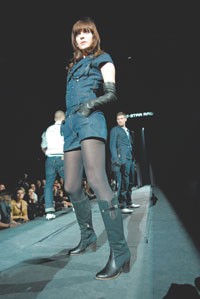
BARCELONA — Talk about a contemporary movement: European sportswear brands showing at the recent Bread & Butter trade show here spun out smartened-up styles in the face of fierce competition from fast-fashion chains and a saturated denim market.
The show, which wrapped up its three-day run Jan. 19, was awash with brands keen to diversify their offerings and smooth the boundaries between high fashion and comfort. Many were also taking a minimalist approach to their collections.
Retailers noted that labels such as Levi’s, Lee and G-Star were diversifying to cover all fashion categories, including outerwear, footwear and accessories.
Targeting a more sophisticated clientele, vendors showed sportswear, streetwear and jeanswear based on clean, streamlined styles. Slim-fitting raw denim worn high on the waist, discrete branding and men’s wear-inspired tailoring applied to women’s jeans were key directions for fall.
Somber dark blue, gray and black set the tone.
Trimmings, such as leather detailing and fabric-covered buttons, added a soupçon of sophistication to collections and allowed for more individuality.
“Collections are clean, but not conventional,” said Jackie Brander, owner of Fred Segal Fun in Santa Monica, Calif., adding that skinny jeans were finally a commercial success at her store.
“There is a return to the basics with elegant, simple silhouettes,” Brander added as she placed orders with France’s American Vintage, Dutch contemporary brand Dept and Canada’s Plain Jane Couture, among others.
Brander noted she would sell exclusively in the U.S. the debut fashion and accessories collection of Smiley, founder of the Smiley face logo.
“The season is about sobriety, elegance and refinement with pure lines and subdued silhouettes,” said Grégoire Proffit, women’s buyer for Galeries Lafayette in France. Proffit, who said his budget was up from last year, said that he would reserve between 15 percent and 20 percent for replenishments and new in-season products.
“Cruise collections or in-season collections were once considered elitist, but today it’s no longer snobbery but a necessity for young brands,” explained David Pariente, president of Paris label American Retro.
With the launch of Zoe’s Tee’s last October in Paris, the entrepreneurial Pariente, who is the son of Gérard Pariente, president of French fast-fashion retailer Naf Naf, presented yet another fashion line at the show. Dubbed Zoé’s Cash, the collection offers a selection of cashmere tops and comfortable dresses and leggings made from ultrafine cashmeres in soft colors and retails for around 300 euros, or $390.
Related Articles
You May Also Like
Buyers from across Europe, especially Spanish, German, Italian and British ones, attended the show. And while a dearth of American and Japanese buyers was noted, it was less of a concern than the unseasonably warm January temperatures that neared the 70 degrees mark.
“The changes in climate are going to start becoming an issue. Outerwear will have to become a part of short-order sales,” said Laurent Roure, co-owner of London’s Bread and Honey, which sells sportswear and contemporary brands for men and women. Roure said he placed orders with London’s Laura Lees Label, France’s Sessùn and Spanish accessories line Mimotica Micola.
The Mimotica Micola label, designed by Barcelona graphic designer and accessories guru Raquel Micola, boasts whimsical designs in tweeds, tartans, patchworks and polkadots that she pairs with her comic characters Mimo and Mr. Pain for a colorful handbag line at affordable prices.
Although many buyers said their budgets remained on par with last season’s, they were shy of placing orders and preferred to hold back as much as 20 percent to 40 percent of their budgets for immediate deliveries and new styles.
“Replenishments are key,” said Patrick Kraaijeveld, G-Star’s export director, noting the brand’s 24-hour delivery policy. “Increasing frequency of deliveries and introducing new in-season styles is a key strategy to drive group sales.”
G-Star has increased its sales by 35 percent year-on-year. According to Kraaijeveld, raw denim looks and discrete branding will be the main fashion messages for fall, along with unique touches. “We’ve integrated cleaner, more mature looks into the collection,” he said. “The market for denim is extremely competitive, so we centered our focus in a smart way on smarter-looking denim.” G-Star also unveiled its debut footwear line, G-Star Raw Footwear.
Levi’s Europe is cleaning up its act for fall. The brand’s Levi’s Blue line boasts elegant cuts in rigid, dark, unwashed denim with an industrial-chic feel.
“Rigid jeans are our bread and butter,” said Miles Johnson, senior designer at Levi’s Europe, noting square cuts around the hips, skinny denim with ultrahigh waists and androgynous denim styles for women would be key features of fall wardrobes.
“We are moving into sportswear couture,” agreed You Nguyen, senior vice president of Levi’s product for Levi Strauss Europe.
When it comes to trends, Northern European and especially Scandinavian labels, pioneers of the superslim styles, are up on the latest fits.
“The hype is on the skinny, but we see the trends moving back to straight, traditional fits and raw denim in the future,” said Palle Stenberg, president of Nudie Jeans, based in Gothenburg, Sweden. The brand’s jeans retail at 99 to 150 euros, or about $130 to $195.
Stenberg said the Japanese denim market was, of course, tuned into the latest styles. In fact, Nudie Jeans will inaugurate its first flagships in Stockholm and Tokyo in March.
“The stores will give the brand a window which will allow us to build our image and business,” Stenberg said.
Premium denim lines such as France’s Atelier de la Durance and budding Intoxica, of Amsterdam, continued to offer forward-thinking looks using ultrarigid silhouettes and Japanese selvage denim.
“The collection was inspired by the industrial revolution and how it boosted a new wave of creation,” said Kentroy Yearwood, creative director and co-owner of Intoxica, which presented its first high-end women’s wear collection at the show. Prices range from 110 euros to 116 euros, or $143 to $150.80, at wholesale for denim. Yearwood, who pinch hits as a professor of fashion design at the Kolding design school in Denmark, added special elements to his collection such as a 19th-century inspired denim cape and elegant, slim-fitting denim vests.
Sportswear brands are also opting for unique touches and cleaner fits for fall. Take Aem’Kei, based in Berlin, which boasts a more elegant take on sportswear as the key direction for next winter.
“Younger populations are going away from the streetwear trends,” said Markus Klosseck, president of the label. According to Klosseck, trendy girls today are no longer prepared to suffer for fashion. “Comfort is a key issue today,” he said.
Comfortable sportswear and loungewear stood out at the show as part of an underlying comfortable leisure trend. France’s American Vintage and Germany’s Schiesser innerwear collection were favorites among retailers, and Spanish designer Davidelfin launched his new line, DA Davidelfin, a sports couture line, a 100 percent cotton collection of sweatshirts and T-shirts for men and women.
The well-being message at the show certainly was evident at Smiley, the Seventies brand behind the famous Smiley face T-shirts. “We are launching our first fashion and accessories lines,” said Nicolas Loufrani, chief executive officer and son of Smiley’s founder, Franklin Loufrani.
The line boasts a selection of cashmere knits equipped with stitched, Swarovski crystal-studded or gold-threaded Smiley faces for around 110 euros, or $143, at wholesale for men and women. Dresses, denim and a full jewelry collection round out the women’s collection. “We’ve repositioned a logo that everyone knows and put it into a more fashionable environment,” said Loufrani. “The fashion line has been very successful because our clients haven’t forgotten the pleasant mood behind the brand.”