
SAN FRANCISCO — Bebe, which cultivates a Hollywood aura with actresses like Eva Longoria wearing its microminis, wants to fill what chief executive officer Greg Scott described as an “affordable luxury” niche.
After 30 years in business, executives at the 248-store retailer hope to erase any perception of it left from the Nineties as a place for teenagers to shop for prom dresses and tight logo T-shirts. Bebe’s target audience — fashion-savvy women in their 20s and 30s with lots of disposable income — is similar to A|X Armani, BCBG, Diesel and Guess.
“We don’t want to be a junior retailer,” said Scott, adding that the company is seeking sophistication in all facets of the business.
Bebe’s latest push to polish its affordable luxury credentials was the opening in September of an accessories and footwear boutique, Neda by bebe, at Westfield’s San Francisco Centre mall. The gleaming store done in pink, white and chrome with black marble floors is named for Bebe’s vice chairman, Neda Mashouf, the wife of chairman and founder Manny Mashouf.
“This is a whole new beginning for Bebe stores,” Scott said, sitting in a white leather bucket chair tucked in a corner of the store. A second Neda by bebe is to open next year in Los Angeles, and other locations will follow, he said.
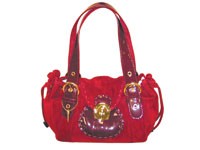
The merchandise under the Neda by bebe label is Italian made and sells for about $250 to $500, including items such as $260 suede-patent leather satchels; $330 round-toe, red patent leather high heels with an ankle strap, and $500 rabbit fur baguette shoulder purses. There is a smattering of shoes in the $500 range from other designers, such as Terry de Havilland’s retro-Seventies platform sandals updated in a python print.
Neda Mashouf, 43, said the store wasn’t stocked with a list of must-have trends in mind. “Personally, I don’t like to carry the ‘It,’ bag,” she said.
Neda by bebe is intended to fill what company executives consider to be a gap in the accessories and footwear market between high-end labels and luxury names. That realm would fall above Charles David and Stuart Weitzman, but below Dolce & Gabbana and Prada. The Neda label is a step above the accessories line already sold in Bebe stores and is being expanded.
Related Articles
You May Also Like
With Neda by bebe, “What they are saying to the world is, ‘You don’t have to go to the four or five marquee names in the accessory business in order to really get a good shoe or outrageous handbag,'” said retail consultant Janet J. Kloppenburg, who described the store as being “all about dress-up, which is where fashion is going.”
The Mashoufs and Scott, who joined the company in 1996 as chief merchant, are in sync on fashion trends. “They really know how to finish each other’s sentences,” Kloppenburg said.
Bebe’s direction seems to be paying off, with same-store sales increasing for the last three years after four consecutive years of declines. For the fiscal year ended July 1, Bebe’s volume was $579 million, a 6.1 percent same-store sales increase. For the last 43 consecutive months sales have risen in stores open at least a year, with an 8.2 percent gain for the September-October period.
The company’s falling same-store sales were attributed to rapid expansion and other growing pains after going public in 1998 with $95.1 million in sales and 85 stores. The initial public offering raised $13.8 million. During this period, Bebe sought to stem a talent drain and moved the design department to Los Angeles from San Francisco to be closer to the West Coast’s fashion hub, where teams of designers could be recruited and retained. The company’s corporate offices are now in Brisbane, near San Francisco International Airport.
“At the same time we were going through a transition from a company where we were all about sportswear, to a fashion company that was all about separates,” said Scott, 43.
Scott returned to Bebe in 2004 as ceo after leaving in 2000 to become president of Arden B., a Wet Seal division.
As part of a tighter focus on fashion, Scott said in the last year the suit options in Bebe’s inventory, like $98 wool pencil skirts, matching $189 cropped blazers and $149 black satin bustiers, have increased while Bebe logo T-shirts — popular with teens — have become less numerous
The company has 10 designers and 10 design assistants who create merchandise, half of which is produced by contractors in the San Francisco Bay area, Los Angeles or New York. The added cost for domestic production is worth the benefits of responding quickly to hot fashions and keeping U.S. manufacturing jobs, Scott said.
As Bebe looks to add 50 stores next year — 28 Bebes, 21 Bebe Sport shops selling fashionable active wear and one Neda by bebe — the company also is finding new ways to be part of the show business spotlight.
Last December Bebe opened a 7,500-square-foot flagship on Rodeo Drive in Beverly Hills. “That really signaled our desire to be considered an affordable luxury brand,” Scott said.
Next came a special runway line designed by Seventh Avenue veteran David Cardona and first shown in March at Los Angeles Fashion Week at Smashbox Studios. Called Collection Bebe, the line includes a $525 strapless gray wool gabardine minidress with a wide waistband and a matching $495 jacket with tulip cuffs. The frocks went on sale Sept. 28 and are being limited to only 20 stores to maintain a sense of exclusivity.
In time to celebrate Bebe’s 30th year, the company also is reissuing a miniskirt with matching jacket popularized by Heather Locklear in the Nineties on TV’s “Melrose Place,” a product placement that helped to solidify an image of Bebe that Manny Mashouf had cultivated. The current face of the brand is Mischa Barton.
Neda Mashouf recalled that the original design for the Locklear suit was copied and sold by a contractor in Paris whom the Mashoufs had hired to produce it. When the garments failed to arrive, the couple flew to Paris. “We saw our special order all over stores in San Germain,” she said. “It was a special pink jacket with a pink bow and a matching miniskirt,”
Manny Mashouf, 68, began Bebe almost on a whim — he spotted an empty storefront — and jumped into women’s fashions from owning three steakhouses that he started after receiving a political science degree in 1966 from San Francisco State University.
Mashouf grew up in Iran, and all he knew about fashion came from hours he had spent as an adolescent accompanying an older sister on shopping trips to designer boutiques in Tehran.
The business, which now has 4,000 employees, was first called Caspian Corner and located on Polk Street in San Francisco. That space is now a wine bar. “My first inclination was to make men’s clothing in the basement of the store,” Mashouf said. “I bought three machines, hired a master tailor and patternmaker. Then I realized by the time I’d make enough clothing to fill the store, it would be out of fashion.”
Mashouf said he scoured women’s apparel showrooms in New York, Los Angeles and Europe and arrived at his new market: women in their 20s and 30s who “want to look vivacious, sexy, but not junior and cheap.”
Within a year Mashouf opened a second store on nearby Union Street. He said he named the store Bebe as an homage to Hamlet’s “To be, or not to be” soliloquy after a discussion over drinks with friends at Caffe Trieste, a famed bohemian gathering spot in the North Beach section.
As Bebe grew, one of its fans was Neda Mashouf, who emigrated from Iran at age 15. A computer major at San Francisco State, she became a regular shopper at Bebe, where she met her future husband. Among her early purchases was a tight pair of jeans with side zippers, no stretch. “They were called Marilyn,” she recalled. “You had to lie down to be able to zip them up.”
The Mashoufs hold 73 percent of the company’s outstanding shares of stock. Forbes magazine put Manny Mashouf on its list of billionaires in September for the first time, estimating his worth at $1.5 billion.
Mashouf shrugged off putting any significance to this designation of his success. “I’m laughing at it,” he said. “It hasn’t changed me and I don’t think money will ever change me, no matter how much it is. I’m still the same person I was…when I was in college.”