
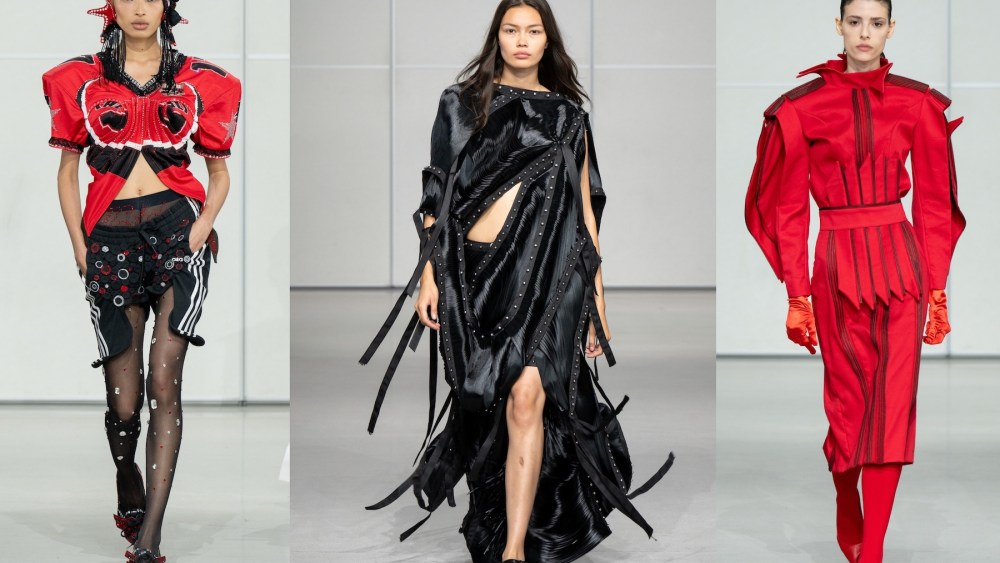
The runway show may have been held in New York City, but its looks were worldwide — digital, too.
Parsons School of Fashion held its annual MFA of Fashion Design and Society 2025 Runway Show at Manhattan’s panoramic Glasshouse on Sunday afternoon during New York Fashion Week. This year’s cohort — Generation 14 — comprised the program’s 14th collective of graduating designers, artists and entrepreneurs from 10 different parts of the world.
The students showcasing included Karina Nasywa Bakri, Sustilé Blank, Camila Bustamante, Qi “Effe” He, Jontay Kahm, Dina Mahrouz, Abel Martirosyan, Mikaeru Mo, Kimberly Ortega, Alejandra Parra Parodi, Francesca Salis, Lillian Tuttle, Yingdi Xiong, Maryam Yazdanpanah and Chi-An Yu.
You May Also Like
Related Articles
“I think it’s the most international group we’ve ever had,” said Fiona Dieffenbacher, associate professor of fashion for the School of Fashion at Parsons School of Design. “It’s really a global group, bringing global perspectives on fashion and identity and craft, by drawing on their cultural backgrounds and bringing that to bear in the context that they’re in in this moment.”

to draw and paint. The collection is dedicated to him.
“Crafted from reclaimed materials, this collection celebrates my father by merging Indonesian traditions with the vibrant colors and forms of our shared childhood dreams,” Karina Nasywa Bakri said.
The New York-based Indonesian womenswear designer has a strong foundation in luxury, previously working for brands like 3.1 Phillip Lim, Gabriela Hearst, Prabal Gurung and Proenza Schouler. Bakri creates work that explores her childhood, heritage and dedication to contemporary craftsmanship.
Her collection is part of the Takihyo for Good sustainability initiative, Bakri said. Three-quarters of the garments were created with reclaimed outdoor-gear materials from their warehouse.

“This collection turns the in-between space into a wardrobe,” Sustilé Blank said. “It is part battle gear, part love letter for anyone navigating their own transformation.”
Blank, the nonbinary mind behind Detroit-influenced brand Skndlss, is an interdisciplinary artist based in New York City. Titled “Softening the Edges,” Blank’s collection draws on the dark fantasy of hyper-stylized 2000s cult-classic films.
“In those worlds, heroes lived between realms — never fully belonging, yet powerful in their liminality,” Blank said. “As a queer person, I identify with that space — with the tension of moving through a world that tries to define you, while crafting your own armor and mythology.”

“My room is still a mess and my socks don’t match and I hate my bra,” Camila Bustamante said.
The Brooklyn-based fashion designer specializes in knitwear and luxury clothing. Her collection is a tableau of teenage girlhood through the lens of her adolescence in Lima, Peru.
“Intentionally unorthodox proportions evoke the awkwardness teenagers feel when they become aware of their changing bodies, societal body standards and cyclical trends,” Bustamante said, noting the combination of Neoprene and Japanese denim with commonplace clothing invites the viewer — and the wearer — to experience the “everyday life of a 2010s teenager growing up online.”

“If conformity dies, we live,” Qi “Effe” He said.
This collection, titled “31: Offside Identity,” began with the idea of an assertive uniform, the Chinese-born, New York-based fashion designer said. The result is “elegance with teeth,” per the 2024 recipient of the CFDA Scholarship Fund — a “manifesto exalting the merger of sportswear and femininity” with pieces that are “hyper-feminine but never fragile.”
“Life is a collision — you stitch yourself back together with the threads that remain in the aftermath. Fashion is defiance,” Effe said. “It’s how we scream without words in a world that demands silence. Uniforms represent conformity. Without them, how would we know what to tear apart?”

“Blending traditional craftsmanship and avant-garde aesthetics, I create powerful expressions of identity, history and spirituality,” Jontay Kahm said. “My work challenges perceptions and celebrates Indigenous people and our culture.”
Kahm expands on the concept of women’s ribbon skirts in his first menswear collection, “Beyond Vessels,” to challenge gender norms. He does so by blending masculine and feminine elements of Native fashion into a non-gender-conforming line, he said, to not only honor Indigenous heritage but push the boundaries as well.
Kahm, a rising Plains Cree fashion designer from Saskatchewan, Canada, received the “Best Emerging Fashion Designer of the Year” award at the 2024 Creative Arts and Fashion Awards in Toronto. He was a finalist for the CFDA Graduate Award the same year.

“Is it in the pressure of tightness that the desire for space is born,” Dina Mahrouz asked.
Originally from Iran, Mahrouz holds a Bachelor’s degree in both urban engineering and fashion and textile design from Tehran University and Turkey’s Izmir Economic University, respectively.
Her collection, “From Framework to Freedom,” is an award-winning MFA Fashion Design and Society thesis that received Parsons’s Student Research Award. The personal exploration of restriction and release was inspired by the ill-fitting garments of the Iranian designer’s teenage years, Mahrouz said.
“Worn out of necessity, due to a lack of options in my small, isolated city, these pieces made me feel physically and emotionally restricted,” she said. “They shaped how I moved and experienced the world.”
Mahrouz has worked with designers and brands across Turkey, Iran and New York, including 3.1 Phillip Lim, Veronica Beard and Retrofête. She was selected for the LVMH 360 Sustainability Project and participated in the Proenza Schouler x Gormek Institute Fashion Business Mentorship as well.

“This is not about looking back,” Abel Martirosyan said. “It’s about building something new from the past — a world where clothing protects, reveals and empowers all at once.”
Martirosyan’s collection, “Valley of the Mythic,” is inspired by traditional Armenian costume, reimagined through a contemporary and dreamlike lens, the Armenian-born designer said.

“Precision in shell, strength in line — ornament is optional, adaptation essential,” Mikaeru Mo said.
The Shanghai-based fashion designer specializes in the fusion of bespoke tailoring and high-performance sportswear. His collection, titled “Cut by Wind, Sewn by Hand,” marries high-performance outdoors gear with polished menswear tailoring to “embody a commitment to innovation and accessibility,” Mo said.
“Informed by elegance and utility, I’ve incorporated technical detailing such as Fidlock magnetic snaps; coated, waterproofed nylon, and thermal insulation to create garments that seamlessly transition between urban life and extreme environments.”

“When fabric becomes memory,” Kimberly Ortega said, “the unwanted is reimagined as deeply human.”
The Ecuadorian interdisciplinary artist and fashion designer launched her label, Soak (aka her initials backward), in 2021. Her collection, “The Art of the Unwanted,” is about telling stories, blending cultural aesthetics and reinterpreting workwear through an expressive, personal lens, per Ortega.
“I grew up as a middle-class kid in Ecuador, surrounded by piles of plastic from the auto-parts junkyard owned by my parents. I remember my dad saying, ‘I make money from the trash.’ He always found potential in what others discarded,” she said. “While creating this collection, I quickly realized I was following my father’s vision, only through fabric.”

“I am here. I am seen. I am vast,” Alejandra Parra Parodi said.
Parodi’s designs portray the inner world of the Latine mad woman: “one who has bravely defied convention and been ostracized because of it,” the Colombian designer and artist said.
Her “Skins for Undomesticated Thoughts” collection draws inspiration from women writers who were marginalized within the male-dominated Latin American literary boom of the 1970s and ’80s, Parodi said. Leather and iraca palm — materials from contrasting geographies, per the designer — are brought together to illustrate the tension between sensitivity and intellect that these women embodied.
The leathers were sourced from La Nueva Peletería, a local supplier in Colombia. The woven pieces were created in collaboration with Marelys Escalante, a master weaver and leading expert in iraca palm craftsmanship from the artisan community of Usiacurí, Colombia.

“This collection is a reflection on identity, memory and transformation, interpreted through Sardinian cultural heritage, historical silhouettes and the emotional resonance of clothing,” Francesca Salis said.
The Italian fashion and knitwear designer merges historical references with contemporary silhouettes. Inspired by traditional Sardinian dress, “Beneath the Layers” explores garments as “vessels of memory, belonging and unspoken social codes around gender,” Salis said.
“Though I didn’t grow up in Sardinia, my connection to the island through my grandfather’s roots, family stories and archival research provided a framework for reimagining its traditions in a contemporary context.”
Using materials such as silk, leather, chiffon and reclaimed textiles, Salis tapped techniques like draping, hand-stitching, lacework, corsetry and fabric manipulation.

“You’ll no doubt feel a bit strange right off the bat, as if seeing your ceiling for the first time,” Lillian Tuttle said. “This is understandable.”
Born and raised in Petaluma, Calif., Tuttle has designed clothing for herself and her community since childhood, she said. The New York-based fashion designer’s collection, powered by research involving early American clown costumes, is a wardrobe of pieces “available for each clown to pluck from as they see fit,” she said.
“Life needs clowning up. Clowning is an approach to the day-to-day; a methodology of vulnerability, emotional transparency, resiliency and throwing away the script,” Tuttle said. “I want to ‘clown up’ our everyday dress.”

“No wedding dress spoke my people’s tongue, so I forged one,” Yingdi Xiong said. “I tore apart the rulebook and rewove it with bridal nostalgia, waste, yarn and rebellion, stained in the bold, fierce colors of a heritage too long forgotten.”
The Beijing-born knitwear designer’s brand is rooted in Asian heritage and joy as well as storytelling. Trained at Central Saint Martins and Parsons, she builds colorful, sculptural garments — working with textile waste, crochet and structured silhouettes — to reimagine tradition for a global audience. The collection is a “tactile language of joy, memories, labor and belonging,” she said, “stitched from fragments of what we almost forgot.”
“While researching Chinese wedding garments, I was moved by the patchwork techniques of the past, used to hand-stitch blessings from mother to daughter,” Xiong said. “I’ve reconstructed this tradition using post-industrial textile scraps, transforming factory waste into sculptural garments that hold both fragility and strength.”
Each piece was shaped using sugar-water stiffening, a traditional Chinese technique once used to give structure to sleeve edges and collars.

“To wear Saaku is to embrace one’s warrior spirit — to walk through the world armored with confidence, strength, mindfulness and self-expression, ready to conquer both the visible and the unseen,” Maryam Yazdanpanah said.
Before graduating from Parsons, the Tehran-born, New York-based designer earned a Master of Science from RMIT University in Melbourne. Yazdanpanah won the 2022 A’ Design Award and received honorable mention from the IDA Design Awards. She was a 2023 mentee of the Gromek Institute x Proenza Schouler Fashion Business Program as well. She established Saaku in 2016.
“Each look is tailored to a unique warrior with a name: Light Keeper, Blade Forger, Blood Runner, Shadow Walker, Flame Voyager and Sun Riser. These identities represent different aspects of my inner evolution,” Yazdanpanah said. “I exist across the spectrum of these six roles. Some I have stepped into, others I am still growing toward.”

“Time leaves its mark not in moments, but in what remains,” Chi-An Yu said.
The Taiwanese designer’s collection, titled “About Time,” saw garments made by bonding tracing paper and fabric, per Yu, with suits reshaped, uniforms undone and paper turned into weight.
“Cuts expose seams, folds become structure and details carry traces of time,” Yu said. “Clothes are my letters, cut, folded, sewn. They carry regret, but also the chance to begin again.”