
Like the shows themselves, retailers found the New York collections to be a bit all over the map.
While generally feeling optimistic about the season — helped by the burgeoning U.S. economy and the strength of the dollar against the euro — buyers also expressed some disappointment that there were no major unifying trends for fall in designer apparel. The category has been in the doldrums at retail for the last few years, and stores as well as designers continue to seek the magic key to unlock consumer spending.
So the mix of trends — folkloric and Victorian-inspired looks on one hand, Nineties minimalism on the other — had some buyers wishing for a little more cohesion.
Related Articles
“What many people lamented about spring was that so many designers were feeling the bohemian moment,” said Ken Downing, senior vice president and creative director of Neiman Marcus. But Downing liked the overarching theme of spring, and wanted to see more agreement on this season’s runways. “It says to the customer, ‘this is where fashion is headed.’ I wanted to see more of that in New York.”
You May Also Like
“In general, I didn’t think it was a very strong week,” said Beth Buccini, cofounder of Kirna Zabête. “I feel like too many American designers are overly inspired by what they see in Europe. I wish they would work a little harder to find their own voice.”
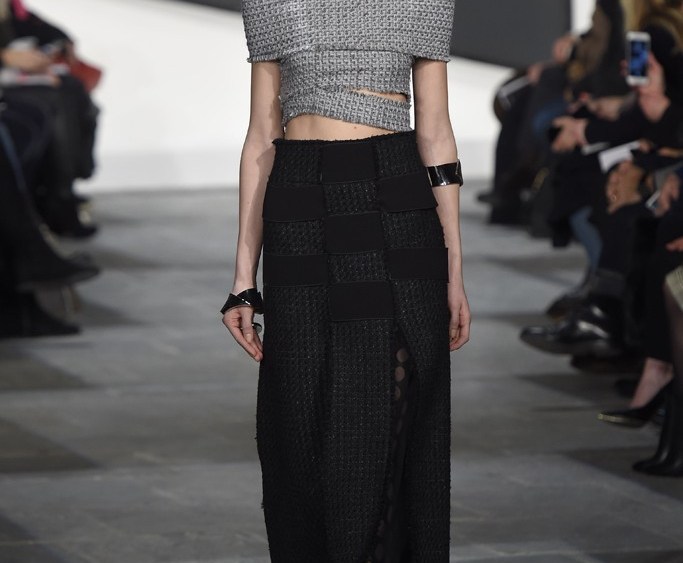
There were standout collections, though. Buyers almost unanimously praised Joseph Altuzarra, Jason Wu, Proenza Schouler, Victoria Beckham, Thom Browne and Prabal Gurung, while pointing to newer lines like the women’s collection by Public School, Gabriela Hearst, Baja East and Brock.
Key for most retailers there were the words “price” and “value.” With the dollar strong, American stores are feeling flush and looking forward to their trips to the European shows even as European stores are being a bit more cautious about their buys in New York. Meanwhile, the strength of the U.S. economy has stores feeling upbeat even as they admit the consumer is pickier than ever.
Downing said it’s important for the price-value relationship to be readily apparent in the clothes. “This has taken place since the recession and will continue going forward,” he said. “When the clothes look the price, it’s not a problem. I was happy to see that many designers brought so much embellishment and detail to their collections.”
Victorian blouses with lace at Joseph Altuzarra, fur and calf-hair accents at Proenza Schouler and intricate Moroccan patterns at Tory Burch “speak to a folkloric, crafted sensibility,” Downing said, adding, “I loved Carolina Herrera’s shapes and color palette. Joseph Altuzarra keeps us wanting more.”
“I like when there’s a reason to buy and it was quite clear,” said Suzanne Timmons, senior vice president and fashion director of Hudson’s Bay and Lord & Taylor. Timmons, whose top collections included Thom Browne, Rodarte, The Row, Prabal Gurung and Victor Alfaro, saw a bevy of must-have items such as luxe parkas and long coats, slipdresses, sweater dresses, jackets and blazers. “Every show had blazers, which is very good for business,” she said. “It’s an item that’s not been present in any way, except in the old, farty suit departments.”
Despite many options, she’s playing it safe in terms of her spend. “We always have to be careful about what we’re buying all the time,” she said. “We go in with our budgets and know how much we’re going to spend on a particular collection. Even though the euro is not strong, the U.S. dollar is good. It doesn’t make you buy more. For us, in Canada, it’s not going to make us go crazy and buy more. Our dollar is kind of weak now, so I wouldn’t think the prices are dropping too much.”
Timmons’ week started off “kind of ho-hum,” then picked up steam. She’s adding lines such as Public School and keeping an eye on Rosetta Getty, Sandy Lang, Baja East, Sally Lapointe and Gabriela Hearst. “There’s a lot of new talent coming up. We’re certainly going to hear more from them. This is a category that’s expanding.”
Barbara Atkin, vice president of fashion direction at Holt Renfrew, said the week ushered in a new form of “relaxed luxury with nonchalance and beautiful ease that’s in keeping with how people are feeling today.” Singling out designers such as Derek Lam, The Row, Rag & Bone and Alexander Wang, Atkin said the torch is being passed from established designers to a younger generation.
“We were all curious to see how Oscar de la Renta was going to unfold,” she said. “The new designer, Peter Copping, paid his respects to Oscar and didn’t change it up that much. We would have liked to see a little more of what Peter can do. We’d like him to lighten it up a lot more. At the show, it was glaring. There was the old guard, with Barbara Walters, sitting on one side, and the new guard, with Taylor Swift, on the other. I would have liked Peter to have moved the bar a lot more.”
As a Canadian company, Holt Renfrew is “very used to currency fluctuations,” Atkin said. “We adapt accordingly and hedge our currencies. We’ve always had this problem. The Canadian dollar to the euro isn’t suffering. We’re picking up some new designers and going back into other businesses.”
For example, Holt Renfrew will once again sell Jason Wu, Derek Lam and Lam’s 10 Crosby. “We feel it’s time to take a stand with them,” Atkin said. “We’re always looking at the contemporary market in New York. When we see an opportunity, we keep an open-to-buy. We don’t want to miss the opportunity. We’ll continue to spend money in New York, but we also have a big European business.”
It is the European retailers who are feeling the pressure of the weaker euro. “We still feel that this is an important market and we’ll continue our buy,” said Jennifer Cuvillier, fashion director at Le Bon Marché. “Of course, we’re careful with retail prices as the dollar now is almost in parity with the euro. We’re carefully doing our selection to propose the right products to our customers.”
Cindy Ho, fashion director at 360 Style in Kuwait, said the euro hasn’t yet had an impact on the store’s buying, but its effect is being felt in terms of pricing. “It hasn’t been easy,” she said. “Last season, there was a brand that requested we change the price of its products three times, which led to confusion among customers. I always feel that the consumer these days is smarter. They like to check and see if the price and the products correspond. The brand value is added, but can’t be too high. This is the point we are working carefully on.”
Nadia Dhouib, deputy director for luxury and designer at Galeries Lafayette, echoed Cuvillier’s view. “Of course, we always have to be careful about the price and value of the product,” she said. “We’re working on the value. If the value is there, then the price is OK. The consumer is more than ever looking at the price. It’s a question of balance. From what I saw in New York, designers were careful about the quality.” Galeries Lafayette is putting an emphasis on exclusives. “The luxury consumer is traveling a lot and sees the same collections everywhere,” Dhouib said. “The competition is worldwide and not only local.”
That has retailers more than ever seeking out new talents. While praising Altuzarra and Proenza Schouler, Sarah Easley, cofounder of Kirna Zabête, also pointed to Delpozo, Rosie Assoulin, CFDA Fashion Incubator 3.0 member Katie Ermilio, Wes Gordon and Veronica Beard. “We were the first retailer to carry Veronica and we’ve really built up the business. It’s what a lot of girls want — solutions and a cool, real look,” Easley said, adding of Gordon, “Each season, we buy more Wes Gordon. I see him as a rising star.”
Easley said the weak euro won’t result in a tremendous advantage, other than the fact that she’s taking more members of her buying team to Europe. “It’s a more affordable trip,” she said. “What I don’t want to see happen is people just traveling to Europe and not traveling to New York.”
Kelly Golden, owner of Neapolitan Collection in Winnetka, Ill., is planning to increase her budget in Paris. The euro’s weakness “is definitely not going to hurt,” she said. “There’s no better opportunity than what’s happening now. Overall, our business continues to grow each year. We’re increasing our buy in Paris, but we’re also increasing it in New York. Those are the two strongest cities for us. The sportswear in New York and specialness and uniqueness of Paris are hard to replicate anywhere else.”
“New York has come of age,” declared Linda Fargo, senior vice president of fashion office and store presentation at Bergdorf Goodman. “Actually, it’s quite grown-up and accomplished. Designers, both established and relatively newer, gave us polish and swank and levels of luxury far beyond our usual history for casual sportswear. Not only might this better position the U.S. on the global fashion stage, it will play well into our store’s needs. Even if a collection was highly modernist — like Proenza Schouler’s — it was done with a rich hand.”
Fargo is buying into sweater dressing and split skirts and variations on the Victoriana theme. She cited Alexander Wang, Rag & Bone, Joseph Altuzarra, Marc Jacobs, Rodarte, Ralph Lauren, Michael Kors, Prabal Gurung and Adam Lippes as standout collections.
For Nicole Fischelis, group vice president and fashion director at Macy’s Inc., the season was about knit dressing, men’s influences, fur, embellishment and mixed media. “There’s a lot of bohemian attitude and interesting color combinations,” she said. “Many collections showed couture-quality detailing and the beauty of craft. Our customer is looking for emotion, whether it’s color or print or bejeweled decoration. New York has its own strong brand identity. There were a ton of new items and new ideas.”
“We’re definitely buying deeper into the collections,” said Tomoko Ogura, senior fashion director of Barneys New York. “We saw a lot of great new designers, such as Gabriela Hearst — who’s classic and traditional with a modern twist — and Brock, a collection we’ve watched from the beginning. We’re craving newness and waiting to see which designers are going to develop into the new class of talent. Calvin Klein and Donna Karan have great established businesses, but we’re always looking for the next thing to nurture and develop.” She pointed to, among others, Simon Miller’s patchwork pieces, Helmut Lang’s new collection designed by Katayone Adeli, with a higher designer aesthetic, and Victor Alfaro’s hand knits.
“It was a great week,” said Jeffrey Kalinsky, executive vice president of designer merchandising at Nordstrom. “New York continues to be full of great commerce with lots of trends emerging that will drive our business — among them: capes, parkas, fur and car-wash skirts. Of all the trends, the one I don’t believe is ever that positive at retail is longer lengths, particularly in dresses.”
Gia Ghezzi, fashion director of Intermix, was happy to see in the collections bohemian prints, men’s wear plaids, velvet and gold accents and mixtures of unexpected fabrics and bright jewel-tone colors. “We’re going to see less of the head-to-toe minimal trend,” she said. “Everyone is ready to have a little more fun and play up fashion this season.”
Colleen Sherin, vice president and fashion director of Saks Fifth Avenue, said the shift of consumers toward a more casual lifestyle and the extreme cold weather made tonal head-to-toe knit looks a welcome sight. “Given the bitter cold we experienced during fashion week, the countless statement outerwear options and cozy, layered knitwear looks left many of us who were covering the shows longing to wear these clothes now. That’s a good indicator of success for the coming season.”