
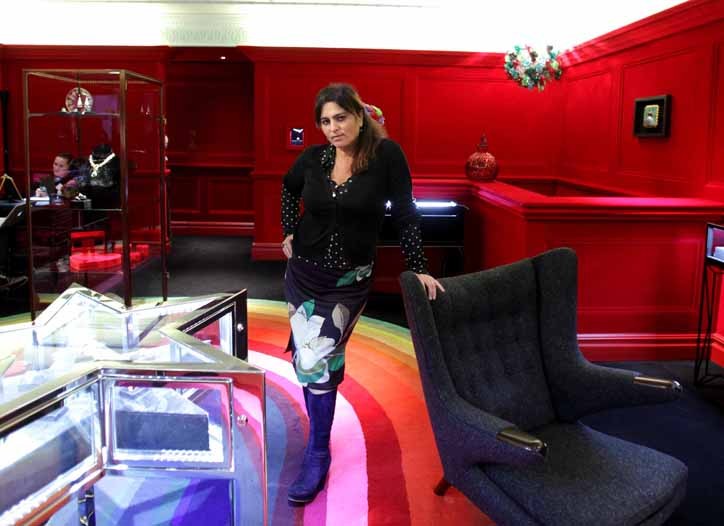
A Wednesday afternoon in early October — the first time the sun has come out in weeks in London, but it might as well be midnight in the VIP area of Solange Azagury-Partridge’s London store. Down the rainbow staircase is a subterranean cavern full of shiny things: the Swarovski Elements-studded walls and ceiling, a disco ball and, most important, the star-shaped glass display cases filled with precious gems.
With its red velvet walls and techno-pop sound track, it has a permanent nightclub ambience. But this quirky outpost, relocated last May to New Bond Street after 15 years on Westbourne Grove, is but one example of the business going on within the company. For starters, Azagury-Partridge’s Los Angeles store officially opens today, with another to follow next month in Singapore. A few blocks away, also on Bond, are her brand new offices in a three-floor town house complete with her first-ever on-site workshop. “Come Christmas, when we write down everything we’ve done this year, I don’t think we’ll quite believe it, to be honest,” says Azagury-Partridge.
Related Articles
It’s a major real-estate moment hinged partially on the success of the Madison Avenue store the designer opened in Manhattan in April of 2009 — not exactly prime time for the luxury market. “Seeing that kind of clientele and the footfall made us realize that maybe it’s time not to be a destination in London, and to be somewhere that people go shopping,” says Azagury-Partridge, explaining the decision to move the London flagship to its current site in the city’s luxury epicenter. “It’s made a substantial difference.”
You May Also Like
The idea of opening in the most prestigious shopping districts in each city has become a core business strategy that’s extended to Rodeo Drive in Los Angeles and the Takashimaya Shopping Centre in Singapore. This would not have been possible without Labelux Group, the Vienna-based subsidiary of Joh. A. Benckiser GmbH, parent company to Coty Inc., among others, which bought a controlling stake in Azagury-Partridge’s firm in 2008 in what Labelux chief executive officer Reinhard Mieck called a “buy-and-build strategy.” Solange was the seed for Labelux’s fashion portfolio, which has since grown to include Bally, Zagliani and Derek Lam.
Labelux’s interest in Azagury-Partridge’s business stemmed from Peter Harf, chairman and ceo of Benckiser and chairman of Coty Inc. He and his wife Tina were clients when he expressed professional interest in Azagury-Partridge’s brand. Harf wasn’t available for comment.
“I’d been approached before, and I was always terrified of getting involved with strangers,” says Azagury-Partridge. “[Harf and his wife] have been clients of mine for 10 years. I didn’t really know who they were or what they did. They were just very nice people who would come a couple of times a year, buy some really good pieces — they have really good taste.” It still took a year of conversation before she signed the deal on April 4, 2008 with a pen that’s been glued to a mat and framed in her office. “It wouldn’t have happened,” she says, “if it had been just some random money people.”
The jeweler has been involved with big-money people before. They weren’t random, either. In 2001, Tom Ford installed her as creative director of Gucci Group’s Boucheron, the 152-year-old Parisian house of haute joaillerie, where she was charged with updating its image. At the time, Azagury-Partridge was basically a one-woman show with no formal training, just an eye cultivated by jobs with 20th century art dealer Gordon Watson and the costume jewelry house Butler and Wilson during the Eighties.
Her own business snowballed after she designed her engagement ring, an uncut diamond set in gold, for her 1987 wedding to Murray Partridge. It took another five years for her to focus exclusively on jewelry, designing and selling the odd collection by appointment out of her home in Paddington. “It reached the point where I was busy before 10 a.m. or after 6 p.m., and my home was not my own anymore.” Which is when she rented a space on Westbourne Grove for 9,000 pounds a year.
Hers was a nontraditional point of view from the beginning, but that first store crystallized her vision of something out of the ordinary. It was done up like jewel-box boudoir in dark velvet that offset the colorful jewelry for a mood that read as seductive, psychedelic voodoo. Early collections included Enamels, featuring her signature Hot Kiss rings shaped like lips; the Kinetic collection of moveable pieces such as swirled diamond rings that spun — all radically different from the classic emerald and princess cuts available at venerable Place Vendôme jewelry houses.
Her collections have grown to include diamonds, such as the Platonic line, and even engagement rings, though not of the traditional sort. “People have been brainwashed into thinking that the only stone is a diamond, the only diamond is a D-flawless and everything else is rubbish,” Azagury-Partridge says. “If you walk down Bond Street, all you will see are diamonds and maybe the odd ruby and emerald, and they all look like glass. They don’t speak to anybody on an emotional level.”
She prefers her jewels colorful and with a sense of humor. Ball Crusher rings are big pearls in a claw setting; when creating the more recent Stoned collection, she riffed on “real stones, fake stones, fruit stones, getting stoned,” she says. “I quite like to explore linguistically and see where it takes me.”
That playful sophistication attracted design-savvy celebrities like Madonna, Kate Moss and eventually a different kind of celebrity, Ford.
In the three years that Azagury-Partridge worked at Boucheron, she reimagined the jewelry with the house’s moody imagery of snakes, faces and bodies in her first collections, Beauté Dangereuse and Not Bourgeois. She also had her first experience with fragrance, Trouble, which launched in 2004 and set Azagury-Partridge up to develop her own fragrances, Stoned and Cosmic.
She doesn’t say much about the particulars of her experience of working at Boucheron, which sits just two doors away from her on New Bond, other than to note that it provided “a very good education” that has impacted her own business considerably. “Before I went to Boucheron, I couldn’t imagine how my business could be bigger than it was,” says Azagury-Partridge, but witnessing a larger production inspired her to build her own line.
Within a year of leaving Boucheron (she was part of the post-Ford exodus), the designer brought in Guillaume Troncy, a former brand manager at Gucci Group, to be marketing and communications director, and implemented parts of the corporate management structure — an operations manager, a production manager, a ceo — though she says she’s “a bit anticorporate. But having said that, you have to maintain your integrity and identity in whatever you do, so that’s the challenge, isn’t it? I enjoyed the challenge of being independent. Every piece of jewelry I sold enabled me to do something else. [Through Labelux] the process has been sped up a little bit. And the reason I did it was because I had so many ideas that I wouldn’t have been able to fulfill because the jewelry business is a money pit.”
In the past two years Azagury-Partridge’s staff has grown from five to 25, excluding retail. “Now I can have advertising,” she says. “I can get more gorgeous stones, and now I can make my shops look fabulous. Even more fabulous.”
There, she assumes complete control: All of the stores are designed by Azagury-Partridge herself, with the help of an architect who executes the display cases, wall treatments, custom carpets and molded ceilings. Interiors have been a side project of sorts for Azagury-Partridge. In 2008, she designed a range of furniture — tables, rugs and an 18-karat white gold and diamond chandelier — for an exhibition at the Sebastian + Barquet Gallery in New York. It’s a fantasy-driven aesthetic. Sitting on a mid-century chaise in VIP chamber of her London store, she mentions her affinity for the Sixties TV show “I Dream of Jeannie.” “She lived in a bottle and her house was a bit like this, wasn’t it?,” she asks.
As for the new stores, they’ll be “the same but different,” says the jeweler. For example, in Los Angeles, the rainbow carpet has stars “because L.A. is the land of the stars.” Speaking of, she has a few famous friends of her own, including Rachel Weisz and Thandie Newton. Newton, a friend since she commissioned a ring for the birth of her second baby five years ago, stars in a short film Azagury-Partridge produced as an alternative form of advertising, which is currently on her Web site. Weisz and Newton are both Londoners, a world apart from the Hollywood endorsement culture, which Azagury-Partridge is inching closer to with her L.A. store. “Celebrity has a very big part to play these days,” she acknowledges without saying if there’s an upside or a downside. “Some celebrities have taste and some don’t, what can I say?”
The same logic applies to Asia, where every luxury company is desperate to put up a flag. Japan or China are usually the primary targets, so Singapore makes an interesting point of entry, chosen, on one hand because Labelux had a local partner to run the store, but also because “the clients tend to be more mature,” explains Troncy. “It’s not like in China, buying labels. It’s not the first access to luxury they have. They appreciate craftsmanship and art, and they are collectors.”
“We had a fabulous opportunity to enter the prestigious Takashimaya Shopping Centre in Singapore, an institution for luxury shopping,” says Mieck, adding that SAP has come in above target for the year, and more stores are in the works but as yet unconfirmed. “And we already have clients and supporters there making it an obvious destination for the brand in Asia.”
A new collection has been designed specifically for Singapore — it’s a surprise. Azagury-Partridge says she has three more collections in the works, but it will be a while before they’re ready, since “a new shop is enough for a year.”
In the meantime, she has another design project to tackle: “A proper English country house” with a turret and climbing Wisteria in hamlet in Summerset. “It’s like doing up a doll’s house,” says Azagury-Partridge. “I wanted it all pink.”