
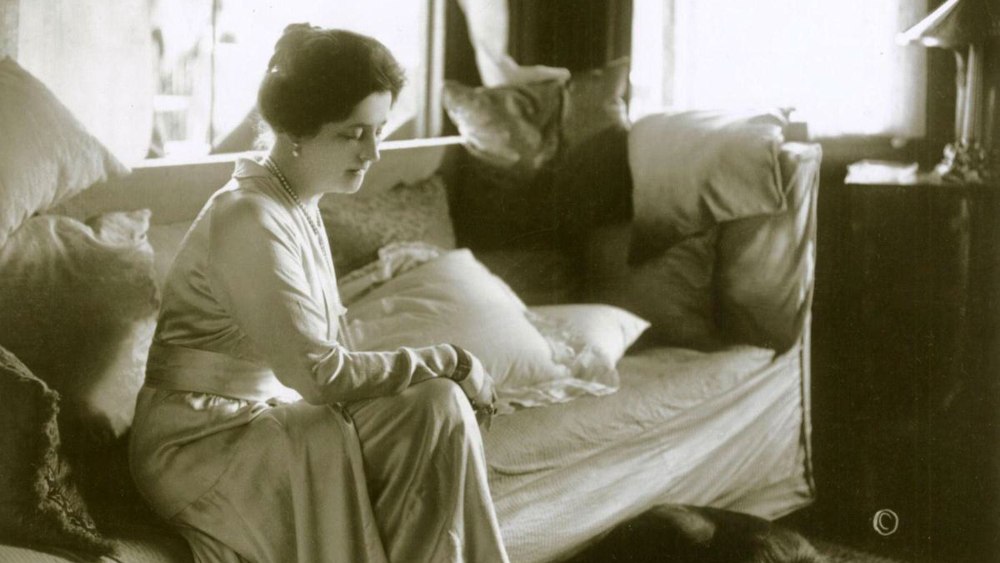
TORONTO – Long before Chanel gave women the little black dress, Victoria’s Secret sexed up underwear and designers built fashion empires, Lucile, Lady Duff Gordon — the foremost female couturier of the 19th century — turned the Edwardian era on its ear with her sheer, sexy evening gowns, daring slit skirts, scanty lingerie and wide-brimmed Merry Widow hats.
Now the British innovator who survived the sinking of the Titanic in 1912 and lived to operate the world’s first global couture brand is the subject of an exhibition, “Lucile: Fashion. Titanic. Scandal.”
On display until Nov. 13 at the Guelph Civic Museum, the show is set in Gordon’s childhood hometown of Guelph, Ontario, and features 15 of the draped gowns and tea dresses she created between 1893 and 1922, all of which are “hugely rare and fragile,” according to guest curator and historian Hugh Brewster.
Related Articles
Hats, lingerie and other artifacts are also showcased, as is a model of the Titanic. Together they trace how Gordon escaped the doomed ocean liner after it hit an iceberg on its maiden voyage on April 15, 1912, killing more than 1,500 people.
You May Also Like
“Today, Lucile is mostly remembered for surviving the Titanic. But this exhibition restores her place in fashion history,” said Brewster, author of the 2012 book, “RMS Titanic: Gilded Lives, Fatal Voyage.”
“Back then British royals and the world’s social elite went crazy for Lucile’s dresses, which spawned that gauzy ‘Downton Abbey’ look we know today,” Brewster said.
The high-waisted dresses with cascading flounces of filmy chiffon were worn by the likes of Mary Pickford, English stage beauty Lily Elsie, Ziegfeld Follies showgirls and Hope Diamond owner Evalyn Walsh McLean.
But Lucile Ltd. originals did not come cheap. Priced at the time between $300 and $600, her dresses today would cost the equivalent of $7,100 to $14,355. Indeed, in 1916 one unidentified U.S. socialite paid $30,000 for her wedding order — roughly $658,500 when adjusted for inflation.
Yet these boudoir-flavored creations built Lucile’s empire, according to Texas-based journalist and historian Randy Bryan Bigham.
“Lucile sexualized clothing in an elegant way,” said Bigham, who collaborated on the exhibition. “Lucile tore out those stiff, bone-lined corsets from her dresses and put in chiffon, which women loved.”
Her transformation of Edwardian lingerie was also revolutionary. The pared-down unmentionables caused a sensation among socialites, who flocked to see them in her salons.
Gordon launched the first fashion shows with live models, glamorized salons with comfortable seating and orchestra music, and wrote columns for Harper’s Bazaar, Good Housekeeping and Hearst newspapers — another first for the era’s couturiers.
She also licensed her name to promote perfume and brassieres, and was a forerunner of today’s fashion marketing when she put Broadway actors in her clothes. “Lucile knew people would see her dresses on stage and want them. She was right,” said Brewster. “Women ran to her stores afterwards to buy her clothes.”
Ironically, the designer was never presented at the royal court despite her achievements and the title she gained after marrying Scottish baronet Sir Cosmo Duff Gordon in 1900. An earlier divorce in 1893 made that impossible. Yet Lucile was “as famous as anybody she dressed,” said Bigham, the author of “Lucile: Her Life By Design.”
Indeed, when WWD’s first Paris correspondent, Edith Rosenbaum, survived the Titanic and met Gordon on the rescue ship the RMS Carpathia she relayed to the world how the designer escaped the sinking ship wearing a beautiful lavender gown. Now Gordon’s story returns to Guelph, “where her empire began,” said Brewster.
Born in London in 1863, Lucy Sutherland lived in Guelph as a child and moved around before returning to England in 1871. In 1884 she wed, had a baby and later divorced her philandering husband. This forced her to sew dresses to survive — a skill she first learned in Guelph. By 1893, Maison Lucile opened in London’s West End.
Other Maison Lucile locations followed in New York (1910), Paris (1911) and Chicago (1915), making Lucile Ltd. the first leading couture house with full-scale branches in three countries. Gordon’s achievements “went against everything I read about that era,” said Bigham, who first discovered the designer while studying at New York’s Fashion Institute of Technology in the mid-1980s.
“Today, it’s the male designers like Worth and Poiret who are remembered from that era,” said Bigham. “But the great ladies of that day were wearing Lucile. She was the one setting all the trends.”