
The resuscitation of the market for pricy jeans is welcome news for retailer Marie Shaffer.
On July 4, 2014, following a four-year hiatus from the denim industry, she opened the doors to Hail Mary in Santa Monica, Calif., where she has been appealing to tourists, as well as technophiles from nearby Silicon Beach, with Diesel’s $298 denim jogger pants and Marc Allison’s $198 boot-cut jeans.
Last month, she cleared a room in the back of her 2,000-square-foot boutique to devote to a denim bar, stocked with jeans from other brands including Eight Field of Freedom, Rising Sun and AG.
Hail Mary marks the latest chapter in Shaffer’s long career with jeans. She worked with Gene Montesano and Barry Perlman to launch Lucky Brand in the Nineties, managed specialty store Fred Segal and outfitted Paris Hilton in her own denim line called Blue Tattoo. Blaming the economy, she said, “we closed my showroom, we closed our denim brand, we closed everything in 2010.”
Related Articles
Now, buoyed by renewed interest in denim, sales in her store are up 90 percent from last year. But what shoppers won’t find there is a pair of yoga leggings. “I did try [offering it] when I first opened,” she said. “It did not sell.”
You May Also Like
After years of losing traction to ath-leisure clothing and lacking a hot trend to stir sales, retailers and designers in the premium denim segment appear to have discovered a few ways to get their mojo back. Characterized more as a gradual ascent than a sudden spike, sales are ramping up for a number of brands, especially those that have tapped into the demand for vintage looks and cropped silhouettes.
Others have acknowledged ath-leisure’s strengths by integrating technology-enhanced textiles into denim-based offerings. Some are crediting luxury labels and social media for highlighting denim’s versatility on the runway and in the streets.
“Business is quite strong at retail,” said Amy Williams, chief executive officer of Citizens of Humanity in Huntington Park, Calif., estimating that this year’s sales increased at least 10 percent from last year and that next spring’s sales will rise another 10 percent.
After a decade of skinny jeans dominating women’s closets, “it was time for a change,” said Seven For All Mankind president Barry Miguel.
If boyfriend jeans hadn’t sparked interest in a looser silhouette, the VF Corp.-owned brand probably wouldn’t have introduced palazzo pants steeped in a Seventies-tinged blue hue as part of its spring collection.
Still, the resurgence doesn’t indicate an abrupt reversal of fortune. VF detected momentum on a mass level for its Wrangler and Lee brands during its second fiscal quarter, but sales in its Contemporary Coalition, which houses Seven, fell 9.7 percent to $86.9 million and the operating profit decreased 87.1 percent to $1.1 million.
“Seven is stable,” VF ceo Eric Wiseman said in July. “We believe we can win in premium denim with Seven. They actually are winning share, but it’s a very tough time in a very tough market.”
Other executives share VF’s tempered optimism. “It’s not overnight, but we definitely feel a denim comeback,” said Arkun Durmaz, president of sales for Mavi.
And Levi’s net income for the third quarter jumped 15 percent on what Chip Bergh, the company’s ceo, described as “a resurgence in denim.”
The upswing in the market is different from past shifts that moved the cyclical industry. “It’s a little more measured,” said Peter Kim, founder and ceo of Hudson Jeans.
Despite questions that have surrounded Hudson’s future — in the past two years, its ownership has changed hands from Fireman Capital Partners and Webster Capital to Joe’s Jeans to Differential Brands Group — the City of Commerce, Calif., company recorded its biggest sales among specialty stores in the past decade at the Project trade show in August. One strong seller was power-stretch denim that played on the ath-leisure trend.
“You get all the coolness of the denim, but with the technology of the fabric, you get the comfort of athletic clothing,” Kim said.
A positive turn in the U.S. economy is putting business on the right track. Consumer confidence edged up almost 10 points from December to September, while personal spending increased 0.4 percent in August and personal income rose 0.3 percent. Although these figures don’t represent the biggest gains in the last five months, they suggest that economic growth is continuing in the third quarter. The national unemployment rate was 5.1 percent in August, a dramatic improvement from 8 percent during the same month three years ago and 10 percent at the peak of the Great Recession.
The recovery of the U.S. economy is benefiting foreign brands. Picking up business with Nordstrom, Neiman Marcus and Saks Fifth Avenue, London-based M.i.h. Jeans said its worldwide orders for next spring doubled from the year before.
While novel details such as cargo pockets and bright colors propelled the last denim boom, “the interest is back in the denim and the indigo,” said Chloe Lonsdale, M.i.h.’s founder and chief creative officer. “It looks like jeans you inherited from your parents or you found in a vintage store.”
For Jason Trotzuk, founder of Los Angeles-based Fidelity Denim, 2014 was the best year-to-date for his 10-year-old company. Ringing in sales between $10 million and $15 million, he expects business to increase 20 percent this year. He attributes much of his fiscal success to fluid manufacturing allowing for quick, local production of small runs. Moreover, he said the majority of his jeans retailing from $189 to $220 are sold at full price.
“Less than 2 percent of my business is done off-price,” he said.
In the current environment, start-ups also have a solid chance to flourish. With its debut collection introduced at The Line, Intermix and other retailers in the spring, Amo Denim said sales came in 30 percent higher than expectations. Next year, it anticipates doubling business.
Aside from being a new brand on the block, Amo’s styles selling between $238 and $260 are distinguished by vintage-inspired washes and a quarter-inch, double-stitched outer seam that twists forward to offer the illusion of a narrower leg. Kelly Urban, who served as design director at Current/ Elliott before cofounding L.A.-based Amo with Misty Zollars, said they’ve never designed a jegging. They also don’t linger on yesteryear’s bestsellers.
“In the past, it was a lot more flashy and trendy with the brand names and logos,” said Zollars, who was previously senior design manager at True Religion. “Now it’s a little more subtle and focused into the fit and wash.”
In the premium space, celebrities continue to wield influence on consumers — but not any famous face will do. To promote the November launch of its men’s business at Barneys New York and on its Web site, Re/Done is amplifying the cool factor from Cam Avery, bassist for Australian psychedelic band Tame Impala, in a buzz-worthy digital campaign that has already featured “It” girls Erin Wasson and Bella Hadid for its women’s styles.
“The guys have to do something interesting,” said cofounder Sean Barron. Added cofounder Jamie Mazur: “He’s a real artist — not just a pop guy.”
Then there’s NBA All-Star Russell Westbrook, who has excelled so much as creative director for his two ad campaigns with True Religion this year that the brand extended his deal through next year. True Religion credits the Oklahoma City Thunder point guard for turning its moto-inspired jeans into top sellers.
“He’s been wearing them a lot,” said Teresa Riva, director of marketing for the Manhattan Beach, Calif.-based company. “He’s giving guys more con- fidence to dive into these trendy cuts and styles.”
At L.A.-based American Rag Cie, home to one of the biggest specialty denim bars, co-owner Mark Werts noted that the men’s denim business has grown. As proof, Erika King, the store’s denim buyer, said that on a random Wednesday one week, she sold a pair of $1,100 men’s jeans by Denham that were washed, ripped and repaired by hand.
And that could spell potential trouble down the road for more traditional jeans styles, especially at higher prices.
Certainly, “the average five-pocket jean is a tough market,” said Jamie Haller, creative director at NSF in Vernon, Calif.
One way to differentiate NSF from others is by linking with Bliss and Mischief. As part of their three-season collaboration, the two brands proffered $449 frayed white jeans patched at the knees and $995 Army coats softened with louche draping and arrowhead-patterned embroidery.
“When something is special and novelty, it does well because it’s different,” she said.
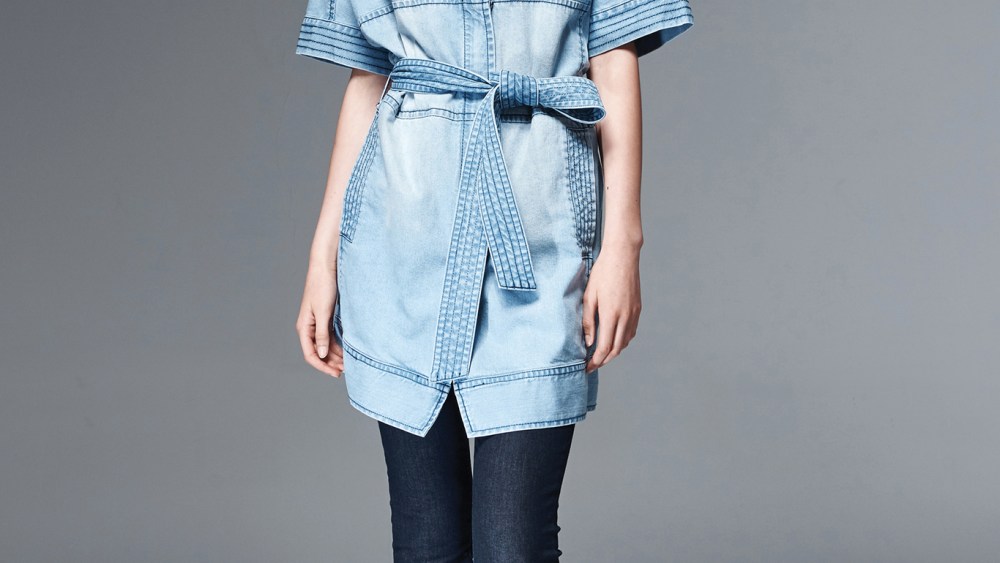
A plethora of styling options is in full view on social media — sometimes even before a brand is available at retail, to build prelaunch momentum. Louise Chan, a veteran of Jordache, Bongo Jeans and Jones Group, is relying on Instagram and Pinterest to attract fans for the spring launch of Luis Denim. She’s displaying the traditionally rugged fabric’s versatility and her production prowess in roomy jackets that lace up on the side, notch lapel blazers and kimono jackets that are smoothed with single-needle stitching. Her target is $1 million in first-year sales.
“Because of the influence of the digital platform of social media,” she said, “people are more willing to try something they wouldn’t have touched before.”