
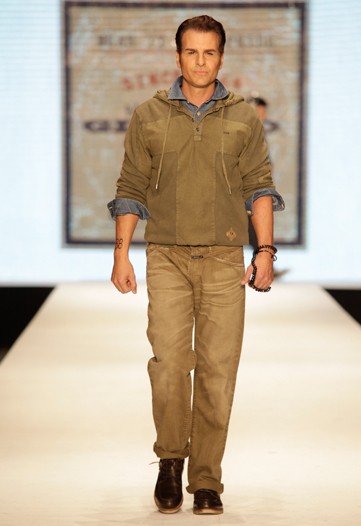
Robert Stec can’t say no to a friend.
So when François Girbaud asked him to help revitalize the floundering Marithé + François Girbaud jeans brand in the U.S., Stec immediately agreed to come on board.
Stec has a long history with the French designer and his partner, Marithé Bachellerie; he ran the Girbaud business for VF Corp. during its glory days from 1989 to 1993, growing the brand to $232 million in sales. After leaving VF in 1993, Stec had success as an investment banker, president of London Fog Industries and then chief executive officer of Lexington Home Brands, which he left in 2006.
He was in between jobs and enjoying some down time at his home in North Carolina when the call came.
Related Articles
“I came here at the request of François,” Stec said in an interview at his Seventh Avenue office in New York. “He said, ‘We have a major problem here. Can you help?’”
You May Also Like
In 2007, Stec agreed to join I.C. Isaacs & Co., the manufacturing company that, at the end of 1997, obtained the Girbaud U.S. license, as interim ceo. “You have to be careful doing favors for friends,” he said with a smile. “Three months turned into three years.” And a permanent position.
Today, Stec is steering the company in a new direction. In January, I.C. Isaacs was renamed Passport Brands Inc. and Stec is working diligently to create a portfolio of small to medium-sized brands with Girbaud as the anchor.
Girbaud’s young men’s product represents around 70 percent of the company’s revenue, which is estimated at around $35 million — women’s was phased out in the late Nineties — and Passport also produces Flow Society, a lacrosse lifestyle brand for men and women. In late January, the company signed a deal with Brandina the Original, an Italian women’s handbag and accessories brand, to launch the label in the U.S. Brandina will be sold exclusively through Passport-owned and operated boutiques called Bottega Brandina, with the first store slated to open in Charleston, S.C., in April.
Also next month, Passport Brands Inc. will take the big plunge back into public view. “I.C. Isaacs went public in ’97 to raise money for the Girbaud business,” Stec said. “In 2008, the cost of being public outweighed the benefits, so we went dark, stopped reporting, moved the stock off the Nasdaq to the bulletin boards. We’re still technically a public company but there’s been no public information since then. But in February, we refiled public papers, a process that usually takes around 60 days. So sometime in April, we will re-emerge as a public, fully reporting company.” The stock will continue to be traded over the counter for now, but Stec hopes to eventually list on the Nasdaq or Amex exchange.
The company is also working to raise additional capital by offering stock through a public offering as well as through private investments.
“We want to create more public float,” he said, noting that only 2 to 3 percent of the company is in the public domain. The rest is held by insiders including the largest shareholder, Ernest Jacquet, an investment banker and private equity fund manager, François Girbaud and management.
The money raised from that public offering will help Stec build Passport Brands into a larger entity. The hope, according to sources, is to raise up to $10 million to allow the company to find labels to add to its stable.
“We’re in the market for niche brands,” Stec said. “Long-term, we’d like to have eight to 10 niche businesses, each doing $10 million to $50 million in sales.” The brands would be “up-tier,” which is “a more-defendable niche” than mass market, Stec said. That upward trajectory is where he took Girbaud when he came on board full-time in 2007.
Under I.C. Isaacs’ former executives, Stec said the label had been “mismanaged. They let the brand go to pot,” he said. Sales had slipped to around $10 million and “the only thing ‘Girbaud’ about it was the name.” The good news, however, is that the department stores that had once done a big business with the brand “just thought that it had disappeared. It didn’t have a negative connotation and their management remembered it in its heyday.”
Stec set out to reduce costs from the business, add merchandising staff, upgrade the offerings and move the retail price points from $39 to $79. “It wasn’t an easy thing to do,” he said, “but now the bulk of the Girbaud product is sold in that price range, which helped us and the stores that sell it,” notably Macy’s and Dillard’s. The label is also carried at Bon-Ton as well as in some regional and local specialty stores.
Although the U.S. business stumbled, the European business has remained strong and today has an estimated volume of 250 million euros, or $348 million at current exchange, Stec said. At one time, the U.S. represented 50 percent of the brand’s sales, so “there’s a great heritage and DNA to build on,” he said.
At VF, Girbaud had a “core replenishment business,” he said, but at I.C. Isaacs, it was pure fashion. Today, 65 percent of the product is core replenishment “so Dillard’s and Macy’s love that, it reduces markdowns,” he said. The flavor of the product was also shifted out of the contemporary arena to young men’s so it can sit with Levi’s, Guess and Buffalo on the floor.
The shift has been so successful, he said, that last month, Passport Brands “shipped the U.S. version of Girbaud product to Europe as their opening price point offering.” It is being sold in Girbaud’s 13 company-owned stores in Europe for spring, and the hope is that by midyear, it will roll out to the company’s franchised and joint venture retail stores, putting it in about 30 units overseas. “It’s retailing extremely well,” Stec said. “It offers a younger vibe and they’re using it to attract a younger customer.”
The brand is also performing in the States, he said.
“The volume is going up and our sell-throughs in department stores are averaging 8 to 10 percent a week,” Stec detailed. “So we’re continuing to expand doors and the product mix and it will be profitable here this year.”
Next up for Girbaud is a return to women’s wear. “We’ve been out of the market for 10 years,” he said, “but we’re looking to bring it back. We can do that quickly and we’d like to get it back into the market this year.” The target, he said, is holiday.
At the same time as Girbaud was being retooled, Stec and his team also sought out other brands to bolster the portfolio. “We don’t want to be in the commodity business and we knew that if we could find several niche opportunities that are not denim-dependent, we could build some level of sustainability,” he said.
First was Flow Society. “Lacrosse is what soccer was 10 years ago,” he said. “There was so much apparel targeted at soccer, but nothing at lacrosse, so we created Flow Society.” The lifestyle brand uses sublimation printing techniques to create prints and patterns on T-shirts, shorts and accessories for lacrosse participants and spectators. The line is targeted to large sporting goods stores and specialty stores “looking for some differentiation.” Dick’s Sporting Goods tested the product in 10 doors and it is planning to expand the collection to all doors by the end of the year, Stec said.
By the end of 2011, Flow Society should be a $10 million business, he projected. “This will be a nice second brand for us.”
The third brand in the stable is Brandina, which is inspired by the Italian Riviera. The label, which is owned by Marco Morosini and his wife Barbara Marcolini, feature bags and shoes made from the striped fabric traditionally used on lounge chairs in the Adriatic. They retail for $150 to $300, and there are also accessories such as sunglasses, gym bags, suntan lotion and other related products. A month after the Charleston store opens, a second is slated for La Jolla, Calif., in May. The stores will average 400 to 500 square feet and will be in “high-traffic, resort areas,” Stec said.
He is hoping to have four to six units in place by the end of 2011 and add another 10 next year. “We’re looking at around 20 potential sites,” he said, noting that the label does $1,000 a square foot at its stores in small towns in Italy. An e-commerce site is preparing to launch later this month and the traffic to that site will also help “dictate where the store sites would be.” He said there are plans to add pop-up stores in the “frost belt,” in summer resort areas such as the Hamptons or Nantucket where a full-time location might not make sense.
Stec realizes the label is not known in the U.S., so Passport Brands launched its marketing push at the Grammys last month by offering product at the gift lounge. In Charleston, Stec said Brandina will tie in with the Spoleto Festival in late May. “Our marketing is very local,” he said.
As for adding other apparel and accessories labels to the mix, the hope is to find young designer brands that can’t get financing on their own. “Brandina couldn’t get started here without working capital,” he said, “and big companies don’t want to bother with startups.”
This isn’t a problem for Passport Brands, however, because of a deal Stec inked with Samsung in 2009 to provide back-office services such as logistics as well as financing. “They provide working capital financing and all we have to do is fund operating capital,” he said. In 2009, when the company had $8 million in assets, banks wouldn’t provide more than $1.8 million in financing, forcing him to get creative and hook up with Samsung.
And so the ingredients are in place for an expanding business model. “We don’t want to get to be a $100 million or $200 million business,” he said. “It’s too hard to maintain that without going down market. So we’ll try this strategy and see where it goes in three to five years.”