
LONDON — The U.K.’s latest denim labels aren’t being dreamt up by kids just out of design school or mills with years of history. Instead, they’re the creation of retailers looking to give their denim offerings an air of authenticity by building their own stylish identities.
Earlier this year, upscale British retailer Reiss launched Reiss 1971, a collection of denim and contemporary pieces that takes a more edgy turn than Reiss’ mainline collection. In September, French Connection unveiled a stand-alone women’s collection, FC: Denim, and has opened a dedicated store to house the line in London’s Covent Garden. Meanwhile, British online retailer ASOS has launched a denim collection called ASOS Denim and mass fashion retailer New Look rebranded its denim offer under the label Yes Yes this summer.
Related Articles
It’s an opportune moment for retailers to concentrate their efforts on their own denim labels. According to TNS Worldpanel, the U.K.’s denim market shrank 13 percent in September, compared with a year earlier, to 634 million pounds, or $1.06 billion at current exchange. However, 92.7 percent of women’s jeans sold in the U.K. are store labels, rather than what TNS terms manufacturer brands, such as Levi’s.
You May Also Like
“Own-label denim has become just as much of a statement to wear as any of the more traditional denim brands,” said Elaine Giles, account manager for TNS Worldpanel Fashion. “It’s like buying a [premium] brand but without the price tag.”
With their seasonal collections and production capabilities, these retailers are offering fashion-forward denim collections in a variety of cuts, washes and effects, rather than the few core fits denim labels have historically produced.
For example, Reiss 1971, a label created by Reiss’ brand director Andy Rogers, who previously served as store-planning and visual director at Stella McCartney, showcases the more creative side of the label’s identity. The spring collection includes pieces such as acid-washed stretch skinny jeans, high-waisted faded denim HotPants paired with fringed leather jackets and denim coverall dresses. They’re complemented by items such as lace minidresses, an oversize boyfriend blazer worn as a dress and tie-dye-print dresses.
“I think we realized there was a gap in the market for good, midpriced denim,” said Rogers.
Reiss 1971’s denim pieces retail from 79 pounds to 89 pounds, or $132 to $149, while prices in the collection run up to 275 pounds, or $462, for a leather jacket.
“But what cool denim brands [also] need is a core identity; they need a world around them,” said Rogers. “We haven’t taken the easy route, but in this difficult climate people appreciate the effort that’s put into the collection.”
Rogers has worked to build the identity of the Reiss 1971 label on several levels. The denim is made in European factories chosen for their expertise in the fabric, with details such as a “crinkled” textured denim, buttons down the jeans’ legs and quirky items such as a leather bag printed so it looks made from denim. Rogers also had a dedicated viral Internet film shot for 1971’s fall 2009 launch campaign and will create another film for spring.
The 1971 collection has also been promoted as a distinct label in Reiss stores, and rather than introducing denim as a safer option for consumers during tough times, Rogers believes Reiss’ customers are instead gravitating to the line for more directional denim and contemporary looks. Skinny jeans, for example, have been the label’s best-selling men’s product for fall.
“When you go shopping, now you want to feel as though you’ve bought something that when you’ve put it on, you know it’s new,” said Rogers.
Rachel Morgans — denim buyer at ASOS, which features jeans embellished with metal studs at the knees, cotton leggings with a denim print and a denim jumpsuit — said customers are choosing the label’s more fashion-forward denim looks.
“People want something that will update their wardrobe and be new and exciting in tough times,” said Morgans, adding the label’s denim leggings are among the retailer’s most popular styles.
ASOS’ denim line, which retails from 22 pounds, or $36, up to 65 pounds, or $109, for ASOS Premium denim pieces, is “performing strongly” against the retailer’s other women’s wear categories, Morgans said.
Similarly, Reiss’ 1971 collection has exceeded the company’s expectations of its performance, said Rogers. The collection makes up 20 percent of Reiss’ overall offer, but Rogers said the collection has represented up to 35 percent of sales in some of Reiss’ stores in metropolitan areas.
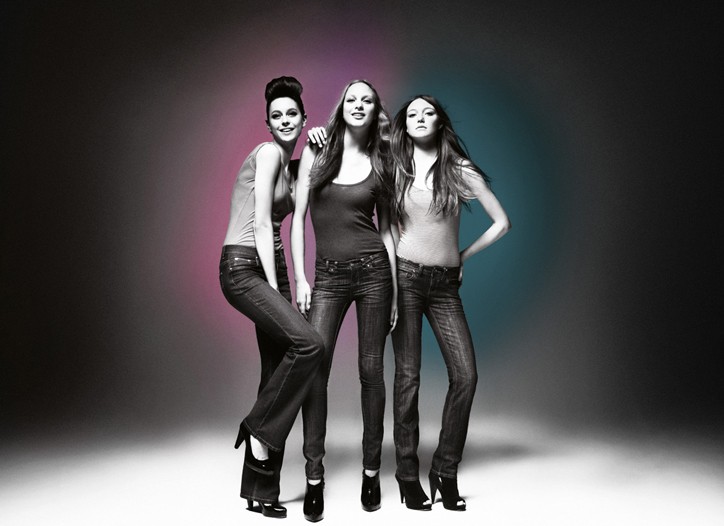
French Connection is in the midst of testing its stand-alone denim retail concept but is also marketing its FC: Denim for women and FCUK for men collections as standout labels. For the collections’ campaign shoot, the company scouted nonmodels on the streets in Shoreditch, East London, and Brighton, a coastal town near London, to reflect the lines’ “individual style.”
For fall, the collection includes skinny jeans in a black-and-white acid wash, and a batwing-sleeve, cropped denim jacket alongside simpler pieces such as faded, boot-cut jeans. Prices range from 20 pounds, or $33, for a T-shirt to 90 pounds, or $151, for a pair of detailed jeans.
To underscore the labels’ identity, French Connection’s concept denim store is done out with lighting rigs, old trunks covered in denim and screens that show behind-the-scenes footage of the campaign shoot. A spokesman for French Connection said the company is considering taking its denim concept to some international locations.
New Look is applying branding to the mass end of the denim market. The 700-store chain is the U.K.’s market leader in denim by volume, according to TNS Worldpanel’s research. Barbara Horspool, group design director at New Look, said she reintroduced New Look’s denim under the Yes Yes label because she wanted the company to “stay dominant in denim.” Previously, the label’s denim featured more embellishment and was sold under the label House of Denim.
“In the world of denim, some kind of brand is quite important….There’s an attachment to a great pair of jeans being associated with a brand,” said Horspool.
New Look’s Yes Yes label consists of five fits, including skinny flare and superskinny styles, and retails from 10 pounds, or $16, for a basic bootleg Hula jean, up to 35 pounds, or $58, for limited edition denim pieces, with most denim priced at 20 pounds, or $33. Again, Horspool said New Look’s customers are opting for the label’s more fashion-forward pieces.
“For us, it’s fashion,” said Horspool. “If we could get more superskinny jeans into stores [they would sell].”
While Horspool acknowledged the importance of any denim label having an identity, she believes both extremes of denim pricing are equally important to the market.
“Denim designers live and breathe those subtleties of fit and wash, such as whether to have a crease or a particular type of rip,” said Horspool. “I’m glad they’re here, as they’re the ones who keep pushing denim design.”