
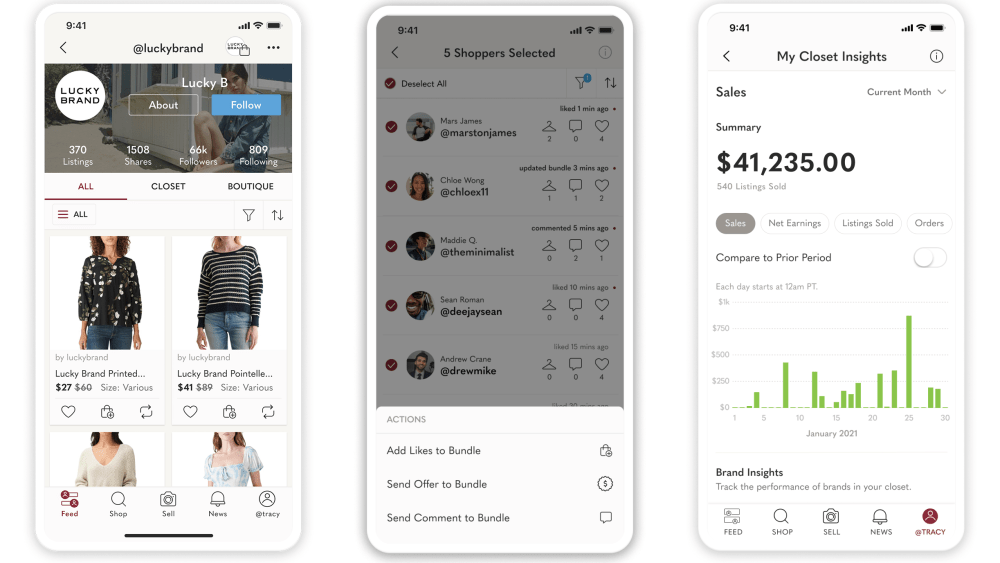
Peer-to-peer resale and social commerce platform Poshmark, a fashion and lifestyle marketplace known best for helping people turn their clothes closets into side hustles, is breaking into a new echelon of business. The company is now courting large brands for the first time, with its all-new Brand Closet program.
Chief executive officer and founder Manish Chandra broke the news during a session at the WWD Apparel & CEO Summit on Tuesday.
In an exclusive interview with WWD, the executive described the new offering as “a full stack that we’ve been working toward over the last year, to put together a package that can allow brands, who operate at a very scaled-up level, to integrate with our marketplace.”
Related Articles
Essentially, the program corrals a number of Poshmark social selling features and turns them into enterprise-level services.
You May Also Like
The company revealed new seller tools earlier this month that offer a more clienteling-oriented experience and data insights, along with the addition of a vice president in charge of a new seller-focused team, teeing up this enterprise play.
As it is, any of Poshmark’s more than 80 million users can use the features to sell a handful or even a few dozen items across its categories, which include women, men, kids, pets and home. These include limited-time offerings through the Drops Soon feature, My Shoppers’ one-on-one clienteling service and branded Posh Parties, the platform’s real-time virtual shopping events.
But the Brand Closet program was designed to suit larger operations at scale, with the back-end integrations necessary for the higher volume. Poshmark has been piloting Brand Closets since 2020 with several brands, including Free People, Lucky Brand and Dose of Colors.
“[With] the seller tool announcements earlier, you saw some of the foundation of what we’ve done. What we’re announcing is pretty deep integration, which allows brands to populate their closets, to fulfill order processing — connect to their e-commerce and warehousing systems — and then manage customer engagement at scale,” Chandra explained. In Poshmark’s nomenclature, “closets” refers to a seller’s assortment or inventory.
“We’ll also give them traffic-routing through the official closet button on their brand pages and specific marketing that allows them to have the kind of experience they would have in a real store,” he added. “We allow them to host these drops in trunk shows [with] a dedicated channel to that fan base.” The company is also rolling out full-scale listing video modules on the first section of brand pages, connected to its Posh Stories feature.
In other words, any Posher can take part in the baseline features, but program participants get the full integration, more robust trunk show features and additional marketing or merchandising opportunities.
According to Chandra, the goal is to give large brands and retailers the sort of social interactions, clienteling and logistical support that they’re accustomed to in their physical stores, but online through Poshmark.
The move makes sense for the company, as its community largely comprises the valuable Millennial and Gen Z consumer sets, which have been key targets of major labels. Poshmark describes them as passionate shoppers who are hyper-engaged and passionate about connecting with their favorite brands.
After a year of testing and a release cycle that puts the foundational features in place, the time looks ripe now, Chandra said. “The pandemic, I think, has made online selling not an optional thing,” he said. “It is a mandatory thing for everyone today.”
The Brand Closet program is just the latest in a slew of Poshmark news, including the aforementioned seller tools and, most recently, its acquisition of sneaker authentication company Suede One.
Sneakers are an important category for Poshmark, but the deal also speaks to its higher priorities.
“There is some synergy here between the two announcements,” Chandra said. “If you think of Poshmark, our focus is to be the social marketplace, focused on fashion and lifestyle products. And both of these are really pillars of our growth strategies: One is continued strength in our category expansion, and the second is really to continue to strengthen our partnerships with all kinds of sellers, including brands.
“And brands love the fact that we have high quality, more authentic products on the platform.”
The Brand Closet program kicks off in the U.S. to start, with sign-ups beginning Tuesday. There’s no cost to register for the program.