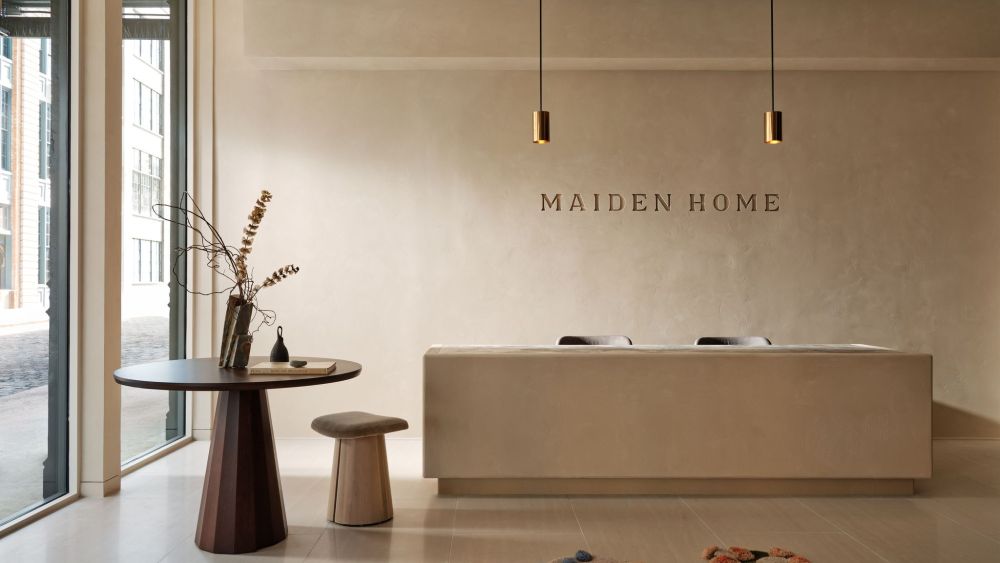
On the eve of the opening of the first Maiden Home store, Nidhi Kapur, the founder and owner of the brand, is already making the case for bringing her brick-and-mortar strategy to multiple locations.
“The store is just a unique opportunity to build really deep relationships with our customers, and with the product that we’re selling, being in the luxury segment of the market, it’s all about relationships. It’s a touch and feel product. Quality is our number-one point of difference,” Kapur said.
Related Articles
On Friday, Maiden Home, a six-year-old website for modern, American-handcrafted furnishings for living rooms, dining rooms and bedrooms, opens a 4,100-square-foot space at 34 Little 12th Street. The store is divided into four galleries, including a design center for customizing sizes, colors, upholstery and finishes, and other galleries with furniture installations, each framed by the crafted materials shown throughout the collection.
You May Also Like
“Our images online are beautiful and we do a great job with our creative, but there’s just nothing like a physical environment,” Kapur said. “We just know that we could show up in a much, much better way and build really deep relationships with clients, which eventually will translate into exponential growth.”
While Meatpacking is considered Maiden Home’s first true store of a permanent nature, last year Kapur did test brick-and-mortar with a four-week pop-up in TriBeCa in Manhattan, where the company is based.
“That was to prove all this out to ourselves. It was a huge success,” Kapur said. “It was by-appointment only, and only for existing clients, but it really helped us perfect the experience and just understand the data. What we found was exactly what we wanted to find — that with the clients who came in, they were spending many multiples of what they would spend with an online transaction. And you could see it happening in front of you in the store, when they met with an interior designer, experienced the product and the breadth of our collection, and saw how it comes together to form a space.”
At the new Meatpacking site, appointments with interior designers can be made, though walk-ins are also welcomed.
Already, even before the opening of the Meatpacking store, Kapur said she has been “actively negotiating” a couple of leases for additional stores. “We’re following our biggest markets at this stage — Los Angeles, as you might expect, and Miami. We’ll do something special in every market. The space in New York very much reflects the aesthetic and creative identity of New York as well as the brand, of course.”
Outside New York, “We will show up in a way that feels right for that market and that culture.” She also cited the Hamptons as a possible retail destination.

Kapur said before starting Maiden Home, she worked in business development at various e-commerce start-ups. She had stints at Birchbox, Google and McKinsey & Co. She decided to enter the home sector, feeling frustrated by what she saw in the market, and sensing an opportunity to capture market share with a business of her own. “I expected more for my home and myself,” she said.
Kapur estimated that there are about 25,000 independent retailers across the country controlling 80 to 90 percent of the high-end side of the home furnishings business, and many of them, she added, have been operating exclusively offline, without fixed pricing or the ability to surface prices transparently to clients online.
“It’s a very fragmented, $100 billion market,” said Kapur. In the last couple of years, many have been going out of business, about 10 percent annually, she noted.
“There’s obvious headwinds in the sense that COVID was a boon period for anybody that was selling anything for the home, for any part of the market. It’s been a really challenging couple of years in the home category, but especially for those independent retailers. So now there’s a post-COVID swing back,” said Kapur. “And if you don’t have a website, you don’t exist to the modern consumer. We are here to capture that market share.
“The winners in this environment are the folks that make it as easy as possible to transact. The middle to low end of the market has been the most challenged right now.”
It’s a different story at the high end of the market, Kapur suggested, with consumers shopping at higher price points and working with interior designers, continuing to decorate their new homes, or refresh the homes they have been living in. “There’s continued strength on the high end. And obviously, you see that in other categories in any economic cycle.”
The biggest change at Maiden Home since the brand was founded was “the elevation of the brand and taking the brand upmarket, and really solidifying the trust and credibility with an affluent clientele,” Kapur said. “That’s paying off for us right now. We are profitable. We’ve been profitable since Day One. And so every investment that we’ve made, including the store in the Meatpacking District, which is one of our biggest investments, we funded ourselves.” It wouldn’t have happened without the pop-up. “That’s really the culture of the company, that test-and-learn mentality around doing things in a small way first, and then doing them bigger. That drives our business.”
Asked what differentiates Maiden Home from the competition, Kapur said, “Quality is our number-one point of difference. We are a modern brand delivering that heritage craftsmanship on a modern timetable. We offer the best lead times. We ship in as little as two weeks. Ready-made product rarely gets to you in that amount of time.”
The company works with about a dozen contract manufacturers in North Carolina, which are mostly family-owned businesses. Kapur said they typically operate with “an old-school dealer mindset” focused on conducting business at trade events such as those held in High Point, N.C., rather than supplying e-commerce websites.
Describing what it’s like to visit Maiden Home in the Meatpacking District, Kapur said that at the point of entry, “It’s designed really not like a seating area vignette you’d see in a furniture store. It’s much more like furniture as art display together in a very artistic way. We had a special rug commissioned for that entry and it’s really the first moment of inspiration as if walking into a furniture gallery.
“The second gallery intentionally transitions into the design space. We put that customization experience front and center in the store.” Design services at other home stores have it “kind of hidden away in the back,” Kapur said. “Once you enter our design center, you’re surrounded by beautiful fabrics. You’re inspired to customize. And then of course, you have an interior designer from Maiden Home there to guide you through that experience.”
The other galleries in the store provide “kind of the heart of experiencing the product. The way they have been styled almost take you through the rooms of a home.” The assortment includes sofas, sectionals, dining tables, coffee tables, accent tables, chairs, barstools, ottomans, office desks and chairs, beds, benches and credenzas. Among the bestselling styles are the Varick sofa, the Remsen lounge chair and the Kent classic bed.
“We don’t do decor today,” said Kapur. “We really play in the big-ticket item space currently.
“But you know, we have aspirations to do a lot more,” for a fuller home assortment. “Rugs, lighting, kids’ furniture, baby furniture and outdoor — these are all categories that Maiden Home can play with.”