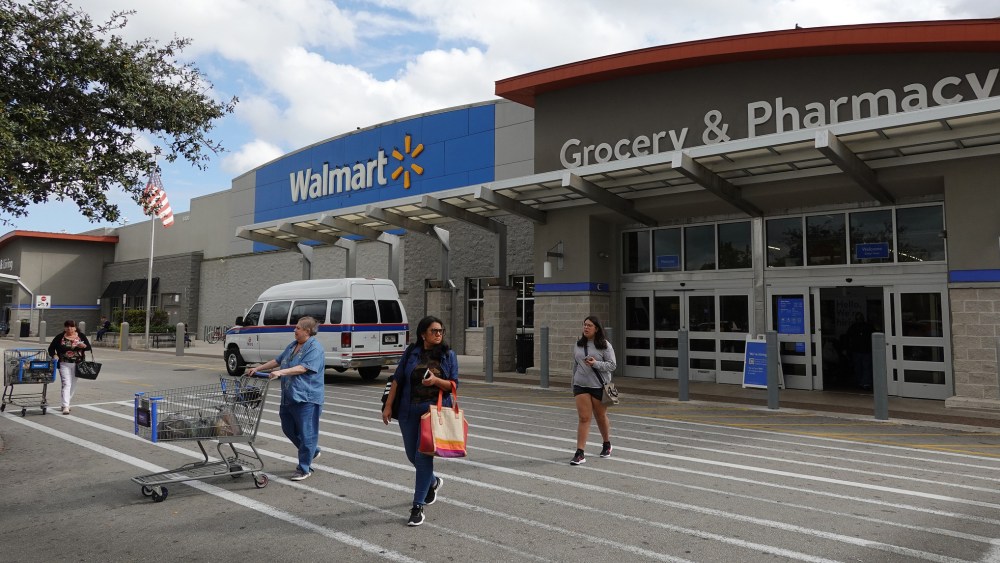
In yet another strong quarter, Walmart saw solid gains on both its top and bottom lines, demonstrating the giant retailer’s ability to manage through the scourge of tariffs and navigate the uncertain economy.
Walmart sales benefited from its low price appeal and particular strength in groceries, as consumers across all income brackets shopped in search of strong values. The company said previously that it would be able to absorb some tariff-related price increases but not all. Faster deliveries also contributed to the gains.
Related Articles
“With regard to our U.S. pricing decisions, given tariff-related cost pressures, we’re doing what we said we would do. We’re keeping our prices as low as we can for as long as we can,” Doug McMillon, Walmart’s chief executive officer, said during a conference call Thursday morning with investors and industry analysts.
You May Also Like
“Our merchants have been creative, and acted with urgency to avoid what would have been additional pressure for our customers, and members. They’ve done a terrific job managing pricing and mix across merchandise categories. They managed to generate rollbacks. They made good quantity, and flow decisions, and they’ve set us up well as we start the back half of the year.
“The impact of tariffs has been gradual enough that any behavioral adjustments by the customer have been somewhat muted,” McMillon added. “But as we replenish inventory at post tariff price levels, we’ve continued to see our costs increase each week, which we expect will continue into the third and fourth quarters.”
Regarding the pace of business through the second half, McMillon said, “Back-to-school is usually something of an indicator of how the holidays will go, and we feel good about how it went for us in terms of units and dollars sold and inventory sell through at both Walmart and Sam’s Club. Our top back-to-school items had a lower price than last year, and we offered a basket of everything students need for their first day of school for under $65. We had our Walmart U.S. store managers together last week for our holiday planning meeting, where they got to see many of our new items, and pricing for the upcoming season. We liked what we saw and heard, and we like our position for the back half of the year. We’re expecting to have a good holiday season at Walmart.”
In the second quarter ended July 31, operating income, impacted by legal and restructuring costs, decreased 8.2 percent to $7.3 billion from $7.9 billion in the year-ago period. But on an adjusted basis, operating income was up 0.4 percent to $8 billion, from $7.9 billion in the year-ago quarter. Net income rose 56 percent to $7 billion from $4.5 billion in the year-ago quarter.
Revenues rose 4.8 percent to $177.4 billion from $169.3 billion in the year-ago period. Global e-commerce sales grew 25 percent, led by store-fulfilled pickups and deliveries, and momentum in the marketplace business. By contrast, Target’s second quarter sales of $25.2 billion were down 1.2 percent.
The Bentonville, Ark.-based retailer raised its forecast for sales gains this year to 3.75 percent to 4.75 percent, up from the previous forecast of sales gains ranging from 3 percent to 4 percent.
The company also raised its forecast for adjusted earnings per share to $2.52 to $2.62, up from the previous forecast of $2.50 to $2.60 per adjusted share.
With Wall Street expecting earnings to be better than what was reported, and concerned about rising prices as the year progresses, Walmart’s stock was down 4.5 percent, or $4.61, to $97.96 when the market closed Thursday afternoon.
During the call, McMillon was bullish on AI. “Our enthusiasm for how AI can help us serve customers and members better, improve the experience for our associates, and increase productivity continues to grow,” he said.
In addition providing more personalized shopping experiences, AI, he said, “will be the primary digital vehicle for discovery, shopping, and for managing everything from reorders to returns.” For associates, AI “will bring everything into one place from scheduling to sales data, one for our suppliers, sellers, and advertisers that they will use to manage things like onboarding, orders, and campaigns.” And he said, AI will help scale innovation across the business “by speeding up how we test, build, and launch new products.”

Continued strength was seen in Walmart’s grocery business in the U.S., which rose by midsingle digits, while the health and wellness business in the U.S. increased in the mid-teens, the company indicated. The retailer also said that it saw share gains “across income brackets led by upper-income households” in its U.S. stores.
“Sales and general merchandise were positive in every segment and across categories in the U.S. led by apparel, media, and gaming, and automotive,” McMillon said during his conference call with investors and industry analysts. “Again, this quarter, we gained market share in the U.S., and across markets internationally. Globally we grew our marketplace by 17 percent and membership income by 15 percent. We grew global advertising by 46 percent, including Vizio,” the producer of televisions, sound bars and software purchased by Walmart in 2024. “Walmart Connect (the retail media advertising platform) in the U.S. was up 31 percent and excludes Vizio,” McMillon said. “The strong growth rates in our newer businesses continue to change the shape of our income statement.”
R.J. Hottovy, head of analytical research at Placer.ai, an AI-powered location analysts platform, said, “Walmart appears to be one of retail’s winners during the second quarter of 2025. The company’s U.S. comparable store sales growth of 4.6 percent —including a 1.5 percent increase in comparable transactions—implies it was a key destination for consumers both online and in-store. While the company cited strong growth in grocery and health and wellness, it also appears to be gaining market share across other categories. These broad market share gains were likely a key reason the company raised its sales growth outlook for the year.”
According to Placer.ai, “Walmart demonstrated resilient in-store traffic, with same-store visits holding steady between 0.8 percent and -1.6 percent year-over-year from May through July 2025, even amid a major e-commerce push.”
“Walmart’s strong top-line performance shows that its strong focus on value and low prices continues to resonate with shoppers across income levels, with outsize gains coming from its e-commerce and ads businesses,” Sky Canaves, a principal analyst at Emarketer, said Thursday. “All of these benefited from the large-scale July promotional events that coincided with Amazon’s longer Prime Day, with Walmart capturing additional traffic over the weekends that bookended Amazon’s sale. But the miss on profits will raise questions about how much Walmart’s margins are being squeezed by tariff pressures and how it will approach pricing through the second half of the year to avoid alienating customers.”