
LAS VEGAS — As department stores continue to struggle, fashion sales flag and consumers seek experiences such as sweating on a stationary bike or grazing on gourmet foods, the nation’s mall owners are rushing to adapt their formats to the new forces shaping retail.
Gone is their reliance on department stores as magnets to attract shoppers. Instead, developers are focusing on improved food offerings such as gourmet food halls and chef-driven restaurants to replace tired, old food courts, while e-tailers searching for bricks-and-mortar locations, beauty and under-the-radar stores are also being sought to fill malls. They anticipate that some of their existing tenants will continue to shutter stores.
Related Articles
All of these trends were on display at ReCon here last month at the Las Vegas Convention Center. While developers put on a generally upbeat face, the dichotomy between retailers reluctant to commit to new stores, and real estate investment trusts willing to bend over backwards to make deals with burgeoning brands and e-tailers was apparent.
You May Also Like
Apparel chains such as the Gap Inc. and Abercrombie & Fitch are rethinking strategies and right-sizing store fleets, while department stores are desperately searching for Millennial appeal and to regain prowess over categories such as beauty and apparel that have been ceded to chains such as Sephora and fast-fashion giants.
“It doesn’t help that there’s no exciting fashion and the economy isn’t firing on all cylinders,” said Kenneth Bernstein, chief executive officer of Acadia. “Department stores were the inducement tenants of the 20th century. They are not that now. Department stores have to provide a better shopping experience, be better at curating brands and provide better service. They have to figure out how to use Big Data — because Amazon will.
“They’re also going to have to figure out how to pay rent,” Bernstein said, referring to fact that malls have historically paid department stores’ construction costs and given them a pass on rent since they helped attract shoppers to the mall.
Acadia divested its shopping centers in favor of street and urban retail. “That’s where people and jobs were going,” Bernstein said. “That shift has insulated us. We have no department stores in our portfolio.”
The company in March entered into a 49-year lease for the 6,920-square-foot, two-level retail space at the base of the Carlyle House on Madison Avenue in New York for $76.5 million, where tenants include Vera Wang, Perrin Paris and Yves Delorme. Acadia has the right to immediately recapture any of the retail spaces.
“There’s a growing bipolar bifurcation. There’s seems to be less in the middle,” Robert Taubman chairman and ceo of Taubman Centers said, referring to middle market consumers and the brands that cater to them. “Fast fashion and luxury have wide acceptance.”
Taubman is in the midst of a $500 million transformation of Beverly Center in Los Angeles, which will include the requisite gourmet food hall overseen by James Beard award-winning chef Michael Mina, a new exterior, continuous ribbon of skylights, row of restaurants and luxury expansion. “It wasn’t updated for 35 years,” Taubman said. “It’s such a great asset.”
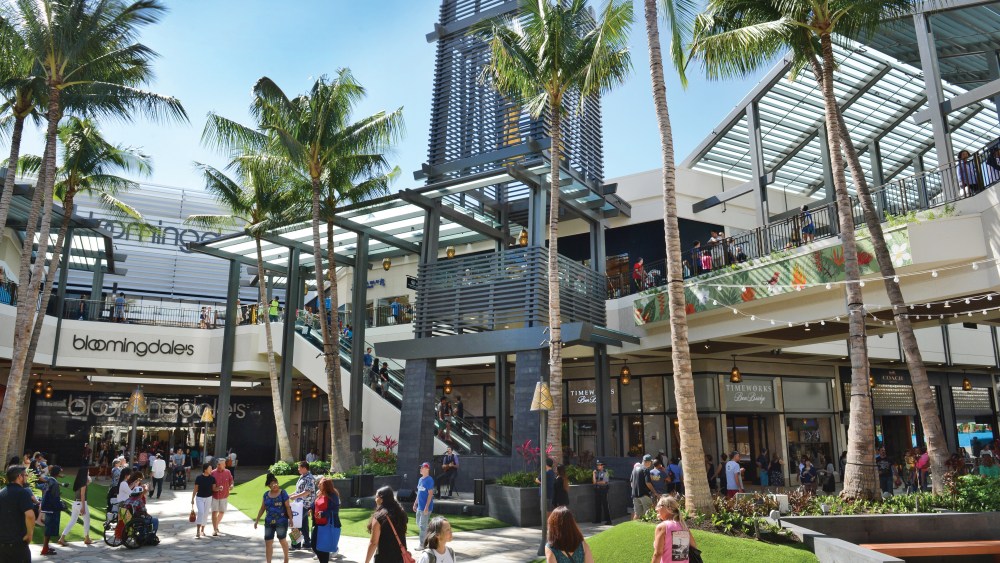
International Market Place, an open-air center with 345,000 square feet of gross leasable space along Kalakaua Avenue in Waikiki, is bowing in August “on the 50-yard line of the Honolulu tourist district,” Taubman said. An 80,000-square-foot Saks Fifth Avenue and 58,000-square-foot Grand Lanai will anchor the project.
Taubman is looking to the East for growth, with projects such as Starfield First Hanam in Hanam City, Gyeonggi Province, South Korea; and City On X’ian, a multilevel center in Shaanxi and City On Zhengzhou in Henan, both in China.
“China has more absolute economic growth than the U.S.,” Taubman said. “China is slowing because it grew at 10 percent for so many years. In 2015 the service economy was the largest contributor — over 50 percent — to China’s GDP. We see more opportunity in China and continued opportunity in Asia. Our next project will likely be in South Korea. Both our partner, Shinsegae, and [subsidiary Taubman Asia] are very happy.”
While department stores such as Shinsegae are thriving — the latter opened a 525,000-square-foot flagship at the Hanam City project — American department stores such as Sears have been downsizing for years and Macy’s in March hired a real estate expert to help it find ways to maximize the value of its real estate portfolio.
“Macy’s and Nordstrom didn’t have great sales. Department stores are losing market share,” said David Contis, president of Simon Property Group‘s mall division. “Mall sales are up, but significantly less than last year. Occupancy is holding relatively stable.”
Simon winnowed its portfolio to 108 malls from 180. “We dramatically improved the portfolio,” Contis said, adding that productivity increased in certain cases where department stores closed and were replaced with other tenants. For example, when Saks shuttered a unit at The Florida Mall, Simon opened a food pavilion in its place. “The sales increased five-fold,” Contis said. “We replaced a Nordstrom at the same mall with a Crayola Crayon factory and Dick’s.”
Retailers with open-to-buys at ReCon included dollar stores, off-pricers and value-driven brands such as Maurices and Ross. “H&M and Zara are looking,” Contis said. “Bauble Bar, Blue Nile and Tesla are in the market for space.”
Restoration Hardware’s ceo Gary Friedman, who was the keynote speaker at a ReCon lunch, met with Taubman Centers and Simon Property Group, presumably to secure space for smaller format stores.
Robert Perlmutter, senior executive vice president and chief operating officer of Macerich, said the combination of a sluggish economy and retailers’ endemic problems are to blame for the churn in the apparel arena. “The Gap doesn’t have great product. How do you get consumers back? Their merchandise isn’t attracting the consumer. Macy’s closing stores may have more to do with Macy’s not doing a good job with their business. Retailers will have smaller fleets in major markets.”
“There’s increasing demand from online retailers and foreign expansion. Many online retailers don’t have the infrastructure and ability to open multiple stores,” Perlmutter said. “WeWork goes in and creates a cool office environment. Can we create a cool environment for [online brands] and get them in for four months, or maybe a four-week lease? The rent is not fixed, but is a percentage of business. We’re trying to make the high barriers to entry a little lower.”
With vacancies rising in several Manhattan retail neighborhoods, there were signs that property owners may be relenting. “It got silly,” Acadia’s Bernstein admitted of rents. “In 2015 we bought nothing, no street retail. Some of that air has come out of the balloon.”
“For the first time in years I heard landlords say that they understand that retailers need to be profitable,” said Lisa Rosenthal, a broker at Lansco. “Retailers are expanding in the markets they’re familiar with and kicking tires in new areas. They’re being very cautious and thoughtful about how they’re expanding.”
“While attendance at ReCon might be up, activity at the major mall developers is noticeably down,” said Jeffrey C. Paisner, partner, Ripco. “Caution fueled by uncertainty with current events seemed to be the general mood and concern of many of the national and international retailers. The tangible result of this dynamic will be less deal velocity in the retail leasing marketplace in both malls and on urban streets. But the best retailers and mall operators are resilient.”
“There are so many negative trends,” said Mark Dufton of DJM Real Estate. “Specialty apparel is a disaster. That sector is being decimated. The traffic trends in malls are not great and there’s a little softening in the outlet sector.”
There’s been little upside to bankruptcies such as Sports Authority, Dufton said, since many of the retailer’s leases weren’t bid on. “There are fewer buyouts of leases and fewer buyouts of lease expirations,” he said. “Buyouts aren’t as prevalent as they once were.”
The year so far has seen a string of retail bankruptcies, with Sports Authority; Vestis, which owns Eastern Mountain Sports, Bob’s Stores and Sports Chalet, and Aéropostale all filing. “Men’s Warehouse is not doing well at all. They closed a bunch of stores and are now trying to restructure,” Dufton said. “Ben Sherman, which was owned by private-equity backed Marquee Brands, closed its stores and sold the brand to BMB Clothing Limited.”
“If you look at our business, sales are up, traffic is up and leasing is strong. The real issue is that the country is overstored,” said Sandeep Mathrani, chairman and ceo of General Growth Properties. “There’s been a divergence. We’ve seen in-line store sales climb and department-store sales decline. I wish department stores were active in franchising stores within stores. That is the European way.
“At the Natick Mall in Natick, Mass., department store sales are flat,” Mathrani said. “Out of six department stores, two do really well.” At Oakbrook Center in Oak Brook, Ill., there are five department stores but only two do well, Mathrani said, adding that the mall does $900-a-square-foot nonetheless.
“The next generation of retailers are Garage and La Senza from Canada and Cotton On from Australia,” he said.
GGP has been diversifying its portfolio with urban properties, including the 2014 acquisition along with three joint-venture partners of the Crown Building at 730 Fifth Avenue in New York for $1.77 billion, or more than $4,500 a square foot. Mathrani said GGP isn’t hedging its bets with street retail. “Our growth comes organically,” he said. “We’re building a mall in Norwalk, Conn., with Nordstrom and Bloomingdale’s as anchors.”
Vornado, which hopes to redevelop Pennsylvania Station, thinks it may have an advantage over other developers that have submitted RFPs to the city; it’s a major property owner in the neighborhood. Edward Hogan, executive vice president and head of leasing, said Vornado has started to overhaul 2 Penn Plaza. “It’s a huge opportunity. About 650,000 people commute through the station a day. It’s the last neighborhood that hasn’t gone through redevelopment,” Hogan said. “We own 9 million square feet of property in the area. We have the ability to get property back [from existing tenants]. I’m seeing retailer interest on 34th Street between Fifth and Seventh Avenues.”
Prior to joining Vornado, Hogan was the architect of Brookfield Place in lower Manhattan. Satya Jewelry has closed, COS Bar is expanding and Jo Malone is opening. There were reports that Michael Kors’ store was being subleased but sources said the designer has decided to stay. Luxury brands such as Gucci and Ferragamo are said to be doing well.
Ferragamo’s name appeared on a model of American Dream next to Hermès, which has signed a lease for an 8,000-square-foot store on two levels. Don Ghermezian, president of Triple Five Group, which is developing American Dream, said the Italian fashion company will open a unit at the sprawling shopping and entertainment center that’s scheduled to open in late 2017 or early 2018.
With Westfield World Trade Center opening in August, the REIT has been turning its attention to projects such as Westfield Century City in Santa Monica, Calif., which will undergo a 422,000-square-foot expansion to make room for a three-level Nordstrom, remodeled Bloomingdale’s and new two-level Macy’s, in line stores and Eataly.
“Department stores had a pretty good run,” said Bill Hecht, chief operating officer of Westfield. “The majors are struggling now. They’ll have to rationalize the number of locations and invest in more productive stores. You don’t need as many bricks-and-mortar stores, but they have to be exceptional. We’ve redeveloped a large number of Sears and Macy’s stores. We’re re-tenanting with larger daily-needs tenants such as gyms and grocers.”
Through Westfield Labs, the mall operator is trying to remove friction from shopping, such as parking, way-finding, deliveries and concierge services. Westfield wants to bring digital feeds of retailers’ inventories to its Web site, so a consumer could know whether a store has khakis in her size in stock.
Hecht said it’s “a massive cultural change” for retailers to turn over data. The technology hasn’t been developed yet for real-time inventory, which Hecht called “the holy grail.” Today, the shopper could go to the store to buy the khakis and learn that the last pair was sold five minutes ago.
“We want to do large market-changing developments that have critical mass,” Hecht said. “Consumers want that broad offer of a 2 million or 2.5 million-square-foot project.”
But that doesn’t explain the popularity of singular retail centers such as The Grove, a 600,000-square-foot open air shopping center in Los Angeles, which is staying true to its mission of offering up-and coming brands. “We built a glass house for very fashion-forward concepts,” said Kloe Colacarro, head of leasing at Caruso Affiliated. Brazilian shoe brand Schutz occupies the space now; Who What Wear will be featured for holiday. In the past, House of Harlow and Rachel Zoe took over the space.
A pop-up program at The Grove has featured Revolve and Jessica Alba’s Honest Beauty, which moved into a permanent space. Elizabeth & James from Mary-Kate and Ashley Olsen will open its first freestanding store at The Grove.
Palisades Village, Caruso’s project scheduled to open in 2018 in Pacific Palisades, will be about first-to-market concepts. “ALC will move into bricks-and-mortar,” Colacarro said. “We’re looking for specialty merchants, no chains, unless it’s something like J. Crew Liquor Store.”
That’s not to say that chains are unwanted throughout the Caruso portfolio. “Amazon and Barnes & Noble want smaller footprints,” Colacarro said. “Nike opened at The Grove last year.” Meanwhile, Caruso’s Americana at Brand in Glendale, Calif., which is expanding, added Top Shop, Under Armour and Urban Steak.
Michael Phillips, president of Jamestown Properties, which develops and manages Chelsea Market in Manhattan and Ponce City Market in Atlanta, said that while entertainment and food retail is growing, “food halls are a little overplayed. Everybody wants one, which is a little naïve.”
Retail, health, wellness and travel is more forward-thinking.” Small micro-brands and nationals and locals are interested in great main streets and curated environments,” Phillips said. “There’s a lot of brand fatigue in the world today. The brands that have a unique voice will continue to be strong.”
Phillips cited Chuck’s, a London-based “swimwear, men’s wear and women’s micro-brand that has legs. I’m interested in Woolrich. Marine Layer is a great store, casual clothing with a focus on fibers. The Fred Segal guys are reviving that brand, and there’s Ball and Buck, a hunting inspired men’s wear brand.”
Phillips denied that Jamestown is for sale, a rumor heard at ReCon. “We are selling assets,” he said. “We’re definitely not for sale. We have some assets we are marketing in several markets.”
As examples of the company’s engagement, Phillips cited Industry City, a planned 6.5 million-square-foot office, industrial and retail complex in Sunset Park, Queens, which is being led by managing partners Jamestown, Belvedere Capital and Angelo, Gordon & Co., and the expansion of Chelsea Market to the building’s lower level.
Stephen Stephanou, a broker at Crown Realty Services, said the flow of European brands to the U.S. may be slowing since tourism is down on the Continent. “The challenge is that sales in Europe are down and you need capital to expand,” he said. “Apparel sales have also been soft in the U.S. Are retailers interested in going to the U.S.? Yes, and there are some looking for real estate in shopping centers and on urban streets.”
Ikea Centres, a division of the Swedish affordable furniture giant and the largest mall operator in Russia, has the welcome challenge of too little space to meet the demand of retail tenants with a 1.4 percent vacancy rate. In the last year, Olga Shevtsova, head of commercial development, said dwell times at Ikea malls have increased as consumers are shopping more locally. “Russians aren’t traveling as much due to the strong dollar,” she said. “It’s no longer cheaper to buy in Europe.”
As a result, there’s been more interest in Ikea from global brands. “Victoria’s Secret opened their first store in Russia at City Center in Moscow,” Shevtsova said. “Armani Exchange, French lingerie brand Etam, L’Oréal and NYX cosmetics unveiled stores.”
Ikea will spend $2.1 billion this year to expand two centers in Moscow. In the meantime, “we’re buying out the leases of the weaker tenants,” Shevtsova said. “We’re upgrading the food courts.” Food, apparently, has universal appeal as malls everywhere try to reinvent themselves.
Michael Glimcher, vice chairman and ceo of WP Glimcher, views anchors in a non-traditional way. About 10 percent to 15 percent of its centers are anchored by grocers and Dick’s Sporting Goods “is really a department store,” he said. When Glimcher replaced a department store that was doing $10 million to $15 million in annual sales with other uses, including Dave & Buster, sales jumped to $30 million to $40 million, he said.
Densifying sites by shrinking down the retail footprint is another strategy. “We could shrink our retail down by 20 percent,” he said. “It’s emulating an urban setting, with apartments, a hotel. When we contemplate opening a fashion department store now, we choose to do a restaurant.”
Glimcher defended the properties in the portfolio, citing Longview Mall in Longview, Tex. “You could say it’s a ‘B’ mall,” he said. “Dillard’s does exceptional volume there. We sold a mall in North Atlanta because we weren’t relevant. The national retailers didn’t want to be there.”